Hello! Let's dive into your next calculus lesson.
In our previous session, we tackled the Product and Quotient Rules, which gave us the tools to differentiate functions combined through multiplication and division. We saw that for , the derivative isn't simply . The rules are more nuanced.
Today, we'll complete our core set of differentiation techniques by learning the Chain Rule. This is arguably the most versatile of the differentiation rules. It unlocks our ability to differentiate composite functions—that is, a function nested inside another function, like or . By the end of this lesson, you will be able to compute the derivatives of these layered functions, significantly broadening your calculus skills.
1. Understanding Composite Functions
Before we can differentiate them, we need to be clear on what a composite function is. You might see this referred to as a "function of a function". It's the result of applying one function to the result of another.
For a clear definition and some examples, let's turn to a resource from mathcentre.ac.uk, which uses a style that should be familiar to you.
This brief section defines a 'function of a function' and shows how to identify the 'inner' and 'outer' parts. This is the crucial first step in applying the Chain Rule.
Please read Section 2, 'A function of a function', on page 2. Pay attention to how expressions like cos(x^2) and (cos x)^2 are broken down into their constituent functions, f(x) and g(x).
To summarise, a composite function has:
- An outer function, .
- An inner function, .
For example, in :
- The outer function is raising something to the power of 5: .
- The inner function is what's being raised to that power: .
Identifying these two parts is the key to using the Chain Rule.
2. The Intuition Behind the Chain Rule
Why is it called the "Chain Rule"? It describes how a change in the input variable, , propagates through a "chain" of functions to affect the final output. A small nudge in causes a change in the inner function, which in turn causes a change in the outer function. The Chain Rule tells us that the total rate of change is the product of these individual rates of change at each link of the chain.
The following video provides a brilliant visual explanation of this idea.
Visualizing the chain rule and product rule | Chapter 4, Essence of calculus
This video from 3Blue1Brown visualizes a composite function using three number lines, showing how a small 'nudge' in x travels through the inner function to the outer function. This builds a powerful intuition for why the Chain Rule works.
Please watch from 8:35 to 14:39. Focus on how a change dx on the first number line leads to an intermediate change dh on the second, and finally a change dg on the third. The core idea is understanding how these changes are related.
As the video explains, if you have a chain of events where affects , and affects , the overall rate of change is found by multiplying the rates of change of each step: . This insight is the heart of the Chain Rule.
3. The Chain Rule Formula
This intuitive idea translates directly into two common forms of the Chain Rule formula.
Leibniz Notation
This notation is very procedural and follows directly from the "chain of rates" idea. If we have a function where , then the derivative of with respect to is:
Here, is a temporary variable representing the inner function. You can almost think of the terms as "cancelling out", leaving .
Function Notation
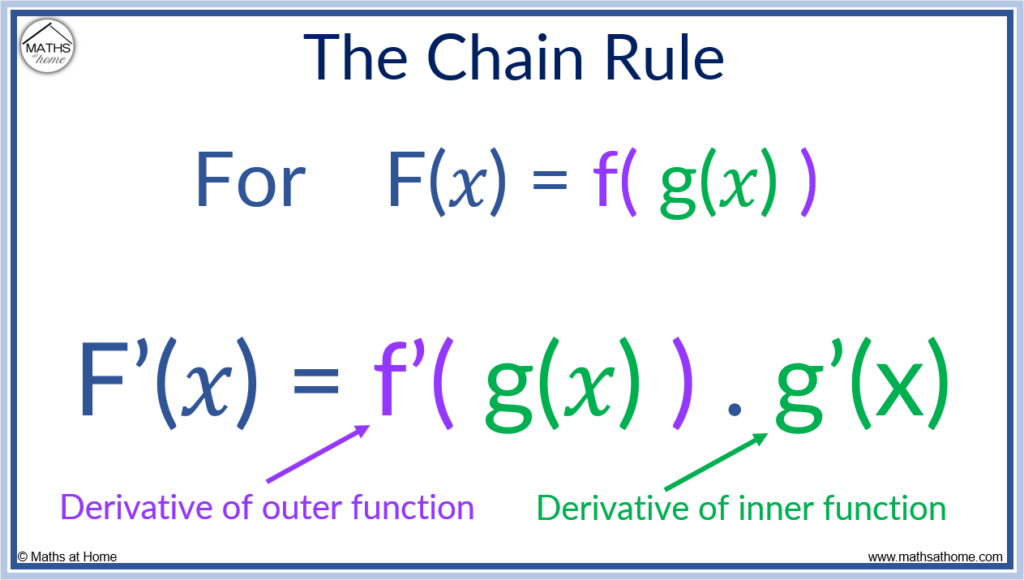
This notation is often quicker to write once you're comfortable with the concept. If , then its derivative is:
In words, this means: "the derivative of the outer function (evaluated at the original inner function) multiplied by the derivative of the inner function."
This image provides a great visual for the function notation version of the rule.
4. Applying the Chain Rule: Step-by-Step
Now let's move from theory to practice. The following video is excellent for learning the mechanical steps of applying the Chain Rule, and it uses the Leibniz notation with t as the intermediate variable, which is common in British-based education.
How to differentiate using The Chain Rule ExamSolutions Maths Revision
This video from ExamSolutions will walk you through several practical examples of applying the Chain Rule to polynomials raised to a power, including those involving roots and negative powers.
Watch the video from the beginning to 11:21. The presenter clearly demonstrates the step-by-step process of identifying the inner function t, finding dy/dt and dt/dx, and combining them.
Let's consolidate this with a written example.
Find the derivative of .
-
Identify the outer and inner functions.
- Outer function:
- Inner function:
-
Find the derivative of each part.
- (We'll formally derive this in the next lesson, but for now, the derivative of is ).
- (Using the Power Rule).
-
Apply the Chain Rule formula: .
-
Substitute the inner function back in. Replace with .
Test your understanding!
Find the derivative of .
Show answer
- Identify functions:
- Outer:
- Inner:
- Find derivatives:
- Apply formula:
- Substitute back:
5. Combining Rules
The true power of these rules becomes apparent when you need to combine them. What if you have a product of functions, where one of them requires the Chain Rule?
Example: Find the derivative of .
This is a product of and . So we start with the Product Rule.
Let and .
The product rule is .
- . Easy.
- To find , we need the Chain Rule.
- Inner function , so .
- Outer function , so .
- Therefore, .
Now, substitute everything back into the Product Rule:
This is a perfectly valid answer, though it could be simplified further by finding a common denominator. The key takeaway is the process of layering the rules.
For more practice, the mathcentre.ac.uk resource you looked at earlier has a large set of exercises with answers at the end. I recommend trying a few from each section to build your fluency.
To solidify your understanding, please review the worked examples in this guide and then try some of the practice problems.
Review the examples in Section 3, 4, and 5 (pages 3-7). Then, attempt a few problems from the 'Exercises' section starting on page 7. The answers are provided on page 8 for you to check your work.
Conclusion
Congratulations, you've now learned the "big three" rules of differentiation: the Product Rule, the Quotient Rule, and the Chain Rule. With these, you can find the derivative of nearly any single-variable function you're likely to encounter by breaking it down into its constituent parts and applying the correct rule at each step.
Key Takeaways:
- The Chain Rule is used for differentiating composite functions ().
- Intuition: The overall rate of change is the product of the rates of change at each "link" in the functional chain.
- Leibniz Notation: is a procedural way to apply the rule.
- Function Notation: can be stated as "derivative of the outside, times the derivative of the inside."
- Complex functions often require combining the Chain Rule with the Product or Quotient rules.
In our next lesson, we will formally find the derivatives of all six trigonometric functions. We've used the derivatives of sine and cosine as examples today, and you'll soon see how we can derive them, and the others, using the very rules you've just mastered.