Hello! Welcome to our next lesson on differentiation.
In the previous lesson, we mastered the Chain Rule, a powerful tool for differentiating composite functions. We even had a sneak peek at today's topic by working with an example like . Today, we will build directly on that foundation.
Our goal is to formally derive and apply the derivatives of all six trigonometric functions: , , , , , and . We'll start by exploring why the rules are what they are for sine and cosine, going back to first principles. Then, we'll see how to use the rules you already know—like the Quotient and Chain rules—to easily find the derivatives of the other four.
1. The Foundation: Derivatives of Sine and Cosine from First Principles
To truly understand where the derivatives of trigonometric functions come from, we need to return to the fundamental definition of the derivative (the limit of a difference quotient). This process also reveals a critical requirement: for these differentiation rules to work, angles must be measured in radians.
The following video from MIT OpenCourseWare provides a complete, clear derivation. It's a classic piece of calculus instruction that builds a really solid foundation.
Professor Strang will walk through the geometric proof for a crucial limit, and then use that limit along with the definition of the derivative to find the derivatives of sin(x) and cos(x).
Please watch from 2:11 to 34:20. The video is divided into three key parts: (2:11 - 22:40) The proof that the limit of sin(θ)/θ as θ approaches 0 is 1. This is the cornerstone of the whole process. Pay close attention to the geometric 'squeeze' argument. (22:40 - 28:16) Using this limit to derive that the derivative of sin(x) is cos(x). (28:16 - 34:20) A similar derivation showing the derivative of cos(x) is -sin(x).
Let's summarise the key points from that deep dive.
The Crucial Limits
The entire derivation hinges on two limits, which were proven geometrically using the "Squeeze Theorem" (or "Sandwich Theorem"):
These limits are only valid when is in radians.
Deriving the Derivative of Sine
Using the definition of the derivative, :
-
Set up the limit:
-
Use the angle sum identity for sine:
-
Rearrange the terms to isolate the crucial limits:
-
Evaluate the limits:
Thus, we have formally proven that the derivative of is .
A very similar process, using the angle sum identity for cosine, shows that the derivative of is .
2. Finding the Other Trigonometric Derivatives
Now for the good news: we don't need to go through that intense process for the other four functions. We can derive their derivatives simply by expressing them in terms of sine and cosine and applying the rules we already know.
Derivative of Tangent
Since , we can use the Quotient Rule, where and .
Recall the Quotient Rule:
Test your understanding!
Try applying the Quotient Rule to using the derivatives we just established.
Show answer
Let .
Using the quotient rule:
Using the Pythagorean identity , we get:
So, the derivative of is .
The remaining three derivatives can be found similarly:
- For : Use the Quotient Rule.
- For : Use the Quotient Rule, or the Chain Rule on .
- For : Use the Quotient Rule, or the Chain Rule on .
3. Summary of Rules and Practical Application
Let's gather all six rules into one place. This table is your reference for differentiating the basic trigonometric functions.
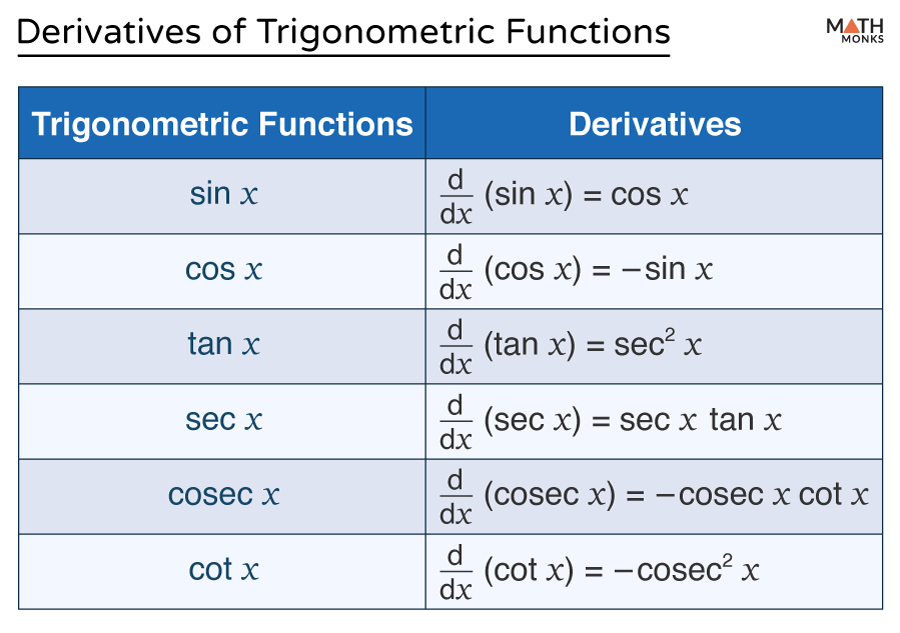
Of course, we rarely differentiate just . More often, we encounter functions like or . As we learned in the last lesson, this is where the Chain Rule is essential. The general form of the rule is:
If , then
This pattern—differentiate the outer trig function, keep the inner function the same, then multiply by the derivative of the inner function—applies to all six.
The following video provides a great summary of these rules in their general form and works through a variety of examples that combine them with the Chain, Product, and Quotient rules.
Edexcel A level Maths: 9.6 Differentiating Trigonometric Functions (Sec, Cosec, Cot and Tan)
This video from Zeeshan Zamurred is very practical. It will show you how to apply these six new rules to more complex functions, which is exactly what you'll need to do in practice.
Please watch the following segments: (0:08 - 2:07): A quick introduction to the general derivative rules for tan, sec, cot, and cosec where the argument is a function, f(x). (2:07 - 7:00): Watch the worked examples for y = sec(5x), y = sec^2(5x), and y = cosec(x^2 + x). This shows the Chain Rule in action. (10:05 - 12:45): Watch the worked example for x^2 sec(3x). This is a perfect demonstration of combining the Product Rule with our new trig rules.
Let's work through one more example that brings everything together.
Find the derivative of .
- Identify the main structure: This is a product of two functions, and . So we start with the Product Rule.
- Find the derivatives of the parts:
- . Using the Chain Rule, this is .
- . Using the Chain Rule on our new trig rule: the derivative of the outer function () is , and the derivative of the inner function () is . So, .
- Substitute back into the Product Rule:
- Simplify (optional but good practice): We can factor out the common term .
Conclusion
In this lesson, we have derived and learned to apply the derivatives for all six trigonometric functions. This is a major milestone in your calculus journey.
Key Takeaways:
- The derivatives of and are and , respectively. These foundational rules are derived from first principles.
- A critical prerequisite for all trigonometric differentiation is that angles must be measured in radians.
- The derivatives of , , , and are , , , and . These can be derived from the sine and cosine rules using the Quotient and Chain Rules.
- For any trigonometric function with an inner function (e.g., ), you must always apply the Chain Rule.
We have now covered differentiation for polynomials, powers, and trigonometric functions. In our next lesson, we will complete our toolkit by finding the derivatives for the remaining major function families: exponential and logarithmic functions.