Hello!
In our last lesson, we explored the deep meaning behind the derivative, interpreting it as the gradient (slope) of a tangent line and as an instantaneous rate of change. We used the "first principles" method—calculating the limit of a difference quotient—to find derivatives. While this process is fundamental to understanding what a derivative is, it's also quite slow and cumbersome for everyday calculations.
Today, we'll learn our first major shortcut for differentiation: the Power Rule. This powerful and elegant rule will allow you to find the derivative of any polynomial or power function almost instantly. This is the first of several differentiation rules you will learn that form the practical toolkit of calculus.
1. From a Pattern to a Rule
In the previous module, you found that the derivative of is . If you were to apply the same "first principles" method to , you would find that its derivative is .
Do you see a pattern emerging?
- For , the derivative is .
- For , the derivative is .
It seems that the original index (power) becomes the new coefficient, and the new index is one less than the original. This is the core idea of the Power Rule. The following video provides a great bridge from the limit definition you already know to this new shortcut.
What is a Derivative? Deriving the Power Rule
The video 'What is a Derivative? Deriving the Power Rule' by Professor Dave Explains will show you exactly how this pattern arises from the limit definition.
Please watch from 5:01 to 9:37. The video demonstrates how applying the limit definition to simple power functions like x, x², and x³ reveals a consistent pattern, which is then formalised as the Power Rule. This will help you understand why the rule works.
2. The Power Rule for Differentiation
As the video established, we can generalise the pattern into a formal rule.
The Power Rule:
For any function that can be written in the form , where is any real number, its derivative is given by:
In words: bring the index (power) down to multiply in front, and then subtract one from the index.
To differentiate a full polynomial, we also need a few other associated rules, which are very intuitive:
- The Constant Multiple Rule: The derivative of is . (You can pull constants out.)
- The Sum/Difference Rule: To differentiate a sum or difference of terms, just differentiate each term individually.
- The Derivative of a Constant: The derivative of a constant (e.g., ) is 0. This makes sense, as the graph of is a horizontal line, and its gradient is always zero.
The following video puts all these pieces together and shows how to apply them in practice. It uses British terminology, which you may find helpful.
The video 'Differentiation (Power Rule)' from 1st Class Maths provides a clear, step-by-step guide to using the power rule on various types of functions.
Please watch from 1:12 to 5:33. This segment will walk you through: Differentiating basic powers like x⁴. Handling coefficients (like in 3x²). Differentiating simple terms like 7x and constant terms like 4. Combining these to differentiate a full polynomial term by term.
Let's summarise with a concrete example. Suppose we want to find the derivative of the polynomial .
We apply the rules to each term:
- The derivative of is .
- The derivative of is .
- The derivative of (which is ) is .
- The derivative of (a constant) is .
Combining them, we get:
Test your understanding!
Find the derivative, , for the function .
Show answer
Applying the power rule to each term:
So, .
3. Extending the Power Rule: Negative and Fractional Indices
The real power of this rule is that can be any real number. This means we can use it to differentiate functions involving roots and fractions, as long as we first rewrite them using the laws of indices (exponents) that you've studied previously.
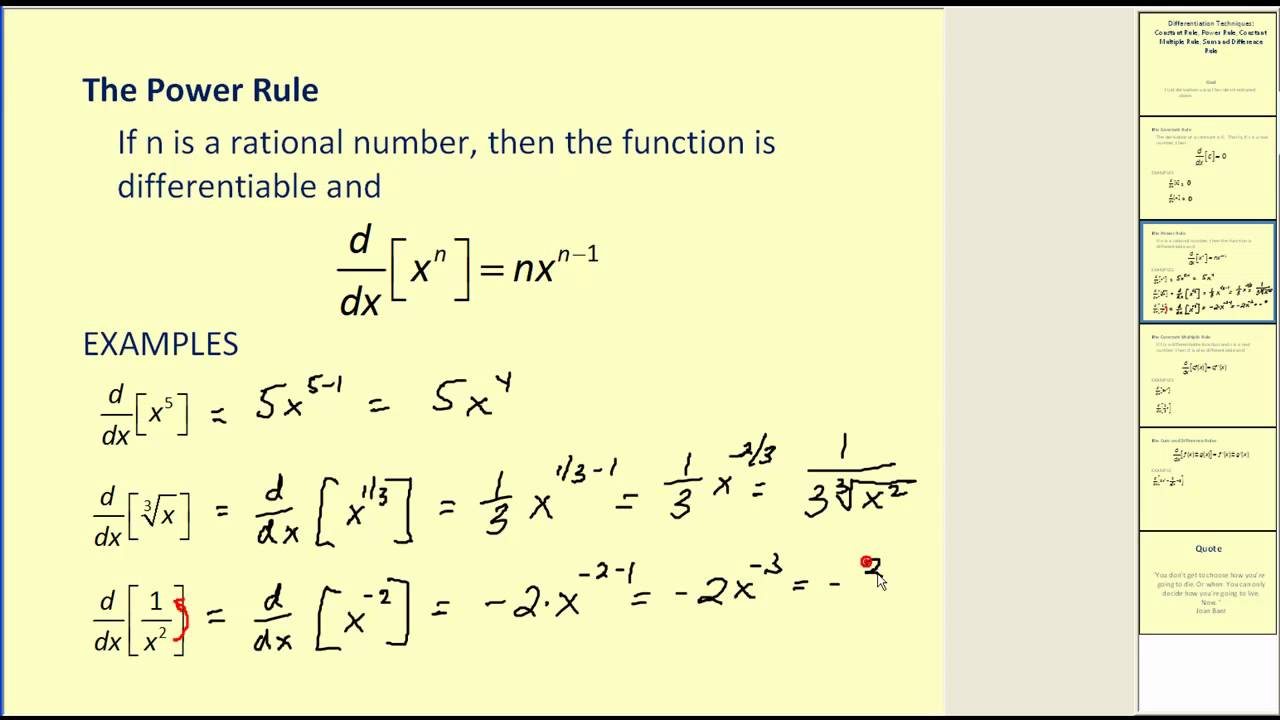
- Roots: Remember that . For example, .
- Fractions: Remember that . For example, .
Once the function is in the form , you can apply the power rule just as before.
The following textbook excerpt provides clear examples of this process.
HELM workbook 11 - Differentiation
The HELM Workbook on Differentiation provides an excellent summary and examples of using a table of derivatives, including the power rule for fractional and negative indices.
Please read Section 11.2, focusing on pages 12-13. Pay close attention to Key Point 4 and the two tasks that follow, which show how to differentiate y = √x and y = 5/x³. This demonstrates how to rewrite functions before applying the rule.
Let's work through an example that combines these ideas. Find the derivative of .
-
Rewrite the function:
First, convert each term into the format.
So, .
-
Apply the Power Rule:
Now, differentiate term by term. -
Combine and Simplify (optional but good practice):
The derivative is .
It's often useful to write the result back in the original format with roots and fractions:
The image below provides a great summary of the three main cases we've seen: positive, fractional, and negative powers.
Test your understanding!
Find the derivative of .
Show answer
- Rewrite:
- Differentiate:
- Combine:
Or, written with roots and fractions:
Conclusion
Today you've moved from the theoretical foundation of the derivative to its practical application for a large and important class of functions. You now have a powerful tool that saves a great deal of time and effort compared to working from first principles.
Key Takeaways:
- The Power Rule: For a function , its derivative is .
- Term-by-Term Differentiation: To find the derivative of a polynomial, apply the power rule to each term separately and add the results.
- The Derivative of a Constant is Zero: The rate of change of a constant value is always zero.
- Rewrite and Differentiate: The power rule can be used on functions with roots or variables in the denominator, but you must first rewrite them using the laws of indices (e.g., , ).
The power rule is a fantastic tool, but it has its limits. It does not work directly on functions that are multiplied together (e.g., ) or divided (e.g., ). In our next lesson, we will learn two new rules, the Product Rule and the Quotient Rule, to handle these situations.