Welcome to the next phase of your learning journey! In our previous module, you successfully built, documented, and published a complete end-to-end machine learning project. That's a fantastic portfolio piece that demonstrates a wide range of practical data science skills.
Now, we pivot to our "epic" portfolio project: building an AI-powered tutor chatbot. This project will take you into the exciting world of modern Natural Language Processing (NLP). The engine behind today's most powerful language models, like ChatGPT, is an architecture called the Transformer.
To build our chatbot, we first need to understand the foundations it's built on. This lesson addresses that directly. Your goal is to explain at a high level how the Transformer architecture works. We'll focus on the core concepts and intuition, which will be essential as we start using these models in the upcoming lessons.
1. The Big Picture: What is a Transformer?
At its heart, a Transformer is a neural network architecture designed to handle sequential data, like sentences, with remarkable effectiveness. It was introduced in the 2017 paper "Attention Is All You Need" and has since become the standard for nearly all state-of-the-art NLP tasks.
Unlike its predecessors (like Recurrent Neural Networks), which process data one step at a time, the Transformer can process an entire sequence at once. Its "secret sauce" is a mechanism called self-attention, which allows it to weigh the importance of different words in the sequence when processing any given word.
To begin, let's get a high-level visual and conceptual overview from one of the best explainers in the field.
Transformers, the tech behind LLMs | Deep Learning Chapter 5
This video from the 3Blue1Brown channel, titled "Transformers, the tech behind LLMs," provides an excellent intuition-first introduction to the topic.
Please watch the first two segments: The introduction explains what Transformers are and how they're used in Large Language Models (LLMs) for text generation. The high-level preview walks through the basic data flow: text is broken into tokens, tokens are turned into vectors, and these vectors pass through a series of attention and feed-forward blocks.
As the video illustrates, the core task of a generative model like GPT is to predict the next word (or token) in a sequence. The Transformer architecture is what makes this prediction so powerful and context-aware.
2. The Core Components of a Transformer
A Transformer is built from a few key components that work together. We'll explore each one conceptually. The "Illustrated Transformer" by Jay Alammar is a classic and highly-regarded resource for understanding this architecture. We will use it as our primary guide.
The Illustrated Transformer - Jay Alammar
This article provides clear, step-by-step visualizations of the Transformer architecture. It's a fantastic resource for building a mental model of how the pieces fit together.
For now, please read the first two main sections: "A High-Level Look": This section introduces the original Transformer's encoder-decoder structure. "Bringing The Tensors Into The Picture": This part explains how data, represented as vectors (tensors), flows through the model. Pay close attention to the idea that each word flows through its own path, but the paths interact in the self-attention layer.

Let's break down the components mentioned in these resources.
A. From Words to Vectors: Embedding and Positional Encoding
A neural network can't work with raw text; it needs numbers. The first step in a Transformer is to convert the input text into a sequence of vectors.
- Tokenization: The input text is broken down into smaller units called tokens. These can be words, parts of words (e.g., "transformer" -> "transform", "er"), or punctuation.
- Embedding: Each token is mapped to a high-dimensional vector using a lookup table (the "embedding matrix"). These initial vectors represent the meaning of the tokens. As you saw in the 3Blue1Brown video, words with similar meanings are represented by vectors that are close to each other in this high-dimensional space.
- Positional Encoding: Since the Transformer processes all tokens at once, it has no inherent sense of word order. To fix this, we add a "positional encoding" vector to each word's embedding. This vector follows a specific pattern that gives the model information about the position of each token in the sequence.
B. Self-Attention: The Heart of the Transformer
This is the most innovative part of the Transformer. Self-attention allows the model to understand the context of a word by looking at every other word in the sequence and deciding which ones are most relevant.
For example, in the sentence: "The animal didn't cross the street because it was too tired."
Self-attention helps the model figure out that "it" refers to "animal" and not "street".
To achieve this, self-attention uses three vectors for each input token, known as the Query, Key, and Value vectors. You can think of this with a search engine analogy:
- Query (Q): The current word we are focusing on. It's like your search query, asking for relevant information.
- Key (K): All the other words in the sentence. They are like the titles or keywords of webpages that the query can be compared against.
- Value (V): Also all the other words in the sentence. They are like the actual content of the webpages.
The process works roughly like this:
- For the current word (the Query), calculate a similarity score with every other word (the Keys). This is typically done using a dot product.
- Normalize these scores using a softmax function so they add up to 1. These normalized scores are the attention weights.
- Create the new representation for the current word by taking a weighted sum of all the Value vectors, using the attention weights.
This way, the new vector for "it" will be heavily influenced by the vector for "animal" because it had a high attention score.
The Illustrated Transformer - Jay Alammar
Let's continue with Jay Alammar's post to see this process in detail.
Please read the following three sections: "Self-Attention at a High Level": This reinforces the intuition behind self-attention. "Self-Attention in Detail": This walks through the Q, K, V calculation step-by-step. Focus on understanding the concept, not memorizing the matrix math. "The Beast With Many Heads": This introduces Multi-Head Attention. The key idea is that the model performs the self-attention process multiple times in parallel (e.g., 8 or 12 "heads"). Each head learns to focus on different types of relationships between words, making the model more powerful. The outputs of all heads are then combined.
3. Assembling the Architecture
Now that we have the core components, let's see how they form the full architecture.
The Transformer Block
The main processing unit is the Transformer Block. In a decoder-only model like GPT, a block consists of:
- A (Masked) Multi-Head Self-Attention layer.
- A Feed-Forward Network (FFN), which is a simple multi-layer perceptron (MLP) applied independently to each token's vector. This helps further process the information gathered by the attention layer.
Both of these sub-layers also have residual connections and layer normalization around them. These are standard techniques that help stabilize the training of deep networks.
LLM Transformer Model Visually Explained
A visual representation of a single Transformer block from the Transformer Explainer article, showing the Self-Attention and MLP components, along with residual connections and layer normalization.
The full Transformer is just a stack of these blocks. GPT-2, for instance, has 12 of these blocks stacked on top of each other. The output of one block becomes the input to the next, allowing the model to build up an increasingly sophisticated understanding of the text.
Encoder-Decoder vs. Decoder-Only
- Encoder-Decoder (The Original): As seen in the main architecture diagram, this model is designed for sequence-to-sequence tasks like machine translation.
- The Encoder reads the entire input sentence (e.g., in German).
- The Decoder generates the output sentence (e.g., in English) one word at a time. It uses self-attention on the words it has already generated and a second attention mechanism (cross-attention) to look at the encoder's output.
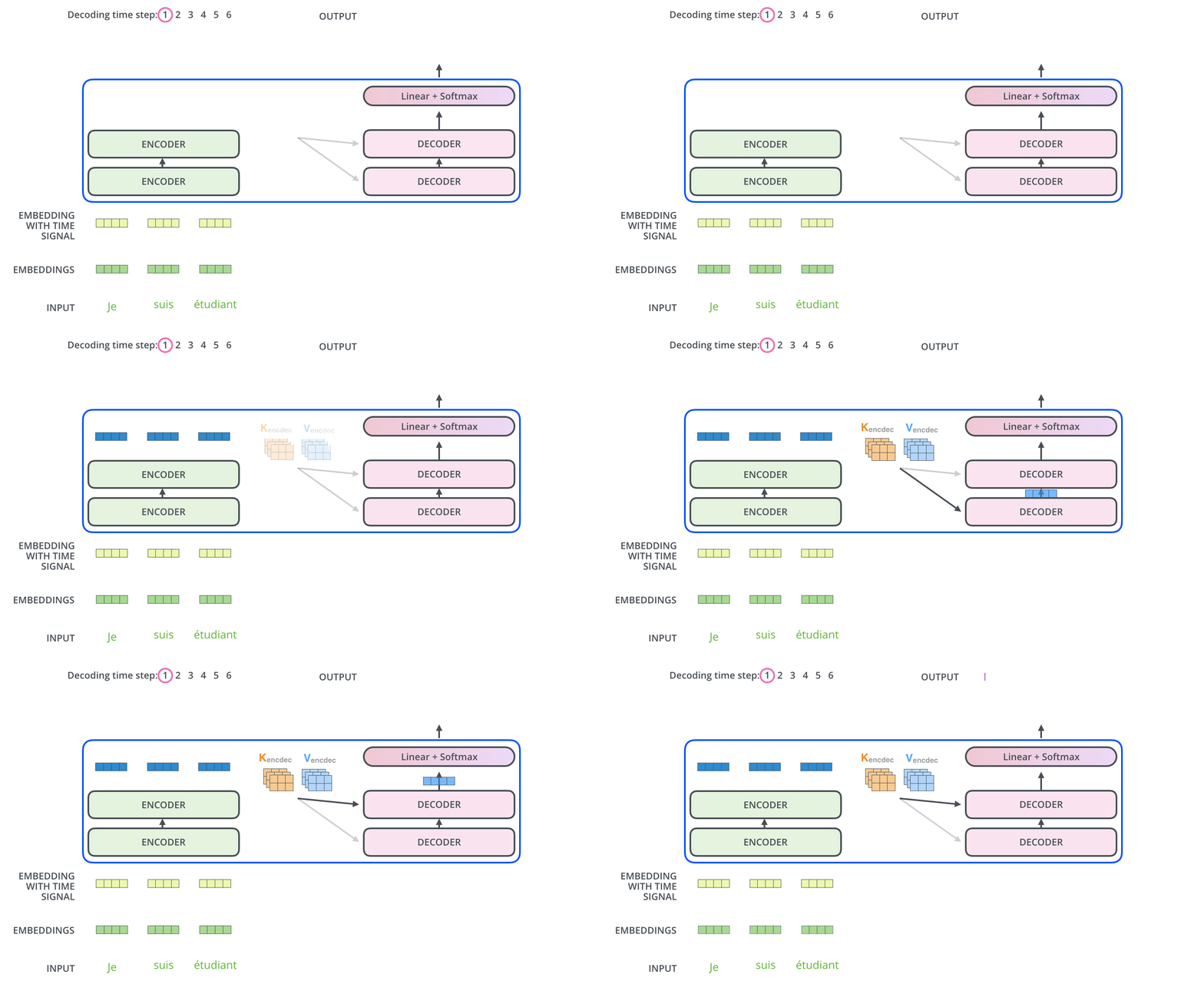
- Decoder-Only (GPT-style): This model is built for text generation. It's essentially just the decoder part of the original architecture. Its self-attention is "masked" to prevent it from "seeing" future words in the sequence during training, forcing it to learn how to predict the next word based only on the preceding ones. This is the architecture we will be most concerned with for our RAG chatbot.
From Final Vector to Next Word
After the input passes through all the Transformer blocks, how does the model make a final prediction?
- It takes the output vector corresponding to the last token in the sequence.
- This vector is passed through a final Linear layer that projects it into a very large vector, where the size is equal to the entire vocabulary (e.g., 50,257 for GPT-2). The values in this vector are called logits.
- A Softmax function is applied to the logits vector, converting the scores into a probability distribution.
- The model can then pick the next token. It might greedily choose the one with the highest probability, or it might sample from the distribution to introduce some randomness and "creativity."
This new token is then appended to the input sequence, and the whole process repeats to generate the next token, and so on.
Conclusion
You've just completed a high-level tour of the Transformer architecture! It's a complex system, but the core ideas are what matter most for our purposes.
Key Takeaways:
- Transformers process entire sequences of data at once, using positional encodings to keep track of word order.
- The core mechanism is self-attention, which uses Query, Key, and Value vectors to allow words to weigh the importance of other words in the sequence.
- Multi-Head Attention allows the model to focus on different kinds of relationships simultaneously.
- The main building block is the Transformer Block, which contains a multi-head attention layer and a feed-forward network. Stacking these blocks creates a deep model.
- Generative models like GPT are typically decoder-only and work by predicting the next token in a sequence auto-regressively.
With this conceptual foundation, you're now ready to move from theory to practice. In our next lesson, we will get our hands dirty and learn how to use a powerful pre-trained Transformer model from the Hugging Face library to generate text embeddings. This is the first practical step toward building the knowledge base for our AI tutor chatbot.