Welcome back! In the last lesson, we dove into the art of systematic error analysis, learning how to pinpoint exactly where and why our models are failing by identifying and diagnosing specific failure modes in data subsets.
This lesson completes the cycle. Now that we know how to find the problems, we will focus on how to fix them. You will learn to translate the insights gained from error analysis into concrete, actionable steps for model improvement. This is the "mitigation" phase, where we use our findings to strategically guide feature engineering, data collection, and model adjustments to build more robust and accurate systems.
1. The Iterative Loop of Model Improvement
A crucial concept in applied machine learning is that model development is not a linear process but a continuous cycle. Error analysis is the engine that drives this cycle, providing the feedback necessary for targeted improvements.

Your goal is to move through this loop efficiently. Instead of randomly trying new features or models, your error analysis will give you a data-driven hypothesis about what to try next. For example, if you find your model fails for customers with low tenure, you now have a clear objective: improve performance for that specific cohort.
2. From Error Category to Actionable Strategy
In our previous lesson, we categorized errors into types like high bias, high variance, and pipeline failures. Let's now map these categories to specific improvement strategies, focusing heavily on feature engineering as you requested.
The book Machine Learning Yearning by Andrew Ng, which we've referenced before, provides an excellent framework for this.
[PDF] andrew-ng-machine-learning-yearning.pdf - DeepLearning.AI
This reading from Andrew Ng's book provides a concise list of strategies to tackle the two main sources of error: bias and variance.
Read Chapter 25, "Techniques for reducing avoidable bias," and Chapter 27, "Techniques for reducing variance." As you read, notice a key overlap: "Modify input features based on insights from error analysis" appears in both lists. This highlights just how central feature engineering is to fixing model errors.
Let's break down how this works in practice.
Case 1: The Model Fails on a High-Bias Subset (Underfitting)
You've identified a cohort where your model performs poorly even on the training data. It's too simple to capture the underlying patterns for this group.
Primary Strategy: Create More Informative Features
Your existing features are not expressive enough for this subset. Error analysis guides you to create new ones.
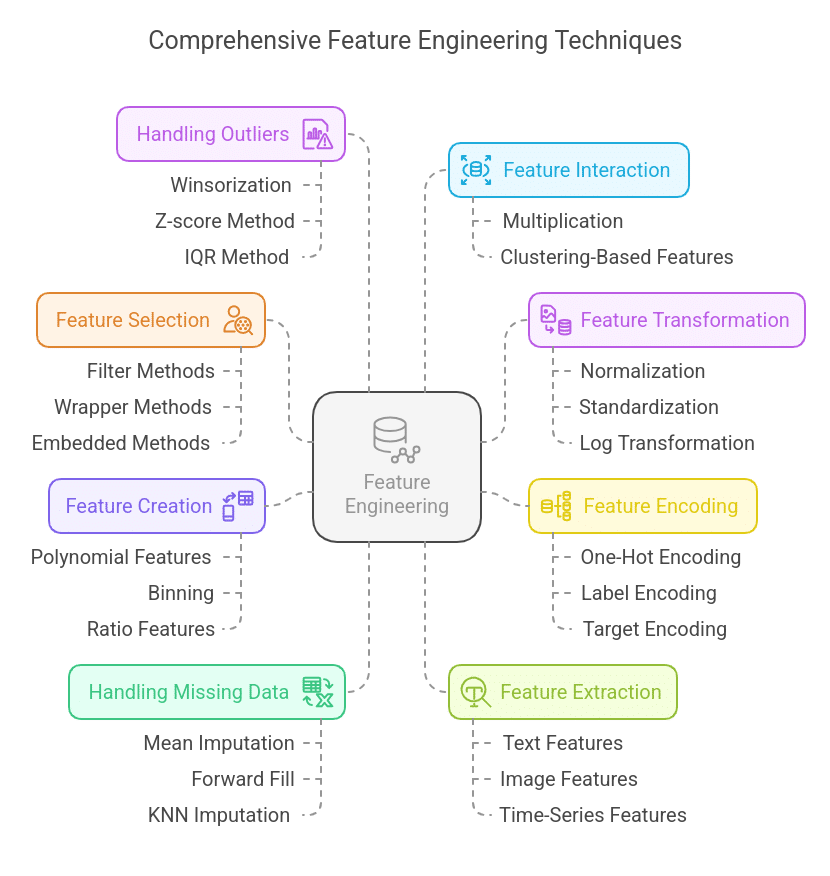
- Polynomial and Interaction Features: If your model fails for customers with low
tenureand highMonthlyCharges, a linear model might not capture this. Creating an interaction feature liketenure * MonthlyChargesor a ratio likeMonthlyCharges / tenurecould provide the non-linear signal the model needs. - Domain-Specific Features: If error analysis shows failures for users with a specific
PaymentMethod, like 'Electronic check', this might suggest a behavioral pattern. With a domain expert, you might hypothesize that these users are less "sticky." You could then engineer a feature likeis_auto_payment = 0for electronic checks and1for credit cards, which might capture this concept of commitment. - Binning for Non-Linearity: Maybe
tenuredoesn't have a linear effect on churn. New customers might churn a lot, loyal customers very little, and mid-term customers somewhere in between. You can capture this by binning the continuoustenurefeature into categories like'New','Established','Loyal'.
Case 2: The Model Fails on a High-Variance Subset (Overfitting)
You've found a cohort where the model does well on the training data but poorly on the dev/test set. The model has learned noise specific to the training examples for this subgroup.
Primary Strategies: Add Data and Simplify Features
- Get More Data: This is the most reliable way to combat variance. If your model is overfitting on a rare category (e.g., a small customer segment), it's likely because it hasn't seen enough examples to learn a generalizable pattern. Your error analysis provides a clear mandate: collect more data for that specific cohort.
- Artificial Data Synthesis: When collecting real data is expensive or impossible, you can sometimes generate it. Andrew Ng discusses this in the context of creating noisy audio for a speech recognition system.
[PDF] andrew-ng-machine-learning-yearning.pdf - DeepLearning.AI
This chapter explains how to create new training data based on the needs identified during error analysis.
Read Chapter 43, "Artificial data synthesis." Think about how you could apply this to a business problem. For example, if your model fails on blurry images of products, you could programmatically add blur to your clear training images to create a larger, more robust dataset.
- Feature Selection: If you have many features, some might be introducing noise for a specific subgroup. Your analysis might suggest that for a certain cohort, a simpler model with fewer features would perform better, reducing the risk of overfitting.
Case 3: The Model Fails Due to Data Mismatch
Your analysis reveals that a key subgroup in your test set has different characteristics than the same subgroup in your training set.
Primary Strategy: Align Your Training Data
The solution is conceptually simple: make your training data look more like your test data.
[PDF] andrew-ng-machine-learning-yearning.pdf - DeepLearning.AI
This chapter provides direct advice for when your training and test distributions differ.
Read Chapter 42, "Addressing data mismatch." The core idea is to use error analysis to understand the differences and then try to acquire training data that bridges that gap.
For instance, if your churn model was trained on data from 2021, but you're testing it on 2023 data where customer behavior has changed due to a new competitor, your error analysis will highlight this. The action is clear: you need to acquire and train on more recent data.
3. A Practical Walkthrough: Fixing a Churn Model
Let's apply this to the churn prediction example we saw in the last lesson. The analysis identified specific cohorts where the model was struggling.
A Comprehensive Guide to Error Analysis in Machine Learning | by Kemal Toprak Uçar | Medium
This article provides a concrete example of identifying failing cohorts and proposing solutions.
First, quickly review the "Error Analysis" section to remind yourself of the findings: the model performed poorly for customers with 'Month-to-month' contracts and for those with low tenure values. Then, read the "Suggestions" section carefully. This section bridges the gap from diagnosis to mitigation, proposing several actions based on the analysis.
The article identified two key failure modes:
- Contract Type: Accuracy was only 70% for customers with
Contract = 'Month-to-month'. - Tenure: Performance was poor for low values of the
tenurefeature.
Let's brainstorm specific feature engineering ideas based on these findings, going beyond the general suggestions in the article.
Hypothesis: Customers on month-to-month contracts are less committed and more sensitive to short-term value. Low-tenure customers are still "evaluating" the service. Our model isn't capturing this nuance.
Actionable Feature Engineering Ideas:
-
Create a 'Value Perception' Feature: For month-to-month customers, the ratio of what they pay to how long they've been around might be a strong signal of churn.
# Avoid division by zero if TotalCharges is 0
df['value_ratio'] = df['MonthlyCharges'] / (df['TotalCharges'] + 1e-6)
For a new customer,
TotalChargesis close toMonthlyCharges, so this ratio is high (~1). For a long-term customer, this ratio is low. This might capture the "is it worth it right now?" calculation better thantenurealone. -
Create an Explicit 'New Customer' Feature: The model might benefit from a clear flag identifying new, high-risk customers. This allows it to learn a specific weight for this group.
df['is_new_customer'] = (df['tenure'] <= 6).astype(int) -
Interaction with 'InternetService': Perhaps new, month-to-month customers who have the expensive
'Fiber optic'internet service are the most likely to churn if dissatisfied.# Example of a complex interaction feature df['new_fiber_customer'] = ((df['tenure'] <= 6) & \ (df['Contract'] == 'Month-to-month') & \ (df['InternetService'] == 'Fiber optic')).astype(int)
After engineering these new features, you would retrain your model and re-run the error analysis on the same cohorts. Did performance on 'Month-to-month' or low tenure customers improve? This closes the iterative loop.
4. Improving Multi-Component Pipelines
Finally, let's revisit the idea of complex ML pipelines from the last lesson. We used error analysis to identify a bottleneck component by feeding it "perfect" inputs.
Lecture 13 - Debugging ML Models and Error Analysis | Stanford CS229: Machine Learning (Autumn 2018)
This lecture clip from Andrew Ng's Stanford course, which we saw previously, demonstrates how to identify the bottleneck in a pipeline.
As a quick refresher, re-watch the segment on attributing error. The key insight is that this analysis tells you the potential upside of working on each component.
The finding from this analysis directly guides your engineering efforts. If you determine that the face detection component offers a potential 6% improvement to system accuracy, while the background removal component offers only 0.1%, your path is clear. You should treat the face detection component as a new, high-priority machine learning problem and apply this entire iterative loop (feature engineering, data collection, etc.) to that component alone.
Conclusion
You have now moved from being a model builder to a model improver. By connecting the dots between diagnosis and mitigation, you can work more like a seasoned engineer: systematically, efficiently, and with a clear purpose.
Key Takeaways:
- Model improvement is an iterative cycle driven by error analysis.
- Specific error types point to specific solutions. High bias often requires better features, while high variance often requires more data.
- The findings from error analysis should lead to concrete hypotheses that you test with targeted feature engineering.
- For complex pipelines, error attribution allows you to focus your feature engineering and modeling efforts on the component with the highest potential impact.
In the previous lessons of this module, you've learned to interpret, diagnose, and now improve your models. You are now fully equipped for our next phase: applying this entire end-to-end workflow to build your next major portfolio project.