Introduction
In our previous lesson, we began our exploration of virtualization security by examining the threats of VM sprawl and data leakage, along with their respective countermeasures. We established that securing a virtualized environment requires a multi-layered approach, addressing both governance failures and technical vulnerabilities.
This lesson continues our focus on virtualization security, addressing your syllabus topic 2.3 Virtualization security threats. We will specifically tackle two of the most critical threats: hyperjacking and VM escape. The learning outcome for this session is to: Describe countermeasures for hyperjacking and VM escape (e.g., hypervisor hardening, regular patch management, intrusion detection systems).
We will define a clear set of defensive strategies for each threat, providing you with the structured knowledge and specific terminology required to construct high-scoring exam answers.
1. Countermeasures for Hyperjacking
First, let's briefly recall what hyperjacking is. It's an attack where a malicious program, or "rootkit," takes control of the hypervisor. The attacker can then manipulate the entire virtual environment—including all guest VMs—without the guest operating systems even being aware. It is one of the most severe attacks against a virtualized system.
Defending against such a fundamental attack requires securing the hypervisor itself from every possible angle. The countermeasures can be grouped into a defense-in-depth strategy.
Let's start by exploring the academic perspective on these attacks and the countermeasures.
An in-depth analysis of system virtualization models
The research paper 'An in-depth analysis of system virtualization models' provides a formal classification of virtualization attacks. It defines hyperjacking and VM escape, and then dedicates a significant section to countermeasures.
First, find the subsection titled 'hyperjacking / hypervisor injection attacks' (near the end of section 3.4.3) to refresh your understanding of the attack. Then, find the subsection 'VM escape to a VM attack' (in section 3.5.1) to understand that attack vector. This will provide context for the countermeasures we will discuss next.
Now that we have reviewed the formal definitions, let's detail the defenses. The primary strategy is Hypervisor Hardening.
A. Hypervisor Hardening and Attack Surface Reduction
Hypervisor Hardening is the process of securing the hypervisor by reducing its potential vulnerabilities, or "attack surface." The smaller the attack surface, the fewer opportunities an attacker has.
This concept is well-summarized in the following blog post from Corevisor, which offers a practical, industry-focused view.
Top 5 Security Risks in Virtual Environments & Prevention Strategies
The article 'Top 5 Security Risks in Virtual Environments & Prevention Strategies' clearly outlines hyperjacking and lists practical prevention strategies. It's a great source for clear, actionable advice.
Read the section titled 'Risk #1: Hypervisor Compromise (a.k.a. “Hyperjacking”)'. Pay close attention to the list under 'Prevention strategies that actually work.' We will expand on these points.
Based on these sources, the key hardening techniques are:
-
Regular Patch Management: This is the most critical and fundamental defense. Hypervisor vendors (like VMware, Microsoft, and the KVM community) regularly release security patches to fix known vulnerabilities. Applying these patches promptly closes the door on known exploits.
-
Disable Unnecessary Services and Features: A hypervisor may come with many features (e.g., specific device drivers, management agents) that are not needed for every environment. Each active feature adds to the code base and potential attack surface. A core hardening principle is to disable anything that is not explicitly required.
-
Strict Access Control: The hypervisor's management interface is the gateway to the entire system. Access must be severely restricted.
- Role-Based Access Control (RBAC): Assign permissions based on user roles, ensuring administrators only have the access they need to perform their jobs.
- Principle of Least Privilege: This is a foundational security concept. A user or process should only have the minimum set of privileges necessary to complete its task.
- Strong Authentication: Enforce Multi-Factor Authentication (MFA) for all administrative accounts.
The image below illustrates how access control mechanisms protect the virtual environment.

B. Architectural Defenses
Beyond hardening the hypervisor software, architectural choices can significantly improve security.
- Management Plane Isolation: The hypervisor management network should be physically or logically isolated from the regular user and VM data traffic. An attacker on the data network should have no direct path to the management interface. This is a crucial defense.
- Hardware-Assisted Security: Modern CPUs provide features that can be leveraged to protect the hypervisor.
- Secure Boot: Ensures that the machine boots using only software that is trusted by the hardware manufacturer. This can prevent a malicious hypervisor from loading at startup.
- Trusted Platform Module (TPM): A dedicated microchip that can perform cryptographic operations and securely store artifacts. It can be used for attestation—a process where the TPM provides cryptographic proof that the hypervisor's code has not been tampered with.
2. Countermeasures for VM Escape
A VM escape occurs when a program running inside a guest VM breaks out of its isolated environment and gains access to the hypervisor or the host operating system. This is typically achieved by exploiting a vulnerability in a shared resource, such as a virtual device driver or a hypercall.
While hyperjacking targets the hypervisor from the "outside" (e.g., via the management plane), a VM escape attacks it from the "inside" (from a guest VM).
The image below provides a clear, high-level overview of the mitigation strategies for VM Escape, which you should find very useful for structuring exam answers.
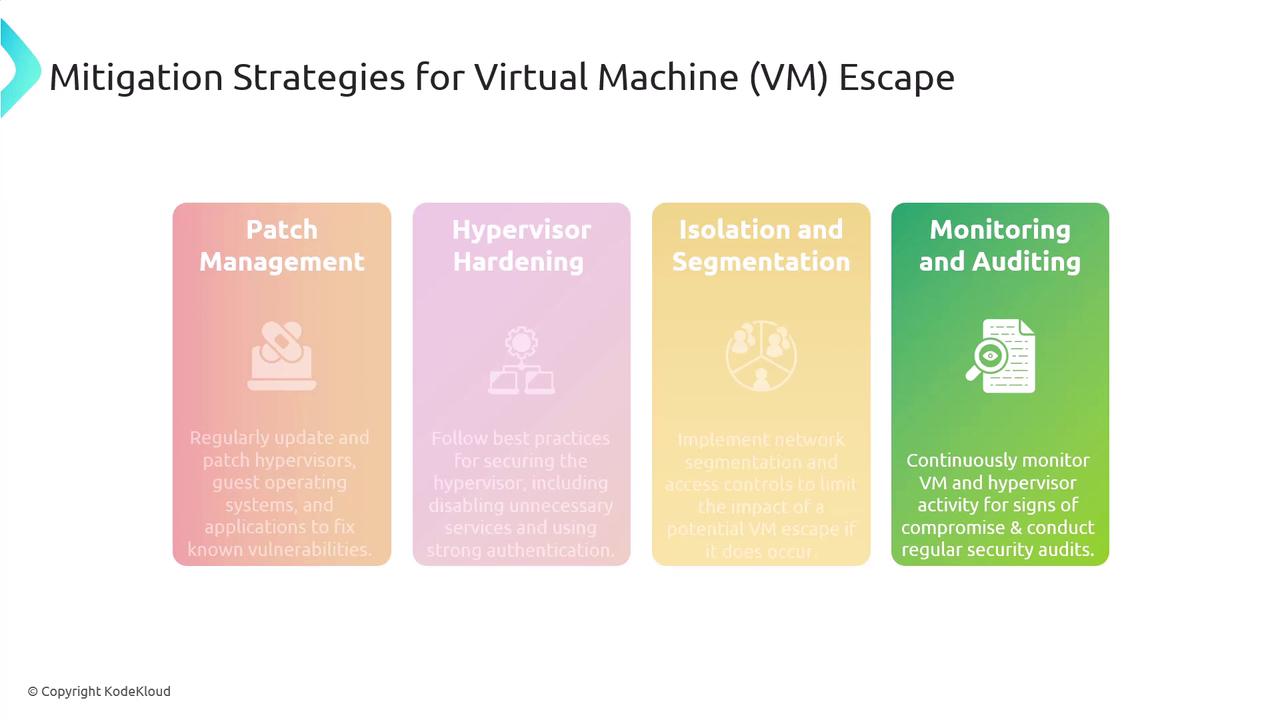
Let's break down these strategies.
A. Relentless Patching (The #1 Defense)
Just as with hyperjacking, timely patching is the most effective defense. VM escape vulnerabilities are often found in the complex code that emulates hardware devices (e.g., network cards, disk controllers) or in the hypervisor services passed through to the VM. When a vulnerability like this is discovered, vendors rush to patch it. Lagging behind on these patches creates a significant window of opportunity for an attacker.
B. Attack Surface Reduction for the Guest
This is a specific form of hardening focused on the interface between the guest VM and the hypervisor.
Top 5 Security Risks in Virtual Environments & Prevention Strategies
Let's return to the Corevisor article, which also covers VM escape and its prevention.
Now, read the section 'Risk #2: VM Escape (Guest → Host Exploits)'. Focus on the strategy of 'Reduce attack surface'.
As the article suggests, a key tactic is to disable unnecessary virtual hardware and device passthrough. Features like sharing USB devices, clipboards, or direct GPU access between the host and guest create complex communication channels. If these features are not essential for the VM's function, they should be disabled to eliminate them as potential attack vectors.
C. Hypercall Filtering and Monitoring
Hypercalls are the system calls a guest VM makes to the hypervisor to request services (e.g., I/O operations). An exploit might involve making a malformed or malicious hypercall. Advanced security systems can monitor and filter these calls, blocking any that deviate from expected patterns, which can prevent an exploit from succeeding.
D. Isolation and Segmentation
This strategy is about damage control. Assume an escape might one day succeed. What can be done to limit the blast radius?
- Network Segmentation: As discussed in the previous lesson, if a compromised VM escapes to the host, strong network segmentation can prevent it from pivoting and attacking other systems on different network segments.
- Intrusion Detection/Prevention Systems (IDS/IPS): These systems monitor network traffic for suspicious patterns. If an attacker who has escaped a VM attempts to scan the network or attack other VMs, an IDS/IPS can detect this "East-West" traffic and raise an alarm or block the connection.
Summary for Exam Revision
This table summarizes the countermeasures for both threats. Note the overlap, which highlights the importance of defense-in-depth.
| Threat | Primary Goal of Countermeasure | Key Techniques and Examples |
|---|---|---|
| Hyperjacking | Protect the integrity and control of the hypervisor itself. |
|
| VM Escape | Maintain the isolation boundary between a guest VM and the host/hypervisor. |
|
Conclusion
In this lesson, we have detailed the critical countermeasures for hyperjacking and VM escape, two of the most significant threats in a virtualized environment.
Key Takeaways:
- Both hyperjacking and VM escape target the hypervisor, the core of the virtualized infrastructure.
- A defense-in-depth strategy is essential, combining multiple layers of protection.
- The four pillars of defense are:
- Hypervisor Hardening: Reducing the attack surface by patching, disabling features, and using strict access control.
- Architectural Isolation: Separating management networks from data networks.
- Integrity Checks: Using hardware (TPM, Secure Boot) to verify the hypervisor's code.
- Monitoring & Containment: Using IDS/IPS and network segmentation to detect and limit the impact of a successful attack.
Preview of the Next Lesson:
Having concluded our deep dive into virtualization concepts and security, we are now ready to move to the next topic in your syllabus: Containerization. In the next lesson, we will introduce the concept of containers, examine the container architecture, and begin the critical comparison of Virtualization vs. Containerization, a very common exam topic.