Introduction
In our last lesson, we identified the key security threats unique to virtualized environments: VM sprawl, VM escape, hyperjacking, and data leakage. Understanding these vulnerabilities is the first step, but for your exams, knowing how to defend against them is equally critical.
This lesson directly addresses the learning outcome: Describe countermeasures for VM sprawl and data leakage between VMs (e.g., lifecycle management policies, network segmentation). We will focus on the specific strategies and technologies used to mitigate these two common and important threats. We'll break down the official terminology and provide clear, structured explanations that you can readily use in your exam answers.
1. Countermeasures for VM Sprawl
As we discussed, VM Sprawl is a governance failure that results in the uncontrolled proliferation of virtual machines, increasing the attack surface and wasting resources. The countermeasures, therefore, are less about a single technical fix and more about implementing robust management policies.
The Core Strategy: VM Lifecycle Management
The most effective countermeasure is a comprehensive VM Lifecycle Management policy. This is a set of formal processes that govern a virtual machine from its creation to its deletion.
For an authoritative perspective on this, let's consult the NIST guide on virtualization security. It frames VM sprawl not just as clutter, but as a significant operational and security challenge.
Guide to Security for Full Virtualization Technologies
The document 'Guide to Security for Full Virtualization Technologies' from NIST directly discusses the problem of 'proliferation of images, also known as sprawl'. It recommends a structured approach to management.
Please read the section titled 'Image and Snapshot Management'. Focus on the paragraph that begins 'Another potential problem with increasing the use of virtualization...'. Pay attention to the proposed solution: implementing formal image management processes.
As the NIST guide recommends, a formal management process is key. This process can be broken down into several practical strategies. The following image provides a great overview of the key actions involved in controlling VM sprawl.

Let's break down these strategies into exam-friendly points:
Key Countermeasures for VM Sprawl:
-
Establish Policies and Standards:
- Templates: Create pre-configured, hardened "golden images" or templates for common server roles. New VMs should be deployed from these templates to ensure they start with a secure baseline configuration.
- Naming Conventions: Implement a clear and consistent naming convention for all VMs. This helps in identifying a VM's owner, purpose, and environment (e.g.,
DEV-WebSrv01-JohnD). - Limited Creation Privileges: Restrict the ability to create new VMs to authorized administrators. This prevents the random creation of VMs by developers or testers without oversight.
-
Implement Auditing and Tracking:
- Regular Audits: Periodically conduct an inventory of all VMs. The goal is to identify any "rogue" (unauthorized) or "dormant" (unused) machines.
- Ownership and Justification: Every VM must have a designated owner and a documented purpose. If a VM's owner or purpose cannot be identified, it should be flagged for decommissioning.
-
Optimize and Decommission:
- Right-Sizing: Analyze the performance of existing VMs and "right-size" them by adjusting their allocated CPU, RAM, and storage to match their actual workload. This frees up resources.
- Archiving & Sunsetting: Establish a clear process for shutting down and eventually deleting VMs that are no longer needed. This includes policies for test/dev VMs, which should have an expiration date.
- Cleanup: Regularly clean up orphaned files, such as unused virtual disks (VMDKs, VHDs) and old snapshots, which consume valuable storage and can contain sensitive data.
This approach is reinforced by other security bodies. For your exam, being able to cite multiple sources strengthens your answer.
Cyber Centre data centre virtualization report: Best practices for data ...
The Canadian Centre for Cyber Security's report on Virtualized Data Centres provides a list of best practices. One of these directly addresses VM sprawl.
In the section 'VDC Reference Architecture Best Practices', locate and read Best Practice #23. Note how it emphasizes 'effective image management' and the use of 'templates' as key mitigations.
By combining policy, automation, and regular audits, an organization can effectively prevent and remediate VM sprawl.
2. Countermeasures for Data Leakage Between VMs
In our last lesson, we saw that data can leak between VMs through side-channels or by exploiting shared resources. The primary defense against this is to enforce strict isolation, particularly at the network level.
The Core Strategy: Network Segmentation
Network Segmentation is the practice of dividing a computer network into smaller, isolated logical sub-networks or segments. Communication between these segments is then controlled by a firewall or another filtering device.
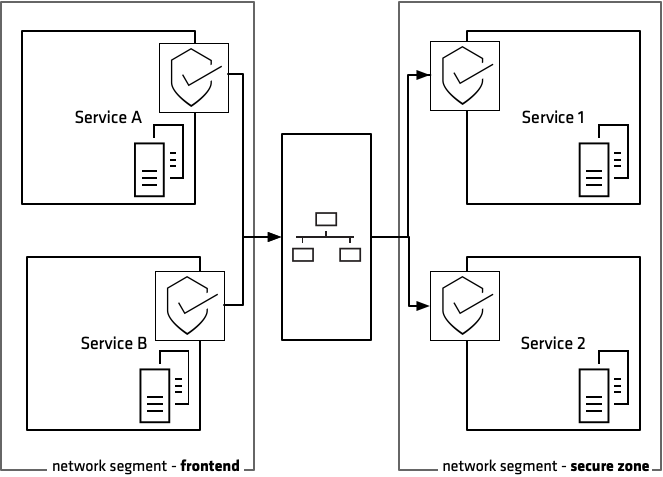
In a virtual environment, segmentation is used to prevent a compromised VM in one segment from attacking or snooping on traffic in another.
A more modern and granular form of this is micro-segmentation.
- Definition: Micro-segmentation is a network security technique that allows security policies to be defined and enforced down to the individual workload (i.e., a single VM). Instead of just protecting the perimeter of a network zone, it creates a secure perimeter around each virtual machine.
This is particularly effective at controlling East-West traffic—the communication that occurs between servers within a data center. Data leakage between VMs is a classic East-West security problem.
Cyber Centre data centre virtualization report: Best practices for data ...
To grasp the concepts of micro-segmentation and East-West traffic, let's refer back to the Canadian Cyber Centre's report.
First, read the subsection 'Micro-Segmentation'. Focus on its definition and how it protects East-West traffic. Then, in the 'VDC Reference Architecture Best Practices' section, read Best Practice #11, which explains how logical controls like micro-segmentation supplement broader network zones.
Other Key Countermeasures
While network segmentation is the primary architectural defense, other simpler policies are also crucial.
-
Disable Unnecessary Shared Resources: As we learned, features like a shared clipboard, shared folders, and drag-and-drop between a guest VM and the host OS create direct channels for data transfer.
- Countermeasure: The NIST guide makes a clear recommendation: these features present a security vulnerability. The policy should be to disable them by default. They should only be enabled if there is a compelling business reason, and their use should be monitored.
-
Use Access Controls and Encryption: Strong security is built in layers (a principle known as "defense-in-depth").
- Logical Access Controls: Enforce strict permissions on which users and services can access which VMs and data stores.
- Encryption: Encrypt sensitive data both at rest (on the virtual disk) and in transit (as it moves across the virtual network). Even if an attacker manages to intercept traffic, encryption renders it unusable.
Summary for Exam Revision
This table connects the threats from our previous lesson to the countermeasures covered today. This is an ideal format for quick revision.
| Threat | Primary Countermeasure | How it Works | Key Terminology |
|---|---|---|---|
| VM Sprawl | Lifecycle Management | Establishes formal processes for creating, tracking, and deleting VMs to prevent uncontrolled growth and ensure all VMs are managed and secured. | Golden Images, Templates, VM Auditing, Decommissioning Policy |
| Data Leakage (between VMs) | Network Segmentation / Micro-segmentation | Isolates VMs into secure network zones, with policies controlling the traffic between them. This prevents unauthorized communication and lateral movement. | East-West Traffic, Zero Trust, Defense-in-Depth |
| Data Leakage (via shared resources) | Disable Risky Features | Turns off high-risk convenience features like shared clipboards and folders to eliminate direct data exfiltration channels between guest and host. | Host Hardening, Guest Isolation |
Conclusion
In this lesson, we have detailed the specific countermeasures for VM sprawl and data leakage.
Key Takeaways:
- VM Sprawl is a governance problem solved with Lifecycle Management Policies. This involves using templates, conducting regular audits, and having a strict process for decommissioning unused machines.
- Data Leakage is an isolation problem solved primarily with Network Segmentation and Micro-segmentation. These architectural controls limit communication between VMs to only what is explicitly allowed, preventing snooping and lateral attacks.
- Additional layers of defense include disabling risky shared features, enforcing strong access control, and using encryption.
Mastering these defensive strategies is essential for building and maintaining a secure virtualized environment, and they are foundational concepts for understanding broader cloud security.
Preview of the Next Lesson:
We have now covered the essentials of virtualization, from its core concepts to its security challenges and defenses. The next logical step in your syllabus is Containerization. In the next lesson, we will define what a container is, examine its architecture, and begin comparing it directly to the virtual machine architecture we have just studied.