Introduction
Welcome to your next lesson on Cloud Computing. In our previous session, we examined the architecture of the hybrid cloud and its powerful 'cloud bursting' use case. We saw how combining private and public clouds offers a flexible solution for managing variable workloads.
This lesson logically follows from that discussion. Now that you understand what the different deployment models are, we will address the crucial question of how to choose one. The learning objective for this session is to explain the key criteria for choosing an appropriate cloud deployment model for a given business scenario.
Mastering this topic is essential for your exams, as it frequently appears in questions that require you to analyze a situation and justify a specific cloud strategy. We will focus on establishing a clear decision-making framework, supported by definitions, diagrams, and comparison tables to help you construct high-scoring, analytical answers.
The Decision-Making Framework
Choosing a cloud deployment model is not about finding the "best" model, but rather the "right" model for a specific organization's needs. The decision involves a series of trade-offs between cost, control, scalability, and security.
To begin, let's look at a visual overview of the primary factors that influence this choice.

As the diagram shows, the decision is multi-faceted. We can group these factors into three main categories for a structured analysis:
- Business and Financial Factors (e.g., Cost, Budget, Business Goals)
- Technical and Operational Factors (e.g., Scalability, Performance, IT Expertise, Control)
- Security and Compliance Factors (e.g., Data Privacy, Regulatory Needs)
Let's start by formally defining the core set of criteria you should be prepared to discuss.
Cloud Deployment Models - GeeksforGeeks
To establish a foundational list of criteria for your exam answers, the article 'Cloud Deployment Models' from GeeksforGeeks offers a concise and clear summary.
Please read the section titled 'What is the Right Choice for Cloud Deployment Model?'. Focus on the five key factors listed: Cost, Scalability, Easy to use, Compliance, and Privacy. This will serve as our initial checklist.
Now, we'll dive deeper into each of these criteria, exploring how they influence the choice between Public, Private, Hybrid, and Community clouds.
A Deep Dive into Key Criteria
For each factor, we will analyze the trade-offs and identify which deployment model is most suitable under different conditions.
1. Cost and Budgetary Constraints
Cost is often the most significant driver. The key here is to understand the difference between two accounting models:
- Capital Expenditure (CapEx): Money spent upfront on acquiring or maintaining fixed assets, like buying servers and building a data center.
- Operational Expenditure (OpEx): The day-to-day expenses of running a business, like paying a monthly cloud bill.
Analysis:
- Public Cloud: Operates on an OpEx model (pay-as-you-go). It requires almost no upfront investment, making it ideal for startups and businesses with limited capital.
- Private Cloud: Requires a significant CapEx to purchase hardware and build the infrastructure. It can have a lower Total Cost of Ownership (TCO) over the long run, but only for large, stable organizations that can achieve high utilization.
- Hybrid & Community Cloud: These models present a mix. A hybrid cloud involves CapEx for the private portion and OpEx for the public portion. A community cloud distributes the CapEx among its members.
A great example of this is a startup, which the following video mentions.
Public Cloud vs Private Cloud vs Hybrid Cloud - Major Differences Explained & Examples
To hear this explained in a practical context, let's revisit a short segment from the video we saw in a previous lesson. It explains how cost drives the initial choice for many companies.
Watch the segment from 07:52 to 08:22. Notice the discussion on initial capital expenditures and how companies like Netflix and Dropbox started in the public cloud before building their own private infrastructure.
2. Security, Privacy, and Control
For many organizations, especially in sectors like finance, healthcare, and government, this is the most critical factor.
Analysis:
- Private Cloud: Offers the highest level of control and security. The organization owns the infrastructure and is not sharing it with any other tenants. This is essential for sensitive data and for meeting strict data sovereignty regulations (i.e., rules requiring data to be stored within a specific country).
- Public Cloud: Involves a multi-tenant environment, which introduces perceived risks. While major providers have robust security, you have limited control and must rely on their security measures and third-party audits. As the video LINK noted, you can't just demand a tour of the data center.
- Hybrid Cloud: Provides the "best of both worlds." An organization can keep highly sensitive data and critical applications on its private cloud while leveraging the public cloud for less sensitive workloads. This is a very common strategy.
- Community Cloud: Offers a middle ground. Security and privacy are higher than in a public cloud because access is restricted to a known group of organizations with shared interests.
3. Scalability and Workload Variability
Scalability is the ability to increase or decrease IT resources as needed to meet changing demand.
Analysis:
- Public Cloud: Offers near-limitless scalability and elasticity on demand. This is the best choice for applications with unpredictable traffic, such as e-commerce sites during flash sales, streaming services, or rapidly growing startups.
- Private Cloud: Scalability is limited by the physical hardware the organization has purchased. It is suitable for stable, predictable workloads where demand does not fluctuate wildly.
- Hybrid Cloud: The ideal solution for managing workload variability. As we discussed in the last lesson, cloud bursting allows an application to run on a private cloud and "burst" into a public cloud to handle demand spikes, providing scalability without the cost of over-provisioning private hardware.
4. Compliance and Governance
Many industries are subject to strict legal and regulatory requirements (e.g., HIPAA for healthcare, GDPR for data in Europe, PCI-DSS for payment card data).
Analysis:
- Private Cloud: Provides the easiest path to ensuring compliance, as the organization has full control over the environment and the physical location of its data.
- Community Cloud: Often created specifically to meet the shared compliance needs of a particular industry (e.g., a group of government agencies or financial institutions).
- Public Cloud: Major providers offer services that are certified for various regulations, but the responsibility for using them correctly still lies with the customer (part of the Shared Responsibility Model). It can be complex to prove compliance in a multi-tenant environment.
- Hybrid Cloud: A common approach is to use a private cloud to store regulated data and a public cloud for other parts of the application, simplifying the compliance burden.
5. IT Skills and Management Complexity
The choice of model also depends on the technical expertise available within the organization.
Analysis:
- Public Cloud: The simplest to manage from an infrastructure perspective, as the provider handles all the hardware, networking, and virtualization. The organization's IT team can focus on deploying applications rather than managing infrastructure.
- Private Cloud: The most complex. It requires a highly skilled team to design, build, and maintain the entire cloud stack, from servers and storage to virtualization and management software.
- Hybrid Cloud: Also highly complex. It requires not only the skills to manage a private cloud but also the expertise to integrate and orchestrate workloads across both private and public environments.
Summarizing the Trade-offs: Comparison Tables
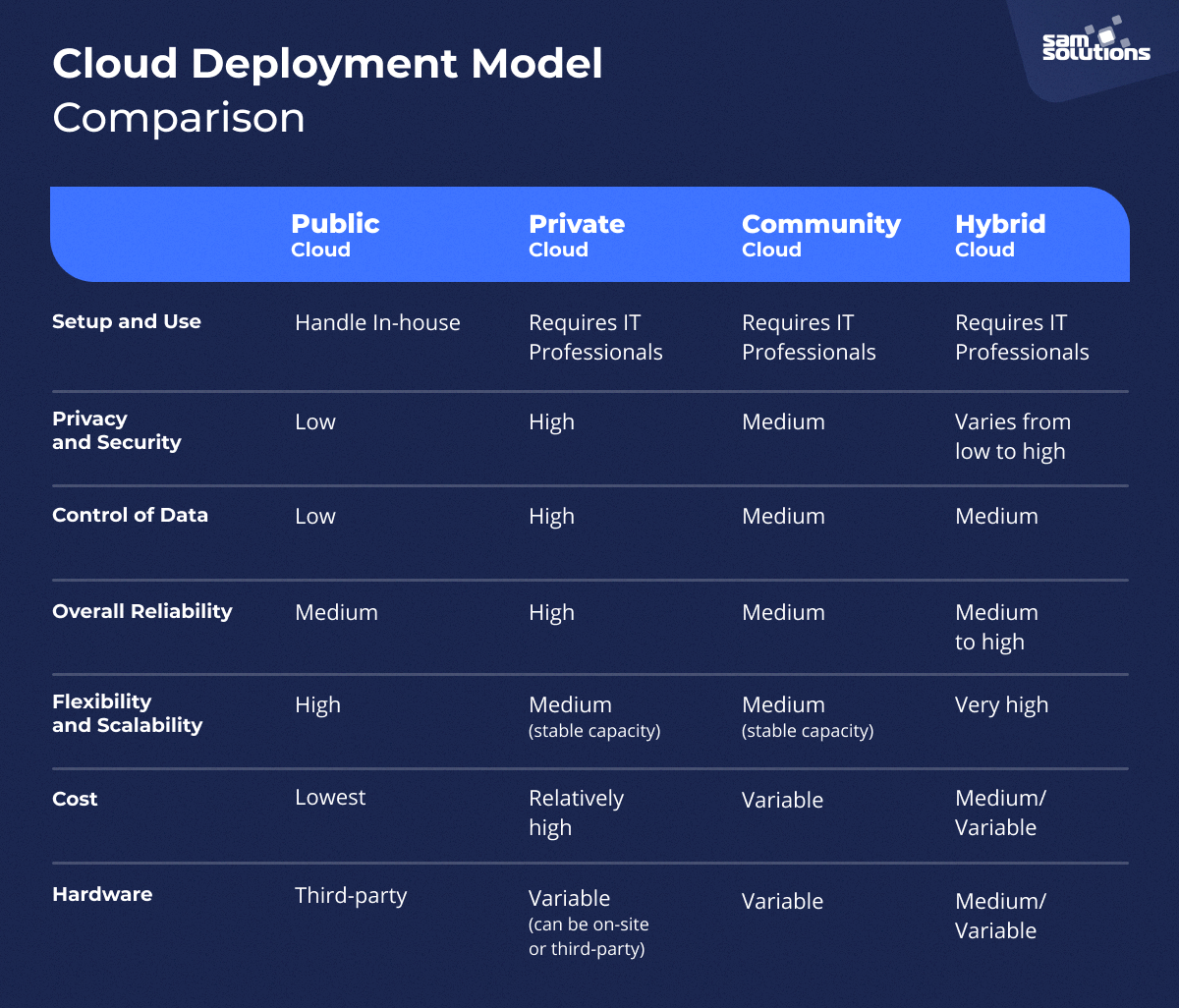
For your exams, being able to present these trade-offs in a clear, tabular format is a highly effective way to demonstrate your understanding.
The following resource provides a very detailed and formal comparison, which is excellent for building a comprehensive answer.
Guidance on the security categorization of cloud-based services
The Canadian Centre for Cyber Security provides an in-depth comparison table in its guidance on cloud services. This is a fantastic resource for understanding the nuanced differences between the models.
Please study the table in 'Annex C Summary of Considerations for Cloud Deployment Model Selection'. Focus on comparing the models across criteria like 'Upfront Investment', 'Visibility and control', 'Risks from multi-tenancy', and 'Elasticity'.
For a quicker visual summary, the following table encapsulates the key points in a more simplified format.
Application: A Business Scenario
Let's apply this framework to a typical exam-style scenario:
Scenario: A financial services startup is building a new mobile banking app. They have limited initial funding but anticipate rapid user growth if the app is successful. They must comply with strict financial regulations regarding customer data privacy. Which deployment model would you recommend and why?
Analysis & Recommendation:
- Cost: Limited funding rules out a full Private Cloud due to its high CapEx. A pay-as-you-go model is preferable.
- Scalability: The anticipation of rapid growth points towards the Public Cloud, which can scale on demand.
- Security & Compliance: Strict financial regulations require high control over sensitive customer data, which points towards a Private Cloud.
Conclusion: The best recommendation is a Hybrid Cloud.
- They can host the core banking system, transaction database, and sensitive customer data on a small, highly secure Private Cloud (or a dedicated, isolated environment that acts as one). This ensures they have maximum control and can meet regulatory compliance.
- They can run the user-facing front-end of the mobile app, marketing websites, and other less sensitive components on a Public Cloud. This gives them the cost-effectiveness (OpEx) and massive scalability needed to handle user growth without large upfront investment.
This approach balances all the competing requirements of the business scenario.
Conclusion
In this lesson, we have established a clear framework for selecting the right cloud deployment model. You are now equipped to analyze a business scenario and make a well-justified recommendation.
Key Takeaways:
- The choice of a deployment model is a strategic decision based on a trade-off between competing business, technical, and security requirements.
- Key Criteria include Cost (CapEx vs. OpEx), Security & Control, Scalability, Compliance, and available IT expertise.
- Public Cloud excels in scalability and cost-effectiveness (OpEx), making it ideal for startups and applications with variable workloads.
- Private Cloud offers maximum control and security, making it suitable for organizations with highly sensitive data and strict compliance needs.
- Hybrid Cloud provides a balanced approach, allowing organizations to combine the security of a private cloud with the scalability and low cost of a public cloud. It is often the optimal solution for established businesses.
Preview of the Next Lesson:
Having covered where cloud services are deployed, our focus will now shift to what services are offered. In the next lesson, we will begin our exploration of the three fundamental cloud service models: Infrastructure as a Service (IaaS), Platform as a Service (PaaS), and Software as a Service (SaaS). We will define each, provide examples, and begin comparing them.