Introduction
In our previous lesson, we defined and compared the four main cloud deployment models: public, private, community, and hybrid. We established that a hybrid cloud combines at least two of these environments, offering a "best of both worlds" approach.
This lesson builds directly on that foundation. We will now take a much closer look at the hybrid model, as it is one of the most common deployment strategies in large organizations. Our learning objective is to illustrate the architecture of a Hybrid Cloud with a diagram and explain a common use case like 'cloud bursting.'
Understanding hybrid architecture and its practical applications is essential for your exams, as questions often require you to go beyond simple definitions and explain how these concepts work in practice. We will focus on the components, diagrams, and specific use cases that will help you construct a detailed and high-scoring answer.
Hybrid Cloud Architecture
At its core, a hybrid cloud architecture is an IT environment that integrates an organization's on-premise data center or private cloud with one or more public cloud services. The key to a successful hybrid cloud is interoperability—the ability for these different environments to communicate and share data or workloads seamlessly.
To understand how this is constructed, let's break down the essential components.
What is Hybrid Cloud? The Ultimate Guide - TechTarget
The article 'What is Hybrid Cloud? The Ultimate Guide' from TechTarget provides an excellent breakdown of hybrid cloud architecture. It lists the fundamental building blocks required to create a functional hybrid environment.
Please read the section titled 'Hybrid cloud architecture'. Focus on the four main components it lists and the brief explanation of hybrid cloud networking and integration.
Based on the reading, a functional hybrid cloud architecture requires four main components:
- Public IaaS Platform: At least one public Infrastructure as a Service platform, such as Amazon Web Services (AWS), Microsoft Azure, or Google Cloud Platform (GCP).
- Private Resources: An organization's private computing resources, which could be a traditional on-premise data center or a fully-fledged private cloud.
- Network Connectivity: A robust and secure network connection between the private and public cloud environments. This is often a Wide Area Network (WAN) or a dedicated private connection (like AWS Direct Connect or Azure ExpressRoute) to ensure low latency and high security.
- Integrated Management Platform: A software layer or platform that allows an organization to manage, automate, and orchestrate resources across both the private and public clouds as if they were a single, unified environment.
The following image shows several possible configurations for a hybrid cloud architecture, illustrating how these components can be interconnected.

As you can see from the diagrams, there isn't one single way to build a hybrid cloud. The specific architecture depends on the organization's needs, such as whether they want to use the public cloud as a backup, for development and testing, or for handling excess traffic. This brings us to a key use case.
Use Case: Cloud Bursting
One of the most powerful and common use cases for a hybrid cloud is cloud bursting. This strategy allows an organization to handle sudden spikes in demand without the cost of permanently owning and maintaining excess hardware.
Let's begin with a clear definition and an analogy to make the concept stick.
What is cloud bursting? | Google Cloud
The Google Cloud article 'What is cloud bursting?' provides a very clear definition and a simple analogy to explain how cloud bursting works. It is an ideal resource for understanding this concept for your exams.
Read the introductory section 'What is cloud bursting?' and the following section 'How cloud bursting works'. Pay close attention to the water tank analogy and the concept of using a 'trigger' or 'threshold' to initiate the burst.
What is Cloud Bursting?
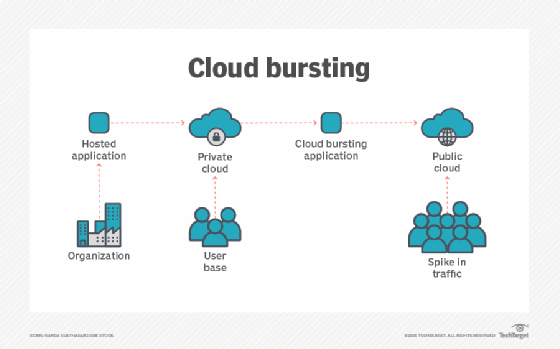
As you've read, cloud bursting is a configuration where an application runs primarily in a private cloud or on-premise data center. When demand for resources exceeds the capacity of that private environment, the application "bursts" into a public cloud, offloading the excess workload. Once the demand subsides, the public cloud resources are released.
The mechanism works as follows:
- Steady State: An application runs on the organization's private cloud, handling normal traffic levels.
- Threshold Trigger: The IT team sets a resource utilization threshold (e.g., 80% CPU usage).
- Bursting: When traffic spikes and resource usage crosses this threshold, automated policies redirect new requests or move specific workloads to the public cloud. The public cloud's elastic resources scale to handle the spike.
- Scaling Down: When the traffic spike ends and utilization on the private cloud drops below the threshold, the public cloud resources are de-provisioned, and the application returns to running solely in the private environment.
The following diagram illustrates this process perfectly.
A Practical Example
To see how these concepts fit together in a business context, the following video provides a narrative example of a fictional company adopting a hybrid cloud to solve scalability issues.
The 'Hybrid Cloud Explained' video from IBM Technology demonstrates how a company can leverage a hybrid architecture. It shows both the integration of on-premise and public cloud services and the scaling of applications to handle peak demand, which is a form of cloud bursting.
Please watch the following two segments: Connecting Environments (00:44 - 02:47): Notice how the company connects a new application in the public cloud to their existing on-premise ERP system. This demonstrates the critical 'network connectivity' and 'interoperability' part of the architecture. Handling Peak Demand (03:03 - 04:27): Observe how the company moves parts of its main application to the public cloud to handle holiday season traffic. This is a practical example of cloud bursting for scalability.
The video effectively shows how the architectural components we discussed (private resources, public cloud, network connection) enable the cloud bursting use case. The company keeps its sensitive user registry on-premise while bursting its main application to the public cloud to take advantage of its scalability.
This is the essence of hybrid cloud: using the right environment for the right job.
Conclusion
In this lesson, we dissected the hybrid cloud model, moving from a basic definition to its architectural components and a critical real-world application. This level of detail is exactly what is needed to provide comprehensive answers in your semester exams.
Key Takeaways:
- Hybrid Cloud Architecture is built on four pillars: a public cloud, private resources, robust network connectivity, and an integrated management platform.
- The goal of this architecture is interoperability, allowing workloads and data to move seamlessly between environments.
- Cloud Bursting is a primary use case where an application in a private cloud expands into a public cloud to manage temporary demand spikes.
- This strategy is highly cost-effective as it avoids over-provisioning private infrastructure, allowing an organization to pay for extra capacity only when needed.
Preview of the Next Lesson:
Now that we have explored all four deployment models and taken a deep dive into the hybrid model, a natural question arises: how does an organization choose the right model? In the next lesson, we will explain the key criteria for choosing an appropriate cloud deployment model for a given business scenario, covering factors like cost, security, scalability, and compliance.