Introduction
In our previous lesson, we introduced Function as a Service (FaaS), highlighting it as an event-driven model at the highest level of cloud service abstraction. We noted its connection to "serverless" computing and promised to explore this relationship further.
This lesson directly addresses that point, which is a common source of confusion and a frequent topic in examinations. Our learning outcome is to explain the relationship between FaaS and serverless computing. We will clarify the distinction, define how they work together, and provide visual aids and examples to solidify your understanding for the exam.
What Does "Serverless" Really Mean?
First, it is critical to correct a common misconception. The term "serverless" does not mean applications run without servers. Servers are still very much involved.
Definition: Serverless Computing is a cloud execution model where the cloud provider dynamically manages the allocation and provisioning of servers. The developer's focus is shifted entirely to writing application code, while the operational burden of managing the underlying infrastructure (servers, OS, capacity planning) is completely abstracted away.
To hear this crucial definition explained, watch the first 30 seconds of the following video.
This video from IBM Technology, titled 'What is Serverless?', begins by immediately clarifying the core meaning of the term 'serverless'.
Watch the segment from the beginning until 00:28. Pay close attention to the distinction between 'no servers' and 'not being responsible for managing servers'.
The key takeaway is that in a serverless model, you operate as if servers don't exist, even though they do.
The Relationship: FaaS is a Subset of Serverless
Now, let's establish the direct relationship between FaaS and serverless computing.
The most precise way to define the relationship is: Function as a Service (FaaS) is a core component and a subset of the serverless paradigm. Serverless is the broader architectural model, while FaaS is the primary compute service that enables it.
The following resources provide clear, exam-ready definitions that you should add to your notes.
What Is Function as a Service (FaaS)?
The article 'What Is Function as a Service (FaaS)?' from IBM directly compares the two concepts.
Read the section titled 'FaaS versus serverless'. Note its clear statement that FaaS is a subset of serverless and that serverless is a broader category including storage, databases, and more.
What is Serverless Computing? - Elastic
Similarly, the article 'What is Serverless Computing?' from Elastic provides another excellent definition of this relationship.
In the section 'Serverless vs. FaaS', observe how it reinforces that FaaS is an event-driven subset of serverless and only one of the services it provides.
This hierarchical relationship is best visualized with a diagram.
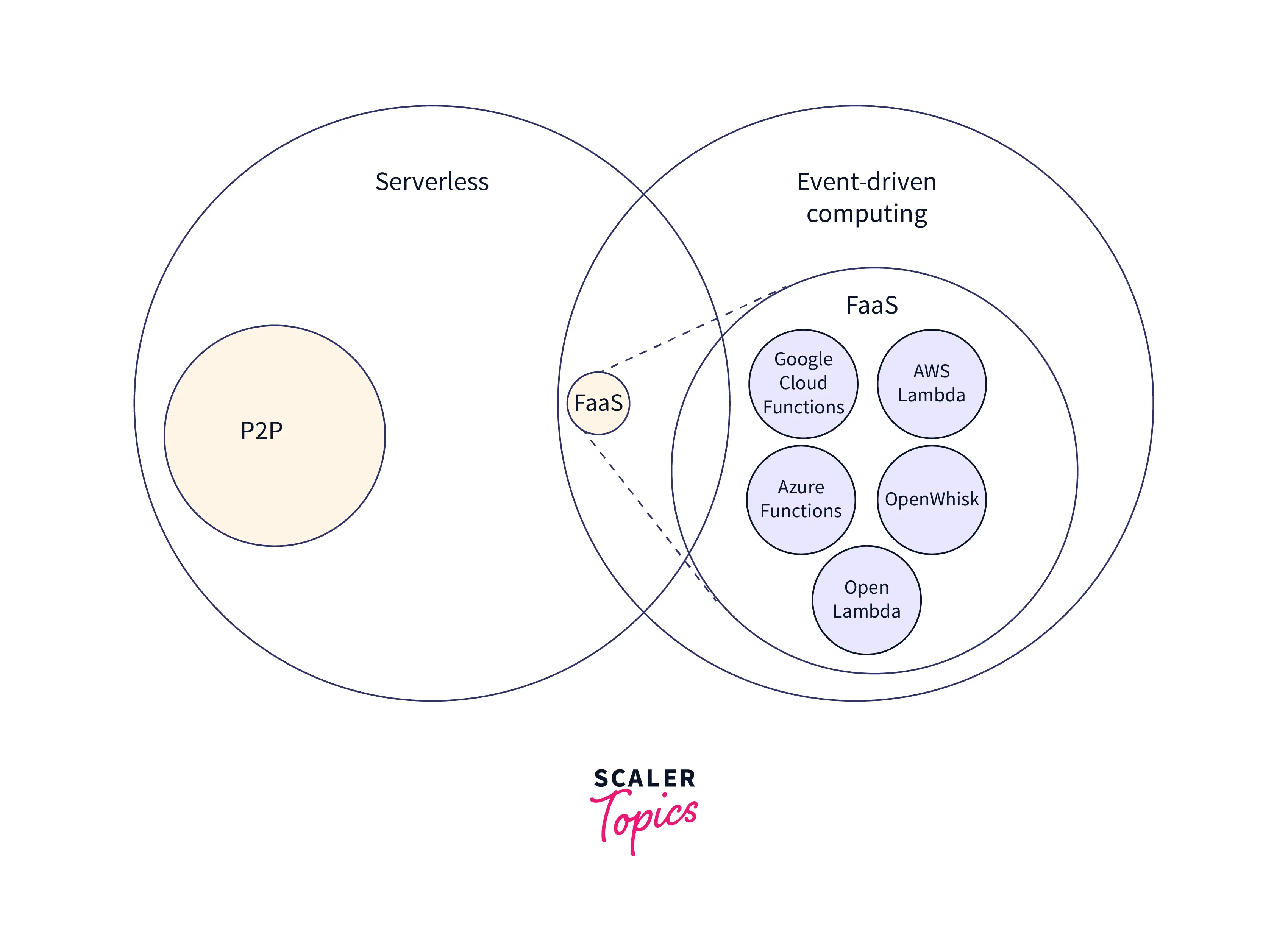
Components of a Serverless Architecture
If FaaS is just one part of serverless, what are the other parts? A complete serverless architecture typically combines FaaS with another category of services: Backend as a Service (BaaS).
- Function as a Service (FaaS): Provides the event-driven compute layer. You provide the code (the function), and the platform executes it in response to a trigger.
- Backend as a Service (BaaS): Provides pre-built, managed backend services that applications commonly need. This includes services like:
- Authentication (e.g., Auth0, Firebase Authentication)
- Cloud Storage (e.g., Amazon S3, Azure Blob Storage)
- Databases (e.g., Amazon DynamoDB, Google Firestore)
A serverless application uses BaaS for its backend logic and state management, and FaaS to run custom, event-driven business logic.
Example: An E-commerce Transaction
The resource from Elastic provides a perfect example of how FaaS and BaaS work together.
- A user browses a website and signs in. The application uses a BaaS authentication service to verify the user's identity.
- The user makes a purchase. This action creates an event.
- The event triggers a FaaS function.
- The FaaS function executes code to process the order and sends a confirmation email to the user.
In this scenario, the developer wrote the code for the FaaS function but relied on a managed BaaS service for authentication, without building it from scratch. This combination is the essence of building a serverless application.
FaaS as the Serverless "Compute Engine"
The core role of FaaS is to act as the compute engine within the serverless model. It brings the "serverless" philosophy to life for running code.
Let's watch a short segment that explains this specific role.
Returning to the 'What is Serverless?' video, this clip explains how FaaS acts as the compute platform for serverless applications.
Watch the segment from 02:33 to 03:32. Focus on how it describes FaaS as the 'compute platform for serverless' where functions are executed based on events.
As the video explains, FaaS is built on an event-driven architecture. This is the mechanism that allows for the "pay-per-execution" model. Resources are only spun up when a trigger occurs, the function runs, and then the resources are torn down. This is why FaaS is inherently efficient and scalable—characteristics that define the serverless model.
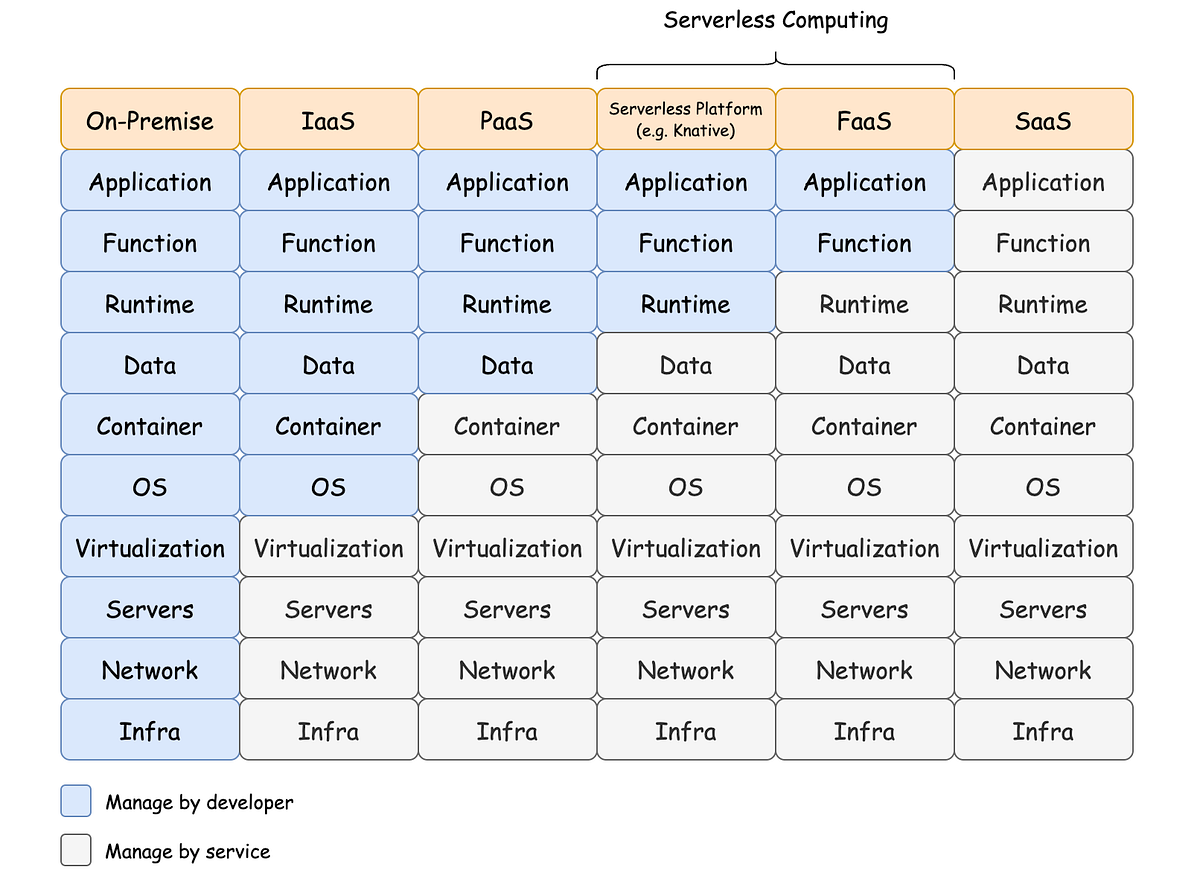
The following responsibility matrix visually confirms the high level of abstraction FaaS provides, making it a cornerstone of the serverless approach.
Summary for Exam Revision
To consolidate these concepts for your exam, here is a comparative table.
| Aspect | Serverless Computing | Function as a Service (FaaS) |
|---|---|---|
| Scope | An architectural paradigm and cloud execution model that encompasses multiple services (FaaS, BaaS). | A specific cloud service model that provides event-driven compute capabilities. It is a subset of Serverless. |
| Core Idea | To build and run applications without thinking about or managing servers. Focus is on business logic. | To run small, single-purpose pieces of code (functions) in response to events, without provisioning compute resources. |
| Components | Includes FaaS for compute, BaaS for backend services (databases, authentication), and API gateways for routing. | The function code itself, which is stateless and ephemeral. |
| Analogy | A fully catered event. You decide the menu (application logic), but the caterer handles the kitchen, staff, and cleanup. | The microwave oven in the catered kitchen. It's a specific appliance used to perform a task (run code) only when needed. |
| Example Services | An architecture using AWS Lambda (FaaS) + Amazon S3 (BaaS) + API Gateway. | AWS Lambda, Azure Functions, Google Cloud Functions. |
Conclusion
In this lesson, we have clarified the crucial relationship between FaaS and serverless computing. This distinction is vital for a strong conceptual understanding of modern cloud architectures and for providing precise answers in your exams.
Key Takeaways:
- Serverless is a broad architectural model where the cloud provider manages all server infrastructure, allowing developers to focus solely on code.
- FaaS is a specific service and a core component of the serverless model. It provides the event-driven compute engine that executes code on demand.
- A complete serverless architecture typically combines FaaS for custom logic with BaaS (Backend as a Service) for common functionalities like databases and authentication.
- You can think of it this way: All FaaS is serverless, but not all of serverless is FaaS.
Preview of the Next Lesson:
A key benefit of serverless FaaS is its ability to scale automatically and instantly to meet demand. This concept of scaling is fundamental to cloud computing in general. In our next lesson, we will begin exploring this topic in detail, starting with the two primary methods of scaling resources. We will define vertical scaling (scaling up) and horizontal scaling (scaling out), using diagrams to illustrate how each method works.