Introduction
Welcome to our next lesson. In our previous session, we concluded by noting that a key benefit of cloud services like FaaS is their ability to scale automatically. This concept of scaling—adjusting capacity to meet demand—is fundamental to cloud computing. This lesson will focus on the two primary methods for achieving this, which is a core topic in your syllabus under "Vertical and Horizontal scaling in cloud".
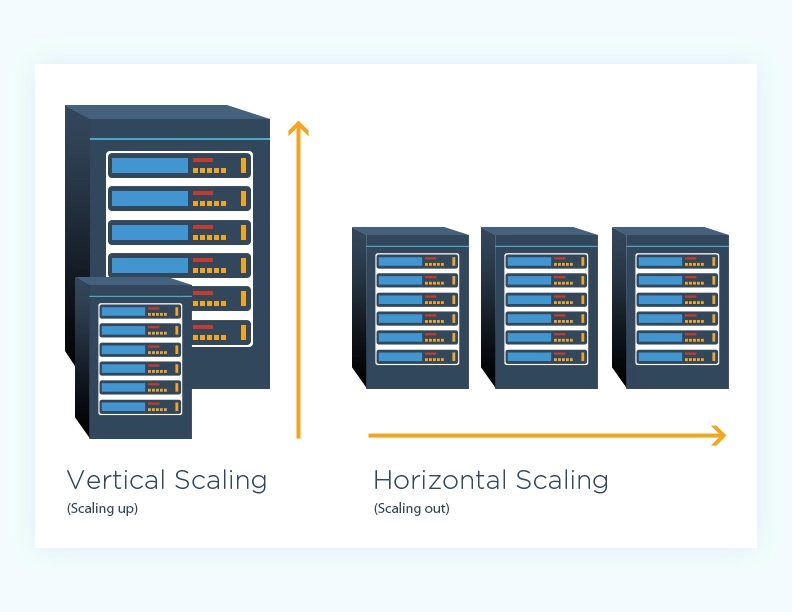
Today's learning outcome is to define vertical scaling (scaling up) and horizontal scaling (scaling out) using diagrams to illustrate each method. Mastering these definitions is crucial, as they form the basis for understanding cloud architecture, performance management, and cost optimization, making them a frequent subject of exam questions.
The Need for Scaling
Before we dive into the methods, let's quickly recap why scaling is so important. Applications can experience dramatic fluctuations in traffic. An application might go from a few users to thousands in minutes due to a viral social media post or a marketing campaign. Without a strategy to handle this increased load, the application would slow down or crash, leading to a poor user experience. Cloud computing provides the tools to manage this dynamically.
To get a brief overview of this problem, please watch the following video segment.
Cloud Computing Explained: The Most Important Concepts To Know
The video 'Cloud Computing Explained' by Be A Better Dev provides an excellent introduction to why application scaling is a central concept in the cloud.
Watch the segment from 00:18 to 01:29. Focus on understanding the problem that scaling solves: handling rapid increases in application traffic.
As the video explains, the two main approaches to solving this problem are vertical scaling and horizontal scaling. Let's define each one.
Vertical Scaling (Scaling Up)
The first and more traditional approach is vertical scaling.
Definition: Vertical scaling, also known as scaling up, is the process of increasing the capacity of a single server or virtual machine by adding more resources to it. This means enhancing its existing hardware or virtual hardware components, such as the CPU, RAM, or storage.
A simple analogy is upgrading your personal computer: if it runs slow, you might add more RAM or install a faster processor. You are making a single machine more powerful.
The following video segment explains this concept and its inherent limitations.
Cloud Computing Explained: The Most Important Concepts To Know
Continuing with the same video, this next part defines vertical scaling and discusses its main drawbacks, particularly regarding cost and reliability.
Watch from 01:29 to 03:47. Pay close attention to the definition of vertical scaling and the explanation of its two main problems: diminishing cost returns and having a single point of failure.
Horizontal Scaling (Scaling Out)
The second approach, which is more aligned with the modern cloud-native philosophy, is horizontal scaling.
Definition: Horizontal scaling, also known as scaling out, is the process of increasing capacity by adding more machines (servers or virtual machines) to your resource pool. The workload is then distributed across this larger number of individual units.
To use an analogy, instead of upgrading a single delivery truck to be bigger and faster (vertical scaling), you add more trucks to your fleet (horizontal scaling).
Let's see how this approach addresses the limitations of scaling up.
Cloud Computing Explained: The Most Important Concepts To Know
This final segment from the video explains how horizontal scaling works by cloning an application across multiple, often smaller, machines.
Watch from 03:47 to 05:22. Focus on how this model improves stability (fault tolerance) and cost-effectiveness compared to vertical scaling.
Illustrating the Concepts
A diagram is the best way to visualize the difference between these two strategies. This is a common requirement in exams.
Formal Definitions and Characteristics for Your Exam Notes
Having grasped the concepts visually and through analogy, it's important to have formal, structured definitions, along with their advantages and disadvantages, ready for your exams. The following resource provides this information in a clear, point-by-point format.
Horizontal and Vertical Scaling | System Design - GeeksforGeeks
The article 'Horizontal and Vertical Scaling' from GeeksforGeeks is an excellent resource for exam preparation. It provides concise definitions and bulleted lists of pros and cons for both scaling methods.
Please read the sections titled 'Vertical Scaling' and 'Horizontal Scaling'. For each, study the definition, the examples, and the 'Advantages' and 'Disadvantages' lists. This format is ideal for structuring exam answers.
Conclusion
In this lesson, we have defined the two fundamental methods of scaling in cloud computing, directly addressing a key part of your syllabus. Understanding this distinction is essential for any further study of cloud architecture.
Key Takeaways:
- Vertical Scaling (Scaling Up): Involves making a single machine more powerful by adding resources like CPU and RAM. It is simpler to implement but has a hard scalability limit, can be expensive, and represents a single point of failure.
- Horizontal Scaling (Scaling Out): Involves adding more machines to a system and distributing the load among them. This method is highly scalable, more fault-tolerant, and often more cost-effective at scale, but it increases architectural complexity.
- The Analogy: Scaling up is like upgrading your car's engine; scaling out is like adding more cars to your fleet.
Preview of the Next Lesson:
Now that we have defined vertical and horizontal scaling, the next logical step is to compare them directly. In our next lesson, we will focus on the next learning outcome: Compare vertical and horizontal scaling in a tabular format, covering their respective advantages, limitations, and suitable scenarios. This will help you formulate detailed comparative answers for your exam.