Introduction
Welcome to the final lesson of this course module. In our last session, we distinguished between monitoring, observability, and alerting—the key practices for maintaining the operational health of your cloud infrastructure. We learned how to track what is happening, why it's happening, and how to respond.
Now, we shift our focus from operational health to financial health. The cloud's pay-as-you-go model offers incredible flexibility, but it also introduces complexity in managing costs. Without a proper strategy, expenses can quickly spiral out of control. This is where the discipline of FinOps comes in.
This lesson will address the learning outcome: Define FinOps and explain its role in managing cloud costs. We will explore what FinOps is, why it's essential in a cloud-first world, and how it differs from traditional financial management.
1. What is FinOps? A New Model for a New Era
In a traditional IT environment, finance teams would approve large, upfront capital expenditures (CapEx) for servers and infrastructure in a slow, predictable cycle. The cloud changes everything by turning these into variable, operational expenditures (OpEx). An engineer can now provision thousands of dollars worth of resources in minutes. This requires a new approach to financial governance.
Let's start with a foundational video that defines FinOps and contrasts it with this traditional model.
What is FinOps and 3 reasons why you should care about it
This video from Google Cloud Tech provides a clear, concise definition of FinOps and explains why the shift to cloud computing made it necessary.
Please watch from 01:07 to 02:23. Pay close attention to the definition provided and how it emphasizes FinOps as both an operational framework and a cultural shift.
As the video highlights, the core idea is to manage cloud costs in a decentralized way where everyone takes responsibility for their usage, guided by a central team.
For your exam, having a precise, standard definition is crucial. The FinOps Foundation, a non-profit trade association focused on this practice, provides the most widely accepted definition.
6 FinOps principles for cloud cost optimization (2026)
The article '6 FinOps principles for cloud cost optimization' from Flexera provides the official definition from the FinOps Foundation. This is the definition you should memorize for your exam.
Read the section titled 'What is FinOps?'. Focus on the block-quoted definition provided by the FinOps Foundation.
To summarize and formalize this key definition:
FinOps is an operational framework and cultural practice which maximizes the business value of the cloud, enables timely data-driven decision-making, and creates financial accountability through collaboration between engineering, finance, and business teams.
The key takeaway is that FinOps is not just a tool or a team; it's a cultural shift that brings different parts of an organization together to manage cloud spending collaboratively.
2. The Role of FinOps: Beyond Traditional Cost Management
To fully understand the role of FinOps, it's essential to contrast it with the methods used for on-premise infrastructure. Traditional IT financial management was built for a world of fixed assets and predictable, periodic budget cycles. FinOps is designed for the dynamic, elastic, and variable nature of the cloud.
The following resource provides an excellent tabular comparison, which is a perfect format for an exam answer.
What is FinOps? | Glossary | HPE Canada
The article 'What is FinOps?' by HPE has a section that directly compares FinOps with traditional IT financial management across several key aspects.
Please read the section 'How does FinOps differ from traditional IT financial management?' and study the comparison table carefully. This table is a powerful tool for revision.
Let's consolidate the most important differences from that table:
| Aspect | Traditional IT Financial Management | FinOps |
|---|---|---|
| Cost Model | CapEx-focused: Upfront investment in hardware. | OpEx-focused: Pay-as-you-go model tied to real-time usage. |
| Collaboration | Siloed: Finance, IT, and business teams work separately. | Cross-functional: Shared accountability and collaboration. |
| Resource Model | Manages fixed, static assets with predictable costs. | Manages elastic, scalable resources with variable costs. |
| Optimization | Periodic: Budget reviews happen quarterly or annually. | Continuous: Monitoring and optimization happen in real-time. |
| Decision-Making | Static: Decisions made months in advance. | Data-driven & Dynamic: Decisions made based on live data. |
| Business Alignment | IT is treated as a cost center to be contained. | Spending is aligned with business goals to maximize ROI and value. |
This comparison clearly illustrates the role of FinOps: it provides a new operating model that allows organizations to control cloud costs, improve efficiency, and make agile financial decisions in a way that traditional methods cannot support.
3. The Framework and Principles of FinOps
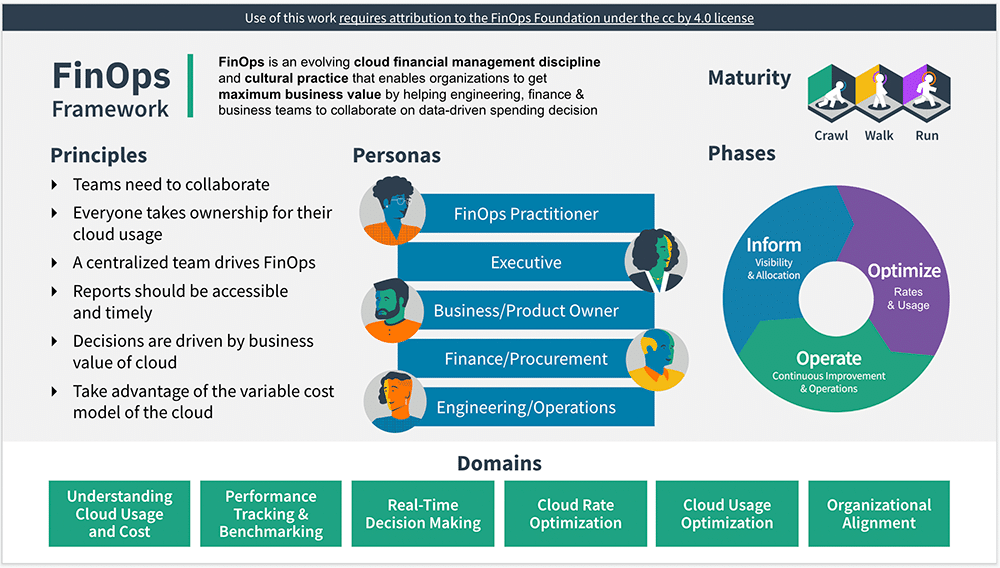
FinOps is not an ad-hoc process; it is guided by a structured framework developed by the FinOps Foundation. This framework consists of principles, personas (the people involved), phases, and domains.
This diagram provides a complete overview of the FinOps Framework. Understanding its components is key to explaining how FinOps is implemented.
The Three Phases of FinOps
The FinOps lifecycle is an iterative process divided into three phases: Inform, Optimize, and Operate.

- Inform: This is the foundation. It's about gaining visibility into cloud spending. You can't manage what you can't see. This involves allocating costs to the correct teams, setting budgets, and benchmarking performance.
- Optimize: Once you have visibility, you can take action. This phase focuses on finding savings by eliminating waste, "rightsizing" underutilized resources, and taking advantage of cloud provider discounts.
- Operate: This phase is about operationalizing the first two phases. Teams continuously evaluate business objectives against their cloud spending. It involves defining governance policies and automating processes to ensure continuous improvement.
The Six Principles of FinOps
The entire framework is guided by a set of core principles. These principles define the "culture" of FinOps and are essential to remember.
6 FinOps principles for cloud cost optimization (2026)
To understand the guiding philosophy of FinOps, let's review its six core principles as detailed in the Flexera article.
Read the section 'The 6 FinOps Principles' and the following detailed explanations for each. Focus on understanding the core idea behind each principle.
Let's summarize these six principles for your notes:
- Teams Need to Collaborate: FinOps breaks down silos between finance, engineering, and business teams to make shared, data-driven decisions about cloud spending.
- Decisions are Driven by the Business Value of Cloud: The goal isn't just to cut costs, but to maximize the value derived from cloud spending. Cost is evaluated in the context of business outcomes (e.g., cost per user, cost per transaction).
- Everyone Takes Ownership of Their Cloud Usage: The teams that provision resources are responsible for the associated costs. This creates direct accountability.
- FinOps Data Should Be Accessible and Timely: Real-time, granular cost data must be available to all stakeholders to enable immediate and informed decision-making.
- A Centralized Team Drives FinOps: A dedicated FinOps team acts as a center of excellence, providing best practices, negotiating provider discounts, and enabling other teams to manage their own costs effectively.
- Take Advantage of the Variable Cost Model of the Cloud: Instead of large upfront purchases, FinOps leverages the cloud's elasticity to match capacity to demand, optimizing costs through rightsizing and using different pricing models.
Conclusion
In this lesson, we have defined FinOps and detailed its critical role in modern cloud management. As organizations increasingly rely on the cloud, managing its variable costs has become a top priority, making FinOps an essential discipline.
Key Takeaways:
- Definition: FinOps is a cultural practice and operational framework that brings finance, tech, and business teams together to manage cloud spending with shared accountability.
- Role: Its role is to enable organizations to maximize business value from the cloud by providing real-time visibility, facilitating continuous optimization, and aligning spending with business goals.
- Contrast with Tradition: Unlike traditional IT finance, which is slow and CapEx-focused, FinOps is dynamic, data-driven, and designed for the cloud's OpEx model.
- Core Components: The practice is structured around an iterative lifecycle (Inform, Optimize, Operate) and is guided by six core principles, including collaboration, ownership, and value-driven decisions.
Preview of the Next Lesson:
One of the key principles of FinOps is to take advantage of the cloud's variable cost model. To do this effectively, you must understand the different pricing options available. In our next lesson, we will begin the final module by exploring exactly that, addressing the learning outcome: Compare cloud pricing models: on-demand, reserved instances, and spot instances, explaining the ideal use case for each.