Introduction
In our last lesson, we delved into the "trap-and-emulate" model for I/O, uncovering how KVM and QEMU work together to simulate hardware for a guest VM. We concluded that while this full emulation is incredibly flexible, it's also inefficient. The path for a single I/O operation involves a costly series of transitions: from guest to host kernel (KVM), then to host userspace (QEMU), and back again, creating a significant performance bottleneck for I/O-intensive workloads.
This lesson introduces the solution to that problem: paravirtualization. Our learning goal is to describe paravirtualization and how the virtio framework provides efficient I/O between guest and host. Instead of tricking the guest into thinking it has real hardware, we'll give it a special virtual device and a driver that knows how to communicate with the hypervisor directly and efficiently.
By the end of this lesson, you will understand:
- The core concept of paravirtualization versus full emulation.
- The architecture of VirtIO as a standardized framework for paravirtualized devices.
- The structure and operation of a
virtqueue, the heart of VirtIO communication. - The data path for a "pure" VirtIO device and the performance bottlenecks that still remain.
1. The Paravirtualization Principle
The fundamental inefficiency of full emulation is that the guest OS and its standard drivers operate under the false assumption that they are interacting with physical hardware. This leads to chatty, register-level interactions that each cause a VM exit.
Paravirtualization (PV) takes a different approach. The guest OS is made aware that it is running in a virtual environment. It uses special "PV drivers" that, instead of mimicking low-level hardware communication, use a more efficient, high-level protocol to talk directly to the hypervisor.
Virtio and Vhost Architecture - Part 1
The article 'Virtio and Vhost Architecture - Part 1' provides a great introduction to this concept, contrasting the many hardware traps of full virtualization with the single, efficient hypercall of paravirtualization.
Please read the initial section, 'Virtio (Virtual I/O)'. Pay close attention to the diagram comparing the full vs. para-virtualized flow and the illustrative code snippets that contrast the 'many traps' of an emulated device with the 'one trap' of a paravirtualized one.
As the article illustrates, instead of the guest driver poking at emulated hardware registers one byte at a time, a PV driver can batch an entire I/O request and send it to the hypervisor in a single, optimized operation. This dramatically reduces the number of expensive VM exits.
2. VirtIO: A Standard for Paravirtualization
Early paravirtualization efforts were hypervisor-specific (e.g., Xen's PV drivers, VMware's VMI). This meant a guest OS needed different PV drivers for each hypervisor. VirtIO was created to solve this by providing an open, standardized framework for I/O paravirtualization. A guest OS with VirtIO drivers can run efficiently on any hypervisor that implements the VirtIO backend, such as KVM/QEMU, Xen, or Hyper-V.
The VirtIO specification is built on a few key design principles.
VirtIO 1.0: A Standard Emerges [linux.conf.au 2014]
This presentation by Rusty Russell, one of the original authors of VirtIO, gives an excellent overview of the motivation and design goals behind the standard. It provides valuable context on why VirtIO is designed the way it is.
Please watch from 01:04 to 08:00. Focus on the four main design goals discussed: Straightforward: How VirtIO leverages existing, well-understood bus types like PCI. Efficient: The emphasis on batching operations and suppressing notifications to minimize VM exits. Standard: The use of a common communication mechanism for all device types. Extensible: The feature negotiation mechanism that allows for forward and backward compatibility.
These principles make VirtIO a robust and performant choice. By presenting itself as a standard PCI device, it integrates cleanly into the guest OS, while its internal mechanisms are highly optimized for a virtual environment.
3. The Heart of VirtIO: Virtqueues
The "standard and efficient" communication mechanism mentioned in the video is the virtqueue. This is the core data structure that enables high-speed data transfer between the guest driver (the "frontend") and the hypervisor device implementation (the "backend").
A virtqueue is a set of shared memory ring buffers that allows the guest and host to exchange I/O requests and data without incurring a VM exit for every single buffer.
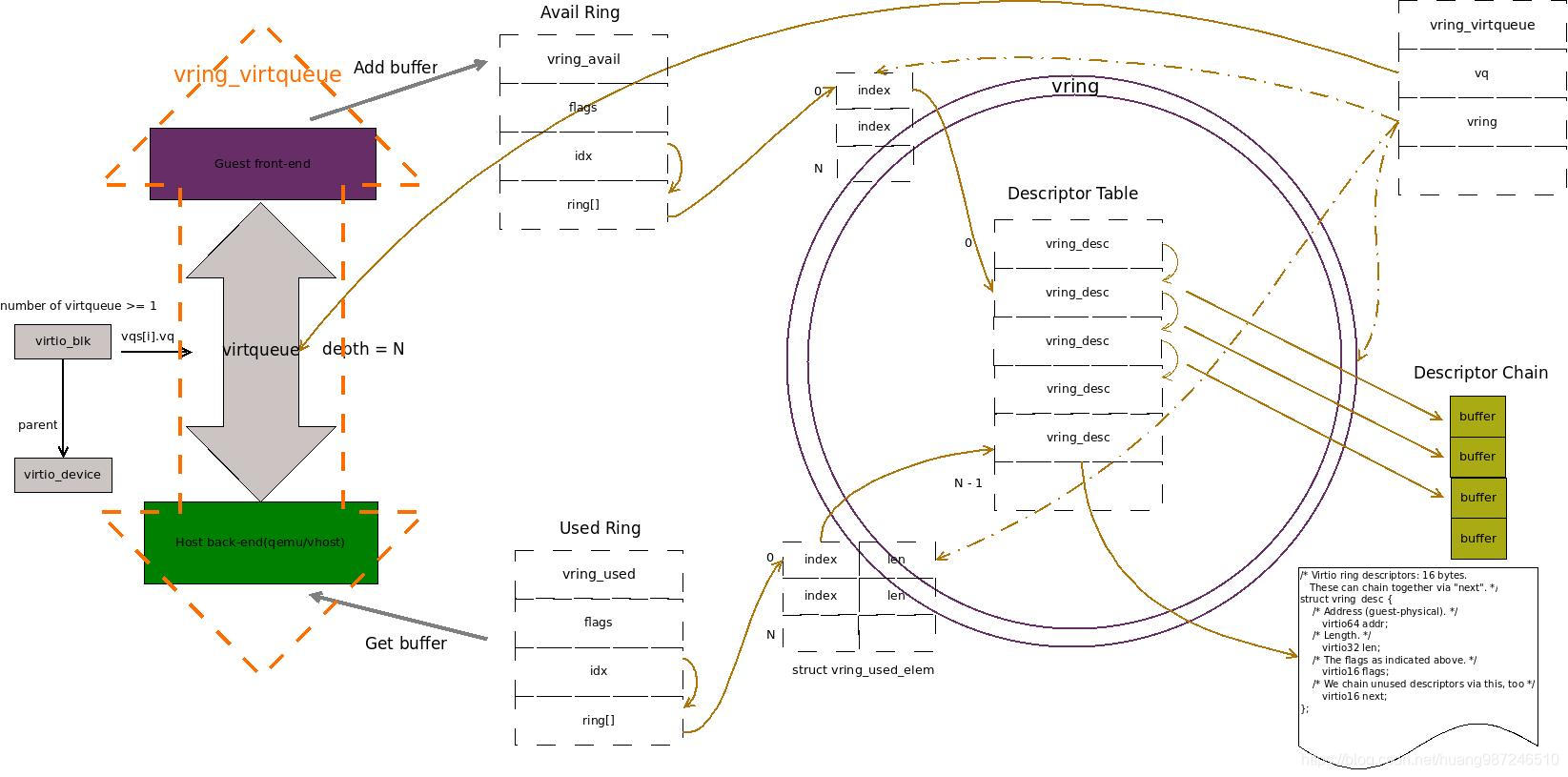
Let's break down these components, as understanding them is crucial for deep kernel work:
- Descriptor Table: An array of descriptors. Each descriptor points to a data buffer in guest memory. Multiple descriptors can be chained together to support scatter-gather I/O, which is essential for networking and storage, allowing the kernel to handle data that isn't in a single contiguous block of memory.
- Available Ring: This ring is used by the guest driver to offer buffers to the host backend. The driver places the index of the first descriptor in a chain into this ring.
- Used Ring: This ring is used by the host backend to return buffers to the guest driver after it has finished processing them (e.g., after data has been read from a disk into the buffer, or transmitted from the buffer to the network).
The general flow for a guest sending data to the host (e.g., transmitting a network packet) is:
- The guest's virtio driver places the address and length of the packet buffers into one or more descriptors in the Descriptor Table.
- The driver places the index of the head descriptor onto the Available Ring.
- The driver notifies the host with a single, lightweight "kick." This is typically done by writing to a specific MMIO register, which is configured to cause a VM exit.
- The host backend (in QEMU) wakes up, sees the new entry in the Available Ring, and processes the descriptors. It reads the packet data directly from the guest's memory.
- Once the host has processed the buffer (e.g., the packet is sent), it places an entry in the Used Ring.
- The host sends a single interrupt to the guest to notify it that used buffers are available. The guest can then reclaim and reuse these buffers.
This batching mechanism is the key to VirtIO's efficiency. The guest can queue up hundreds of I/O requests and notify the host with a single kick, and the host can process them all and notify the guest with a single interrupt.
4. The "Pure VirtIO" Data Path
Now, let's trace the full data path in a standard KVM/QEMU setup, often called "pure VirtIO" or "VMM-terminated VirtIO". In this model, the backend device logic resides entirely within the QEMU userspace process. While this is a huge improvement over full emulation, it is not without its own overhead.
Introduction to VirtIO, Part 2: Vhost
The article 'Introduction to VirtIO, Part 2: Vhost' provides an exceptionally clear analysis of the pure VirtIO data path and its associated overheads. We will use it to understand exactly where the remaining bottlenecks lie.
Read the sections titled 'Limitations of Pure VirtIO' and 'What is Vhost?'. Pay close attention to: Figure 2 and the accompanying step-by-step walkthrough of the Transmit (Tx) and Receive (Rx) paths. Identify where VM exits and, crucially, where host context switches (kernel-to-userspace) occur in the process. Figure 3, which presents an approximate equation for the overhead. Note the terms for Context_Switch and Qemu_Processing.
As the article details, the path for transmitting a single packet still involves significant steps:
- Guest driver adds a buffer to the virtqueue and kicks the host.
- VM Exit: KVM intercepts the kick.
- Context Switch: KVM wakes up the QEMU process to handle the I/O.
- QEMU (in userspace) accesses the shared virtqueue, reads the packet data from guest memory.
- QEMU makes a
write()syscall to send the packet to the host's network stack (e.g., a TAP device). This involves a ring transition into the host kernel. - The host kernel processes the packet and sends it.
- Eventually, QEMU calls
KVM_RUNto resume the guest, involving another context switch back to the kernel and a VM Entry into the guest.
The critical bottleneck here is the context switch between the host kernel and the QEMU userspace process. Even though we've batched the guest-to-host notifications, the data plane itself still has to cross the kernel/userspace boundary on the host, which is an expensive operation.
Interview Scenario
Interviewer: "You've diagnosed that an I/O-heavy VM is suffering from poor performance due to excessive VM exits in a full emulation setup (e.g., using an emulated e1000 NIC). You decide to switch the VM's network card to virtio-net. Describe the architectural changes and explain why this improves performance, and what performance bottleneck might still remain."
To answer this, you would integrate the concepts we've covered:
- Architectural Change: You would explain that you're replacing the guest's standard
e1000driver with the paravirtualizedvirtio-netfrontend driver. The QEMU backend is no longer emulating every register of a physicale1000but is now implementing the simpler, standardizedvirtio-netdevice specification. - Performance Improvement: The key improvement is the move from a chatty "trap-and-emulate" model to an efficient batching model. Instead of trapping every MMIO register access (many VM exits), the
virtio-netdriver places many packet buffers into avirtqueueand notifies the host with a single "kick" (one VM exit). This dramatically reduces virtualization overhead. - Remaining Bottleneck: You would then demonstrate deeper knowledge by pointing out that in the standard "pure VirtIO" implementation, the data path still flows through the QEMU userspace process. This means for every batch of I/O, the host must perform a context switch from the kernel (KVM) to userspace (QEMU) and back. This context switch is the primary remaining bottleneck that
virtioalone does not solve.
Conclusion
In this lesson, we bridged the gap between the slow, fully emulated I/O of our last lesson and the world of high-performance virtual I/O.
Key Takeaways:
- Paravirtualization (PV) makes the guest OS "virtualization-aware," allowing it to use efficient, high-level communication protocols with the hypervisor instead of emulating slow hardware interactions.
- VirtIO is the open standard for paravirtualized devices, ensuring compatibility across different hypervisors.
- Virtqueues are the core of VirtIO. These shared memory ring buffers allow the guest and host to exchange large batches of I/O requests with minimal VM exits.
- The "pure VirtIO" model, while far superior to full emulation, still has a performance bottleneck because the data path must cross the host's kernel-userspace boundary to be handled by QEMU.
Preview of the Next Lesson:
Theory is essential, but seeing is believing. In our next lesson, we will get practical. You will set up a KVM-based VM using QEMU and use kernel tracing tools to observe VM exits. This will allow you to see the phenomena we've discussed—like I/O-induced exits—on a live system, giving you the hands-on experience needed to analyze and debug virtualization performance issues. We will also touch on more advanced optimizations like vhost, which directly address the QEMU userspace bottleneck we identified today.