Introduction
In our previous lesson, we explored seccomp-bpf, a powerful proactive security mechanism designed to prevent vulnerabilities by restricting a process's access to system calls. We saw how creating a tight "allow-list" of syscalls can significantly reduce the kernel's attack surface.
Today, we shift our perspective from prevention to analysis. We will investigate what happens when preventative measures are bypassed or when a vulnerability exists in a permitted code path. This lesson directly addresses the learning outcome: Analyze a kernel privilege escalation CVE, explaining the vulnerability and how specific security mechanisms could mitigate it.
To achieve this, we will perform a deep-dive analysis of two famous, real-world Linux kernel privilege escalation vulnerabilities (CVEs). By dissecting these exploits, you will learn to:
- Identify the root cause of different classes of vulnerabilities (memory corruption vs. logic bugs).
- Understand the sophisticated techniques attackers use to gain control, including heap spraying and bypassing modern security mitigations.
- Recognize how kernel hardening features like KASLR, SMEP/SMAP, and others act as roadblocks to exploitation.
This analysis is critical for developing the deep, adversarial mindset required for both advanced kernel development and succeeding in top-tier technical interviews.
1. Case Study 1: The Complex Dance of CVE-2019-18683
Our first case is a fascinating and intricate exploit in the V4L2 (Video4Linux2) subsystem. It's a perfect example of a memory corruption vulnerability—specifically, a use-after-free caused by a race condition. The exploit involves a multi-stage process to bypass several of the kernel's key security defenses.
The researcher who discovered and exploited this vulnerability, Alexander Popov, gave an excellent talk detailing his entire process. We will use his presentation and a related blog post as our primary guides.
The Vulnerability: A Race to Corrupt Memory
The bug resided in the vivid driver, a software-emulated video device. The core issue was incorrect mutex locking. When stopping a video stream, the code would momentarily unlock a mutex, intending for a kernel thread to acquire it and terminate cleanly. However, this created a race window where another user-space thread could win the race, acquire the lock, and modify a buffer queue when the driver didn't expect it. This led to the driver holding a stale pointer to a buffer that had already been freed by the V4L2 core—a classic use-after-free (UAF) setup.
Let's hear the discoverer explain the bug and the timeline.
OffensiveCon20 - Alexander Popov - Exploiting a Linux Kernel Vulnerability in the V4L2 Subsystem
In this first segment of 'Exploiting a Linux Kernel Vulnerability in the V4L2 Subsystem', Alexander Popov introduces the vulnerability (CVE-2019-18683), its type, and the affected driver.
Watch from 01:02 to 09:28. Focus on: The nature of the bug: a race condition leading to a use-after-free. The context: the vivid driver in the V4L2 subsystem. The flawed logic: unlocking a mutex during a kthread stop operation. The correct fix: using mutex_trylock() to avoid the deadlock without creating a race.
The Exploit: A Multi-Stage Attack
Triggering the use-after-free is just the first step. To turn it into a privilege escalation, a sophisticated chain of techniques is required.
-
Heap Spraying & Object Control: After freeing the target object (
vb2_buffer), the attacker needs to reclaim that memory location with a controlled payload. This is done using a technique called "heap spraying." The exploit uses thesetxattrsystem call in combination withuserfaultfd.setxattrallocates kernel memory for the attribute data, anduserfaultfdallows a user-space process to pause the kernel's attempt to copy data, effectively "freezing" the controlled allocation on the kernel heap. By launching many such threads, the exploit sprays the heap, significantly increasing the chance of overwriting the freedvb2_bufferobject. -
Control-Flow Hijack: The overwritten
vb2_buffercontains crafted pointers. The goal is to make the kernel execute code at an attacker-controlled address. The exploit targets a function pointervaddrwithin thevb2_mem_opsstructure, which can be reached via pointers in the fakevb2_bufferobject. -
Bypassing KASLR, SMEP, and SMAP: This is where the exploit gets truly clever.
- The Problem: The exploit code runs in a kernel thread context where user-space memory isn't mapped. This means mitigations like SMEP (Supervisor Mode Execution Prevention) and SMAP (Supervisor Mode Access Prevention) would normally stop the kernel from executing user-space code or accessing user-space data. The exploit payload must reside in kernel memory.
- KASLR Bypass: Kernel Address Space Layout Randomization (KASLR) means the location of kernel memory is unknown. The exploit finds a V4L2 warning message that gets printed to the kernel log (
/dev/kmsg) before the crash. This log, accessible to regular users on some systems, contains register dumps, including the stack pointer (RSP) and a pointer into the kernel's code segment (R11). By parsing this, the exploit calculates the kernel stack location and the KASLR offset. - SMEP/SMAP Bypass: With the kernel stack address known, the exploit uses the
adjtimexsyscall (again withuserfaultfd) to place a second payload, including a ROP/JOP chain, onto the kernel stack at a predictable future location. The first payload on the heap then points to this second payload on the stack. When thevaddrfunction pointer is called, it pivots the stack to the attacker's ROP chain on the kernel stack, achieving code execution while respecting SMEP/SMAP.
Let's watch the segments covering these exploitation steps.
OffensiveCon20 - Alexander Popov - Exploiting a Linux Kernel Vulnerability in the V4L2 Subsystem
These segments detail the advanced techniques used to achieve privilege escalation.
Watch from 09:28 to 20:39. Pay close attention to: 09:28 - 14:29: How setxattr and userfaultfd are used for heap spraying to overwrite the freed object. 14:29 - 20:39: The strategy for hijacking control flow via the vaddr function pointer and, crucially, how the kernel log info leak is used to defeat KASLR and place the final payload on the kernel stack to bypass SMEP/SMAP.
This vulnerability is a masterclass in modern kernel exploitation. You can also review these steps in the detailed write-up provided by the author.
CVE-2019-18683: Exploiting a Linux kernel vulnerability in the V4L2 ...
This blog post, 'CVE-2019-18683: Exploiting a Linux kernel vulnerability...', is the official text write-up from Alexander Popov. It serves as an excellent reference to solidify the concepts from the video.
Skim through these sections to reinforce your understanding. Focus on the diagrams and code snippets in the sections titled 'Heap spraying', 'Control flow hijack...', 'Unexpected troubles: kthread context', 'Insight...', 'Anatomy of the exploit payload', and 'ROP'n'JOP'.
Mitigation Strategies
How could this have been prevented? The exploit relied on several system features and weaknesses.
OffensiveCon20 - Alexander Popov - Exploiting a Linux Kernel Vulnerability in the V4L2 Subsystem
In this final segment, Popov discusses kernel hardening features that would mitigate or completely block his exploit.
Watch from 29:46 to 36:08. Take note of each mitigation and how it would have disrupted the exploit chain: unprivileged_userfaultfd restriction dmesg_restrict PAX_RANDKSTACK (Kernel Stack Randomization) ARM Memory Tagging Extension (MTE)
Each of these mitigations targets a specific link in the exploit chain. Disabling unprivileged userfaultfd would break both the heap and stack spraying. Restricting dmesg access would block the KASLR leak. Randomizing the kernel stack on each syscall would make it impossible to predict where to place the stack payload. This demonstrates the "defense-in-depth" principle.
2. Case Study 2: The Deceptively Simple "Dirty Pipe" (CVE-2022-0847)
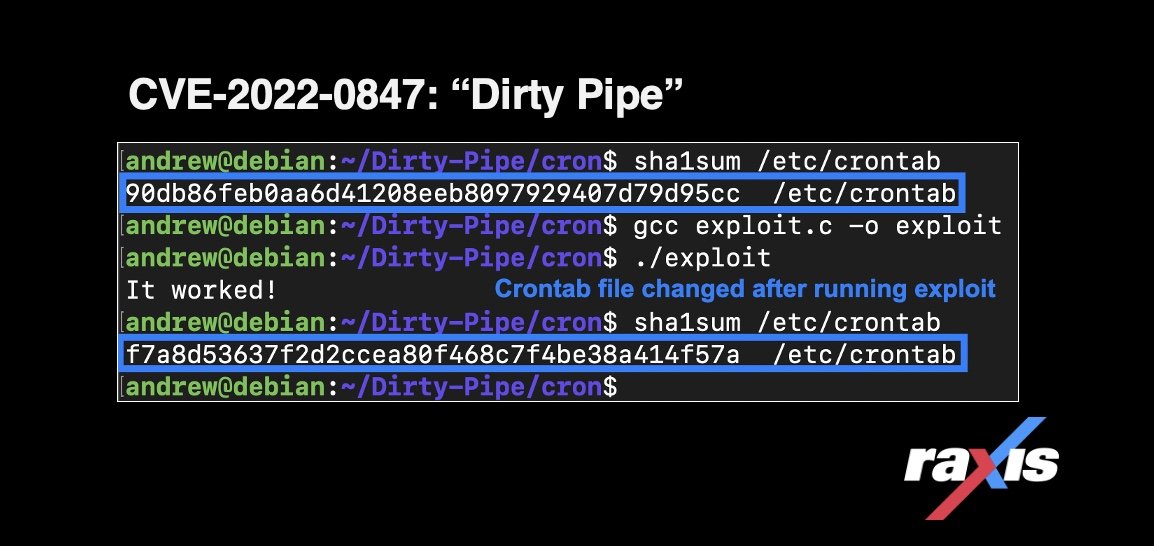
Our second case, "Dirty Pipe," is a fundamentally different type of vulnerability. It is not a memory corruption bug, but a pure logic bug caused by an uninitialized variable. Its simplicity makes it elegant, powerful, and widely exploitable.
The vulnerability allowed an unprivileged user to overwrite data in any readable file, including read-only files owned by root. This is achieved by manipulating pipes and the page cache.
The Vulnerability: An Uninitialized Flag
The root cause lies in how the kernel handles data transfer between files and pipes using the splice() system call.
- A new pipe is created. When data is written to it, the kernel allocates
pipe_bufferstructures. For efficiency, these buffers have a flag:PIPE_BUF_FLAG_CAN_MERGE, which indicates that subsequent small writes can be merged into the same buffer. - The pipe is completely drained (read from). The kernel releases the data pages but leaves the
pipe_buffermetadata intact, including thePIPE_BUF_FLAG_CAN_MERGEflag. The buffer is now empty but still marked as "mergeable". - The attacker uses
splice()to move data from a target read-only file (e.g., a SUID binary) into this pipe. The kernel, for efficiency (zero-copy), doesn't copy the data but simply makes the pipe buffer point to the page in the page cache belonging to the read-only file. Critically, the code forgot to clear thePIPE_BUF_FLAG_CAN_MERGEflag. - The pipe now contains a buffer that points to a read-only page cache page but is simultaneously marked as mergeable.
- A final
write()to the pipe triggers the "merge" logic, and the kernel writes arbitrary data directly into the read-only page cache, bypassing all file system permissions.
Let's watch a brief overview of this mechanism.
Dirty Pipe - CVE-2022-0847 - Linux Privilege Escalation
This video from HackerSploit provides a high-level explanation and demonstration of the Dirty Pipe vulnerability.
Watch from 00:17 to 01:56 and from 11:50 to 14:53. Focus on: The affected kernel versions and CVE identifier. The core concept: overwriting read-only files via the page cache. The explanation of the uninitialized pipe_buffer flag and the role of the splice() system call.
For a more granular, code-level analysis that fits your preference for "atomic" learning, the following article is an excellent resource.
Exploration of the Dirty Pipe Vulnerability (CVE-2022-0847)
This article, 'Exploration of the Dirty Pipe Vulnerability', provides a step-by-step walkthrough of the kernel code, explaining exactly how the state of the pipe gets corrupted.
Read the sections 'What’s the Actual Problem?' and 'Limitations'. This text perfectly summarizes how the uninitialized flag allows a write() to corrupt the page cache and outlines the constraints of the exploit.
Mitigation Strategy
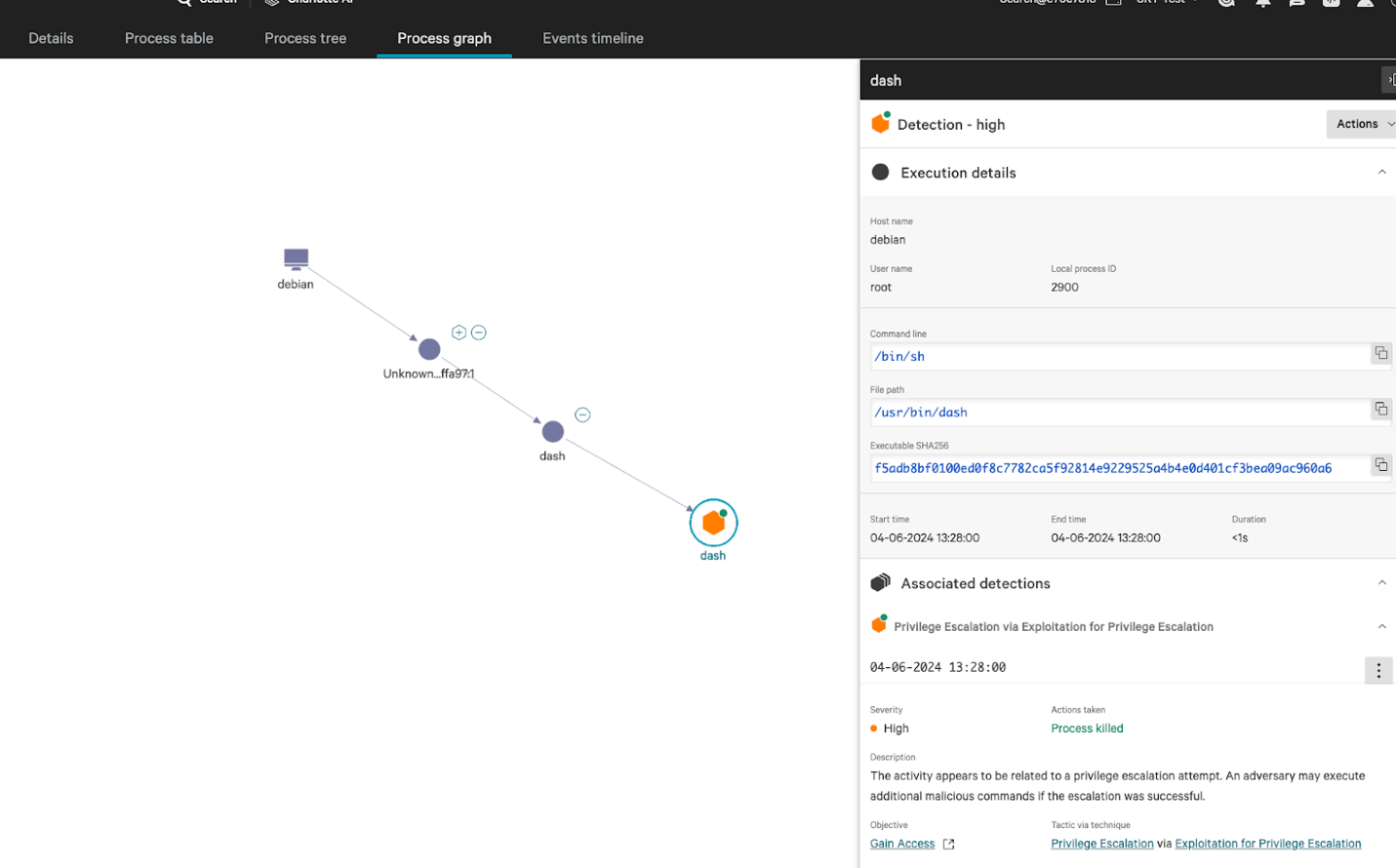
Unlike CVE-2019-18683, this was not a memory safety issue. Therefore, mitigations like SMEP/SMAP, KASLR, or memory sanitizers are completely ineffective. The vulnerability is in the kernel's logic.
The only effective mitigation was to patch the kernel. The fix was remarkably simple: add a single line of code to initialize the flags field to 0 in the relevant splice code path.
--- a/lib/iov_iter.c
+++ b/lib/iov_iter.c
@@ -414,6 +414,7 @@ static size_t copy_page_to_iter_pipe(struct page *page, size_t offset, size_t by

     buf->ops = &page_cache_pipe_buf_ops;
+    buf->flags = 0;
     get_page(page);
     buf->page = page;
     buf->offset = offset;
This highlights that while memory corruption vulnerabilities are common, critical privilege escalations can also arise from simple logic errors that bypass entire classes of security mechanisms.
3. Interview Scenario
Scenario: You are a senior kernel engineer at an embedded device company. A junior engineer brings you a crash dump from a field device. The dmesg output shows a KASAN report indicating a use-after-free has occurred in a custom network filter driver your team maintains. The device cannot be immediately patched.
Question: Based on your analysis of CVE-2019-18683, what is your methodology for assessing the exploitability of this UAF bug? What immediate, though incomplete, containment measures might you suggest if a full patch is not possible?
Click here for the analysis
Answer: This is a critical situation requiring a methodical approach. My methodology for assessing exploitability, drawing lessons from CVE-2019-18683, would be as follows:
-
Root Cause Analysis: First, I would meticulously review the code path identified by KASAN. Is the UAF caused by a race condition, a logic error in reference counting, or something else? Understanding the trigger is paramount.
-
Assess Attacker Control over Allocation/Free: Can an attacker control when the object is freed and when the use-after-free access occurs? A tight, non-deterministic race is much harder to exploit than a bug where the attacker has direct control over the free and use operations.
-
Assess Attacker Control over Content: This is the most critical question. Can an attacker influence the contents of the memory that gets reallocated into the place of the freed object? I would investigate if any user-controllable allocations of the same size (
kmalloccache) can be triggered. I'd look for syscalls likesetxattr,sendmsg(with ancillary data), or others that copy user data into kernel objects of a similar size. This is analogous to the heap spraying step. -
Identify Exploitation Primitives: What does the "use" of the freed object entail?
- If the kernel reads from the corrupted object, it could lead to an information leak.
- If the kernel writes to the corrupted object, it could lead to data corruption.
- If the kernel uses a value from the object as a function pointer, an array index, or a list head, it could lead to a control-flow hijack, which is the most severe outcome.
-
Analyze Mitigations: I would check the device's kernel configuration. Is KASLR enabled? Are SMEP/SMAP active? If so, a simple exploit is not possible. I would then search for potential info-leak "gadgets" (like the
dmesgwarning in the V4L2 case) that an attacker could use to defeat KASLR.
Immediate Containment Measures (if no patch is possible):
- Restrict Access: If the vulnerable driver code is triggered by a specific
ioctlor network protocol, I would recommend usingseccompon user-space applications to block that specificioctlcall if possible. If it's a network driver, a firewall rule at a higher level could perhaps block the specific traffic pattern that triggers the bug. - Restrict Tools: Remind the team that tools useful for exploitation, like
userfaultfd, can be disabled system-wide (echo 0 > /proc/sys/vm/unprivileged_userfaultfd). This would make heap spraying much more difficult, raising the bar for exploitation. - System Hardening: Ensure
dmesg_restrict=1is set to prevent unprivileged users from accessing kernel logs, which could contain pointers that defeat KASLR.
These measures don't fix the bug, but they disrupt known exploit chains, making a successful attack much less likely while a proper patch is developed and tested.
Conclusion
Today, we've dissected two major kernel privilege escalation CVEs, revealing the intricate dance between attackers and defenders. By analyzing these real-world examples, you've gained insight into the practical application of kernel security concepts.
Key Takeaways:
- Vulnerability Classes: Privilege escalation can stem from different root causes, including memory corruption bugs (like UAF in CVE-2019-18683) and logic bugs (like the uninitialized flag in Dirty Pipe).
- Exploitation is a Chain: Modern exploits are rarely a single step. They involve chaining techniques to trigger a bug, control memory, bypass mitigations like KASLR and SMEP/SMAP, and finally execute arbitrary code.
- Defense in Depth: No single security feature is a silver bullet. A combination of hardening features (restricting
dmesganduserfaultfd), proactive sandboxing (seccomp), and memory safety mitigations (SMEP/SMAP) creates multiple barriers for an attacker. - Patching is Critical: For logic bugs like Dirty Pipe, generic memory safety mitigations are often irrelevant. The only true fix is to patch the vulnerable code.
Preview of the Next Lesson:
Having explored the depths of kernel security and process isolation, we will now move to the next major topic in our course: Hardware-Assisted Virtualization and KVM. In the next lesson, we will investigate how modern CPUs provide features like Intel VT-x and AMD-V to run multiple, isolated operating systems. You will learn about the KVM (Kernel-based Virtual Machine) architecture and see how it leverages this hardware to turn the Linux kernel into a high-performance hypervisor. Our understanding of kernel vulnerabilities will prove invaluable as we consider the security implications of this host-guest relationship.