Welcome to your second lesson in the "Foundations of Accounting for Modelers" module.
In our last lesson, we established how the three financial statements are interconnected, noting that the accrual-based Net Income from the Income Statement is the starting point for building the Cash Flow Statement. This naturally raises a critical question: why is profit different from cash, and how do we account for these differences?
This lesson dives into that very question. Our learning outcome is to: Describe the principles of accrual accounting and how they impact revenue and expense recognition in a model. You'll learn the "why" behind the adjustments we saw previously, moving from the mechanical links between statements to the conceptual foundation of modern accounting.
By the end of this lesson, you will understand the fundamental principles that dictate when a company records revenue and expenses, and you'll see how these rules are applied in practice through adjusting entries and financial models.
1. The Core Principles of Recognition
Your MBA studies in finance have certainly introduced you to the core accounting standards. At the heart of these standards are two guiding principles that govern the timing of revenues and expenses. They are essential for creating comparable and reliable financial statements.
Let's read a brief introduction to these principles.
This section from a financial accounting textbook introduces the periodicity assumption and the two key principles for recognizing revenue and expenses. It explains why timing is so crucial in accounting.
Read the section titled 'Timing Issues,' stopping just before 'ACCRUAL VERSUS CASH BASIS OF ACCOUNTING.' Focus on the definitions of the revenue recognition principle and the expense recognition principle.
To summarize the key ideas from that reading:
- Periodicity Assumption: We break down the economic life of a business into artificial time periods (like a month, quarter, or year) to provide timely information.
- Revenue Recognition Principle: Revenue is recognized in the period it is earned, regardless of when cash is received. For a service company, this is when the service is performed. For a company selling goods, it's typically when control of the goods is transferred to the customer.
- Expense Recognition Principle (The Matching Principle): Expenses are matched to the revenues they helped generate. This means an expense is recorded in the same period as the revenue it is associated with, not necessarily when the cash is paid.
These principles lead to a fundamental choice in accounting methods: accrual basis vs. cash basis.
2. Accrual Basis vs. Cash Basis Accounting
The principles of revenue and expense recognition are the pillars of accrual-basis accounting. This is the system required by both Generally Accepted Accounting Principles (GAAP) in the U.S. and International Financial Reporting Standards (IFRS). The alternative, cash-basis accounting, is much simpler but can provide a misleading picture of a company's performance.
Let's explore this critical distinction.
The same textbook chapter provides a clear comparison between accrual and cash basis accounting, using an example that highlights how cash basis can misrepresent a company's financial performance.
Read the section 'ACCRUAL VERSUS CASH BASIS OF ACCOUNTING.' Pay close attention to the Fresh Colors example and how it reports vastly different results under the two methods.
As an FP&A analyst, you will work exclusively with accrual-based financials. The key takeaway is that accrual accounting provides a more accurate picture of a company's economic reality during a period, even if the cash flows don't perfectly align with the reported revenues and expenses. Our job is to understand and model both.
3. The Mechanics: Deferrals and Accruals
So, how do accountants practically apply these principles? They use adjusting entries at the end of each accounting period. These entries ensure that revenues and expenses are recorded in the correct period.
Every adjusting entry falls into one of two main categories: Deferrals or Accruals. The following table provides a helpful mental model for the timing differences.
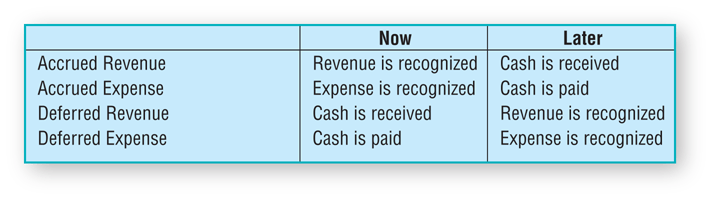
Let's break each of these down.
Before we dive into the details of each type, please read this brief section that introduces why adjusting entries are necessary and names the four categories.
Read the section 'The Basics of Adjusting Entries,' up to but not including 'ADJUSTING ENTRIES FOR DEFERRALS.' This will frame our discussion.
Deferrals (Cash First)
Deferrals are for situations where cash is exchanged before the revenue is earned or the expense is incurred. We are "deferring" the recognition.
1. Prepaid Expenses (Deferred Expenses):
- What it is: The company pays cash for an expense that will benefit future periods.
- Examples: Paying a one-year insurance premium upfront, buying office supplies, purchasing equipment.
- The Adjustment: Initially recorded as an asset (e.g., "Prepaid Insurance"). At the end of each period, an adjusting entry is made to move a portion of the asset's cost to an expense account on the income statement.
2. Unearned Revenue (Deferred Revenue):
- What it is: The company receives cash from a customer for services or goods to be provided in the future.
- Examples: A software company selling an annual subscription, an airline selling a ticket for a future flight, receiving a deposit for a future construction project.
- The Adjustment: Initially recorded as a liability (e.g., "Unearned Revenue"). As the company delivers the service or product and earns the revenue, an adjusting entry is made to decrease the liability and recognize revenue on the income statement.
Accruals (Cash Later)
Accruals are for situations where cash is exchanged after the revenue is earned or the expense is incurred. We are "accruing" the revenue or expense that has built up over time.
3. Accrued Expenses (Accrued Liabilities):
- What it is: The company has incurred an expense but has not yet paid for it.
- Examples: Employee salaries earned for the last few days of a month but paid in the next month, interest on a loan that has accumulated but is not yet due.
- The Adjustment: An adjusting entry is made to record both the expense on the income statement and a liability on the balance sheet (e.g., "Salaries Payable").
4. Accrued Revenue (Accrued Assets):
- What it is: The company has earned revenue but has not yet billed or received cash from the customer.
- Examples: A consulting firm completes a project at the end of the month but won't send the invoice until the following week.
- The Adjustment: An adjusting entry is made to record the revenue on the income statement and an asset on the balance sheet (e.g., "Accounts Receivable").
To see the detailed journal entries and statement impacts for all four types, let's return to our textbook chapter.
This is the most detailed part of the lesson. These sections walk through specific examples with journal entries for each type of adjusting entry. Understanding these mechanics is crucial.
Read the sections 'ADJUSTING ENTRIES FOR DEFERRALS' and 'ADJUSTING ENTRIES FOR ACCRUALS.' For each example (supplies, depreciation, unearned revenue, accrued interest, etc.), trace how the adjusting entry affects both a balance sheet account and an income statement account.
4. Application in Financial Modeling and Analysis
Understanding the theory is one thing; applying it is another. As an FP&A analyst, you won't just be booking journal entries, but you will be building models that correctly reflect these principles.
Modeling Prepaid Expenses
Consider the example of prepaid expenses. In a financial model, you would typically build a "supporting schedule" to track these. This schedule calculates the monthly expense that hits the Income Statement and the remaining asset balance that sits on the Balance Sheet.

Case Study: Subscription Revenue Recognition
Now, let's tackle a practical problem that directly relates to your goal of mastering "Ivy League quality" material. This case study from a Wharton sample exam deals with recognizing revenue for a subscription service—a classic example of unearned revenue.
Test your understanding!
Scenario: On January 1, 2022, a firm signs a customer to a 4-year, noncancelable contract for subscription services. The total contract value is $4,800. The customer pays in annual installments of $1,200. The service commences immediately. The bill for each year is sent on January 1 and is due in 30 days.
Based on the principles we've discussed, try to answer the following:
- What journal entry should the firm make on January 1, 2022, when it bills the customer for the first year?
- What entry does the firm make when the customer pays the first $1,200?
- What entry should the firm make at the end of each month of 2022 to recognize the revenue it has earned?
- A consultant claims that if the firm billed for the entire 4 years upfront ($4,800), it could report revenue quicker. Do you agree? Explain.
Show answer
Here is the breakdown based on accrual principles, which you can verify with the provided solution key (LINK, section 3).
-
Journal Entry on Jan 1, 2022 (Billing): The firm has earned the right to collect $1,200 for the upcoming year's service. However, none of this revenue has been earned yet.
- Debit (Dr) Accounts Receivable: $1,200 (An asset increases because the customer owes the firm money)
- Credit (Cr) Unearned Revenue: $1,200 (A liability increases because the firm has an obligation to provide service for a year)
-
Journal Entry for Cash Receipt: The customer pays the bill. This is just an exchange of one asset for another.
- Dr Cash: $1,200 (Asset increases)
- Cr Accounts Receivable: $1,200 (Asset decreases)
- Note that no revenue is recognized when the cash is received.
-
Monthly Adjusting Entry: At the end of each month, the firm has fulfilled 1/12th of its annual service obligation. It has now earned a portion of the revenue. The monthly revenue is $1,200 / 12 = $100.
- Dr Unearned Revenue: $100 (The liability is reduced because part of the obligation is fulfilled)
- Cr Service Revenue: $100 (Revenue is recognized on the Income Statement)
-
Consultant's Claim: The consultant is incorrect. Billing or collecting cash faster does not accelerate revenue recognition under accrual accounting. Revenue is only recognized as it is earned. Even if the company collected all $4,800 on day one, it would sit on the Balance Sheet as a large Unearned Revenue liability and would still only be recognized at a rate of $100 per month for 48 months. This is a crucial concept that separates cash flow from profitability.
Conclusion
In this lesson, we dissected the principles of accrual accounting that underpin all modern financial reporting. You've moved from simply connecting the three statements to understanding the fundamental rules that govern the numbers within them.
Key Takeaways:
- Accrual accounting is mandatory under GAAP/IFRS and provides a more accurate view of economic performance than cash accounting.
- The Revenue Recognition Principle dictates that revenue is recorded when earned.
- The Expense Recognition (Matching) Principle dictates that expenses are recorded in the same period as the revenues they help generate.
- These principles are implemented through adjusting entries, which are categorized as Deferrals (cash first) and Accruals (cash later).
- Understanding these concepts is critical to correctly interpreting financial statements and building sound financial models.
In our next lesson, we will put this all together. We will take a series of common business events—like making a sale, buying equipment, or taking out a loan—and practice translating them into their full, three-statement impact, applying the accrual principles you learned today.