Hello! Welcome to the third lesson in our "Foundations of Accounting for Modelers" module.
In our previous lessons, we established the interconnectedness of the three financial statements and delved into the accrual accounting principles that govern them. You learned the critical "why" behind the numbers—the revenue and expense recognition rules that ensure financial statements reflect economic reality, not just cash movements.
Now, we will put that theory into practice. This lesson is all about translating raw business activities into their full, three-statement impact. Our learning outcome is to: Translate business activities (e.g., sales, capex, financing) into their corresponding impacts on the financial statements. We'll start by analyzing how transactions affect the fundamental accounting equation and then move to the formal double-entry system used by accountants.
By the end of this lesson, you will be able to take a business event—like making a sale, buying equipment, or taking out a loan—and trace its journey through the income statement, balance sheet, and cash flow statement. This skill is the absolute bedrock of financial modeling.
1. The Foundation: Transaction Analysis and the Accounting Equation
Every business event that has a financial impact is called a transaction. To understand a transaction's effect, we start with the fundamental accounting equation, a concept that should be familiar from your MBA studies:
This equation must remain in balance after every single transaction. A transaction always has at least two effects, which is the essence of the double-entry system.
Your Civil Engineering background gives you an appreciation for stable, balanced structures. Think of the accounting equation as the foundation of a building; if it's not perfectly balanced, the entire structure (the financial statements) will be flawed.
To begin, let's review the main types of accounts that fall under each part of the equation.
Transaction Analysis - Higher Education | Pearson
This chapter from Pearson's 'Transaction Analysis' provides an excellent review of what a transaction is and the specific accounts that fall under Assets, Liabilities, and Stockholders' Equity. It's a great refresher before we start analyzing transactions.
Please read from the beginning of the chapter up to the section 'ACCOUNTING FOR BUSINESS TRANSACTIONS'. Focus on the definitions of each account type (e.g., Cash, Accounts Receivable, Accounts Payable, Common Stock, Retained Earnings, etc.).
Now that we've reviewed the building blocks, let's see how they work together. We will follow a detailed example of a new business, "Genie Car Wash, Inc.," and analyze how 11 different transactions affect the accounting equation.
Here are a few key examples to illustrate the process:
-
Transaction 1: Issue Stock for Cash ($50,000)
- Activity: The owners invest cash into the business.
- Impact: The business receives cash (an asset) and in return gives the owners stock (equity).
- Equation: Assets (Cash) increase by $50,000, and Stockholders' Equity (Common Stock) increases by $50,000. The equation remains balanced.
-
Transaction 4: Perform Service for Cash ($7,000)
- Activity: The business earns revenue by providing a service and gets paid immediately.
- Impact: Cash (Asset) increases. The revenue increases Net Income, which in turn increases Retained Earnings (Stockholders' Equity).
- Equation: Assets (Cash) increase by $7,000, and Stockholders' Equity (Retained Earnings) increases by $7,000.
-
Transaction 6: Pay Cash Expenses ($2,700)
- Activity: The business pays for rent, salaries, and utilities.
- Impact: Cash (Asset) decreases. The expenses decrease Net Income, which in turn decreases Retained Earnings (Stockholders' Equity).
- Equation: Assets (Cash) decrease by $2,700, and Stockholders' Equity (Retained Earnings) decreases by $2,700.
To see how every transaction is analyzed and how they collectively build the financial statements, please study the full example.
Transaction Analysis - Higher Education | Pearson
These sections walk through the full Genie Car Wash example. They demonstrate how each of the 11 transactions alters the accounting equation and then show how the final balances are used to construct the Income Statement, Statement of Retained Earnings, and Balance Sheet.
Read the sections 'ACCOUNTING FOR BUSINESS TRANSACTIONS' and 'Transactions and Financial Statements.' Follow each of the 11 transactions carefully. Then, study Exhibit 2-1 and Exhibit 2-2 to see how the transaction analysis data flows directly into the financial statements.
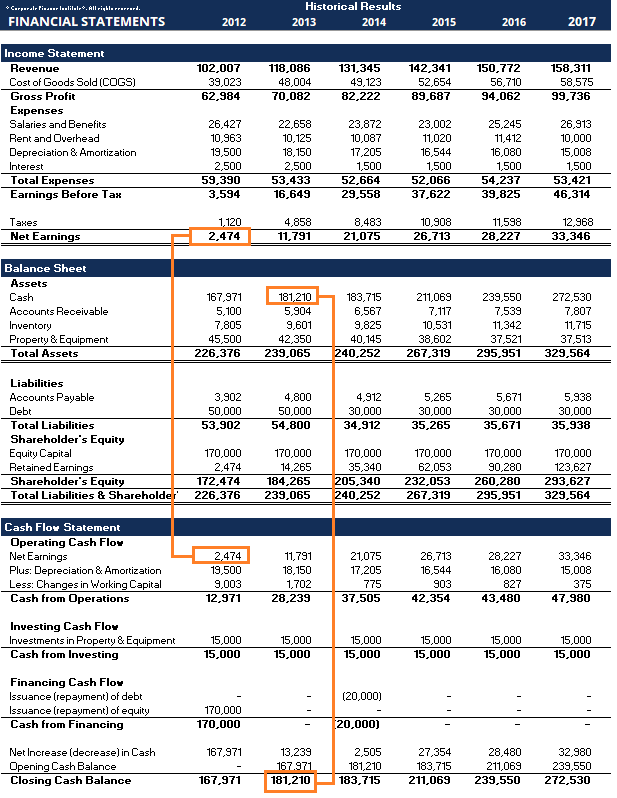
The key takeaway is that the statements are not independent; they are dynamically linked through the transactions. The image below visualizes these crucial connections, showing how Net Income from the Income Statement flows into the Balance Sheet (via Retained Earnings) and the Cash Flow Statement.
2. Putting it into Practice
Now it's your turn. Applying these concepts is the best way to solidify your understanding.
Test your understanding!
Let's analyze a few transactions for a new company, Herzog Researchers, Inc. For each transaction below, determine its effect on the accounting equation (Assets = Liabilities + Equity). Which accounts are affected, and do they increase or decrease?
- Transaction a: The company issues common stock for $25,000 cash.
- Transaction b: The company purchases office supplies on account for $350. ("On account" means they will pay later).
- Transaction d: The company performs research for clients and receives cash of $1,900.
- Transaction g: The company pays cash expenses for office rent ($400) and utilities ($100).
Show answer
- Transaction a:
- Assets (Cash) increase by $25,000.
- Stockholders' Equity (Common Stock) increases by $25,000.
- Transaction b:
- Assets (Office Supplies) increase by $350.
- Liabilities (Accounts Payable) increase by $350.
- Transaction d:
- Assets (Cash) increase by $1,900.
- Stockholders' Equity (Retained Earnings) increases by $1,900 (via Service Revenue).
- Transaction g:
- Assets (Cash) decrease by $500 ($400 + $100).
- Stockholders' Equity (Retained Earnings) decreases by $500 (via Rent Expense and Utilities Expense).
You can see the full analysis for all transactions of Herzog Researchers, Inc. in the "Mid-Chapter Summary Problem" of the Pearson resource (LINK, section 3).
3. The Formal System: Double-Entry Accounting
While analyzing transactions with the accounting equation works for simple examples, it becomes cumbersome for large companies with millions of transactions. The formal system accountants use is double-entry accounting, which relies on debits and credits.
- Debit (Dr): Simply means "left side" of an account.
- Credit (Cr): Simply means "right side" of an account.
The rules for how debits and credits affect accounts are the grammar of accounting. They ensure the accounting equation always balances.
| Account Type | To Increase the Account | To Decrease the Account | Normal Balance |
|---|---|---|---|
| Assets | Debit | Credit | Debit |
| Liabilities | Credit | Debit | Credit |
| Stockholders' Equity | Credit | Debit | Credit |
| ↳ Common Stock | Credit | Debit | Credit |
| ↳ Retained Earnings | Credit | Debit | Credit |
| ↳ Dividends | Debit | Credit | Debit |
| Revenues | Credit | Debit | Credit |
| Expenses | Debit | Credit | Debit |
Notice that Assets, Dividends, and Expenses follow the same "Debit to increase" rule. Liabilities, Equity, and Revenues follow the opposite "Credit to increase" rule. This structure is the key to keeping the system in balance.
To learn these rules and see how they are applied, let's turn back to our textbook.
Transaction Analysis - Higher Education | Pearson
This reading introduces the formal double-entry system, T-accounts, and the rules of debit and credit. It then walks through the process of journalizing and posting the same Genie Car Wash transactions we saw earlier, but this time using the formal system.
Read the sections 'DOUBLE-ENTRY ACCOUNTING' and 'RECORDING TRANSACTIONS.' Pay close attention to Exhibit 2-7, which summarizes the rules of debit and credit. Then, follow along as the Genie Car Wash transactions are recorded as journal entries and posted to T-accounts. You don't need to memorize every entry, but focus on understanding the pattern.
As an FP&A analyst, you won't be writing journal entries daily. However, understanding this system is crucial for diagnosing issues in a financial model and communicating effectively with accountants. Knowing that a CapEx purchase is a debit to PP&E (asset) and a credit to Cash (asset) helps you intuitively understand why it's a "use of cash" in the investing section of the CFS.
4. Bringing It All Together
We've learned how to translate business activities into the formal language of accounting and see their impact on the financial statements. The entire process of building a 3-statement model is based on this logic, as illustrated in the guide below. Today, we've focused on the foundational steps of linking the statements and creating the cash flow statement from changes in the balance sheet.

For a concise summary of these linkages, perfect for reinforcing your knowledge for finance interviews, the following resource is excellent.
How are the Three Financial Statements Linked?
This article from Wall Street Prep provides a fantastic, interview-style summary of how the three statements are linked. It also includes an Excel-based example that shows how these links are built with formulas in a real model.
Read the 'Accounting Interview Question (with Example Answer)' section for a concise summary. Then, review the 'How to Link the Three Financial Statements in Excel' section to see a practical application of these concepts in a spreadsheet. Focus on how changes in one statement drive changes in another.
Conclusion
In this lesson, we bridged the gap between accounting theory and practical application. You learned how to take any business activity and trace its impact across the three core financial statements, first using the simple accounting equation and then with the formal double-entry system.
Key Takeaways:
- Every transaction has a dual effect, and the accounting equation () must always remain in balance.
- Operating activities (like sales and expenses) primarily impact the Income Statement, which then flows through to the Balance Sheet's Retained Earnings.
- Investing activities (like buying/selling equipment or
CapEx) impact assets on the Balance Sheet and are reflected in the Cash Flow from Investing section. - Financing activities (like issuing stock or debt) impact liabilities and equity on the Balance Sheet and are reflected in the Cash Flow from Financing section.
- Understanding the rules of debit and credit provides the underlying logic for how financial models are constructed and audited for errors.
You now have the foundational skills to understand how a financial model is built from the ground up. In our next lesson, we will focus on designing a standardized and scalable financial model layout, learning how to organize inputs, calculations, and outputs in a clean, professional manner—a crucial skill for any FP&A analyst.