Hello! Welcome back to the FP&A course.
In our last lesson, we built a comprehensive debt schedule. We learned to model both revolving credit facilities and long-term debt, calculate principal repayments, and forecast interest expense. We also identified the "circularity" problem that interest calculations can create. This work on the financing section of our model has prepared us for today's crucial step: integrating the core financial statements.
Today's lesson focuses on a foundational element of model construction. We will link the income statement and balance sheet via retained earnings and other equity accounts. This is where your model's integrity is truly tested and the accounting logic comes to life. Mastering this link is what separates a collection of spreadsheets from a dynamic, integrated financial model.
By the end of this 60-minute lesson, you will be able to:
- Explain the role of the Shareholders' Equity section as the primary bridge between the Income Statement and Balance Sheet.
- Construct a roll-forward schedule for Retained Earnings, linking it directly to Net Income and dividend assumptions.
- Model the changes in other equity accounts like Common Stock, Additional Paid-in Capital (APIC), and Treasury Stock.
- Link the outputs of these equity schedules to the Balance Sheet to ensure it remains balanced.
1. The Big Picture: How the Statements Connect
Before diving into the mechanics, let's visualize how the financial statements interact. The Balance Sheet presents a company's financial position at a single point in time. The Income Statement and Cash Flow Statement describe performance over a period of time. The Shareholders' Equity section of the Balance Sheet is what bridges these two concepts.
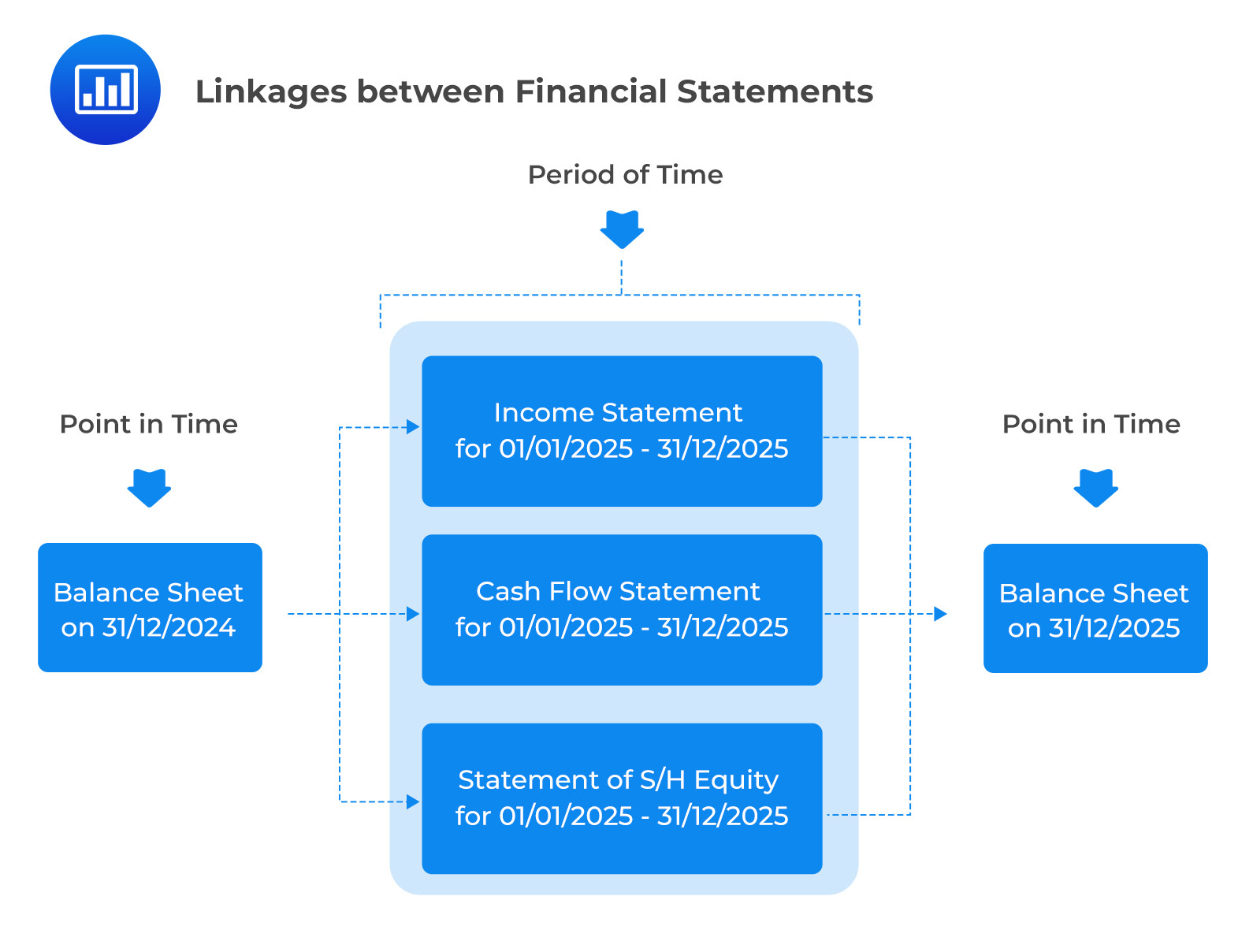
The changes in the Shareholders' Equity section from one period to the next are explained by activities like generating profit, paying dividends, or issuing and repurchasing stock. Our task today is to model these changes.
2. Retained Earnings: The Primary Link
The most direct link between the Income Statement and the Balance Sheet is Retained Earnings. As its name implies, this account represents the cumulative net income the company has retained in the business since its inception, after accounting for all dividends paid to shareholders.
To forecast retained earnings, we use a simple but powerful "roll-forward" formula.
Balance Sheet Forecasting Guide
The article 'Balance Sheet Forecasting Guide' from Wall Street Prep provides an excellent, concise explanation of this core concept. Let's focus on the section about Retained Earnings.
Please read the subsection titled 'Retained earnings'. Pay close attention to the roll-forward formula provided. It is the foundation of our work today.
As the article states, the formula is:
Let's break down how we'll source each part in our model:
- Beginning Retained Earnings: This is simply the ending retained earnings from the prior period's Balance Sheet.
- Net Income: This is linked directly from the bottom line of the current period's Income Statement. This is the critical link.
- Dividends: This will be a forecast assumption. We might assume the company pays out a certain percentage of its net income (the "dividend payout ratio") or a fixed dollar amount each year. These payments are a use of cash that we will later reflect in the Cash Flow Statement.
Now, let's see how this is built in practice.
Build a 3-Statement Financial Model [Free Course]
The comprehensive video 'Build a 3-Statement Financial Model' from Wall Street Prep provides a clear, step-by-step walkthrough. We'll watch the specific segment where the presenter builds the equity schedules.
Please watch from 54:00 to 58:20. The presenter builds the Retained Earnings roll-forward schedule. Observe how he links Net Income from the Income Statement and inputs a hard-coded assumption for dividends.
This roll-forward structure is essential. It isolates the moving parts (Net Income, Dividends) in a supporting schedule before linking the final Ending Balance back to the face of the Balance Sheet.
3. Modeling Other Equity Accounts
While Retained Earnings is the main link, other equity accounts also change over time and must be modeled correctly. We use the same roll-forward logic for these items.
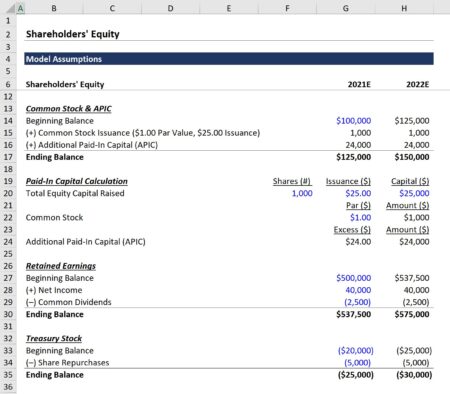
Let's look at the main accounts:
Common Stock & Additional Paid-in Capital (APIC)
This represents the capital received by the company when it issues shares.
- Roll-Forward:
Ending Balance = Beginning Balance + New Stock Issuances - Forecasting: New issuances can come from employee stock compensation plans or from raising capital in a secondary offering. For a standard model, you might forecast this based on historical trends or a simple growth assumption.
Treasury Stock
This is a contra-equity account that represents the cumulative value of shares the company has repurchased from the open market.
- Roll-Forward:
Ending Balance = Beginning Balance + Share Repurchases - Forecasting: Share buybacks, like dividends, are a way to return capital to shareholders. This is a use of cash that will be reflected on the Cash Flow Statement. It's often forecasted based on management guidance or historical activity.
Other Comprehensive Income (OCI)
This account captures gains and losses that bypass the Income Statement, such as fluctuations in foreign currency exchange rates. Because these items are inherently difficult to predict, the standard practice in a three-statement model is to assume no change.
- Forecasting: We will "straight-line" the last historical balance of OCI through the forecast period.
Build a 3-Statement Financial Model [Free Course]
Let's return to the Wall Street Prep video to see the modeling of these other equity accounts.
Now watch from 51:25 to 54:00. The presenter builds schedules for Common Stock & APIC and Treasury Stock, and explains the simple straight-line forecast for OCI. Notice the consistent roll-forward logic.
Test your understanding!
A company has the following at the beginning of 2024:
- Retained Earnings: $1,200
- Common Stock & APIC: $300
- Treasury Stock: -$150 (it's a contra account)
During 2024, the company generates $200 in Net Income, pays $50 in Dividends, issues $20 of new stock to employees, and repurchases $30 of its own stock.
What are the ending balances for these three equity accounts at the end of 2024?
Show answer
- Ending Retained Earnings: $1,200 (Beg) + $200 (NI) - $50 (Div) = $1,450
- Ending Common Stock & APIC: $300 (Beg) + $20 (Issuances) = $320
- Ending Treasury Stock: -$150 (Beg) - $30 (Repurchases) = -$180. (Remember, Treasury Stock is a contra-equity account, so repurchases make it more negative).
4. Finalizing the Balance Sheet Links
Once all the supporting roll-forward schedules for equity are complete, the final step is to link the "End of Period" balance from each schedule back to its corresponding line item on the Balance Sheet.
After forecasting assets (like PP&E) and liabilities (like Debt) in previous lessons, and now forecasting the entire equity section, all the pieces are in place. The only items left to make the Balance Sheet balance should be Cash and any Revolver debt, which are the final "plugs" determined by the Cash Flow Statement.
3-Statement Model: Full Tutorial, Guide, and Excel File
The Mergers & Inquisitions article '3-Statement Model: Full Tutorial' summarizes the linking rules clearly. This reinforces the connections we've just built.
Read the section 'Part 5: Linking the Statements'. Focus on the rule for the 'Liabilities & Equity Side' and how Common Shareholders’ Equity is described as a 'catch-all'.
This "catch-all" nature of the Common Shareholders' Equity (CSE) roll-forward is exactly what we've modeled: it captures the impact of Net Income from the Income Statement, as well as dividends and share buybacks that will flow through the Cash Flow Statement.
Conclusion
Congratulations! You have now mastered the logic for creating the most important structural connection in a three-statement model. By linking the Income Statement to the Balance Sheet through the Shareholders' Equity section, you ensure that the model adheres to the fundamental principles of accounting.
Key Takeaways:
- The Shareholders' Equity section connects the Income Statement (a "period of time" statement) to the Balance Sheet (a "point in time" statement).
- Retained Earnings is the primary link, calculated with the formula:
Ending RE = Beginning RE + Net Income - Dividends. - Other equity accounts like Common Stock and Treasury Stock are also modeled using roll-forward schedules that account for activities like stock issuances and share buybacks.
- The changes modeled in the equity section (dividends, share repurchases, stock issuances) are financing activities that directly impact cash.
In our next lesson, we will use these changes to derive the cash flow statement from the income statement and changes in balance sheet accounts. You will see how the work we did today in the equity schedules flows perfectly into the Cash Flow from Financing section, bringing us one step closer to a fully integrated and balanced model.