Hello! Welcome to the fifth lesson in our module on Relative Valuation.
In our last few lessons, we mastered Comparable Company Analysis (CCA), learning how to select a peer group and use their live market trading multiples (like EV/EBITDA and P/E) to gauge a company's value. We were essentially asking, "What is the market pricing similar companies at right now?"
Today, we shift our focus to a different, but equally powerful, valuation technique: Precedent Transaction Analysis (PTA). Instead of looking at current market prices, we will examine the prices actually paid in past merger and acquisition (M&A) deals.
Your learning outcome for this lesson is to define criteria for selecting comparable M&A transactions and source data from financial databases. This is the foundational step for building a credible PTA. By the end of this lesson, you'll understand how an analyst sifts through the history of M&A deals to find the ones that are most relevant for valuing a target company today.
1. What is Precedent Transaction Analysis?
Precedent Transaction Analysis is based on the idea that the value of a company can be estimated by analyzing the prices paid to acquire similar companies in the past. While it's a form of relative valuation like CCA, there's one crucial difference.
When a company is acquired, the buyer almost always pays a control premium—an amount above the target's pre-deal trading price to gain control of the business. This premium reflects the value of being able to make strategic decisions, control cash flows, and potentially realize synergies (cost savings or revenue opportunities) by combining the businesses. Because of this, valuation multiples derived from precedent transactions are typically higher than those from comparable company analysis.
Precedent Transactions Analysis - Examples, Templates
For a concise introduction, please read the first section of the article 'Precedent Transactions Analysis' from Macabacus. It defines the analysis and introduces the concept of the control premium.
Read the initial section titled 'Precedent Transactions Analysis', down to the 'Advantages and Disadvantages' exhibit. Focus on understanding why transaction multiples are generally higher than trading multiples.
The overall process for a Precedent Transaction Analysis involves several steps, as shown in the diagram below. Today, we are focusing squarely on the first and most critical step: finding the right transactions.
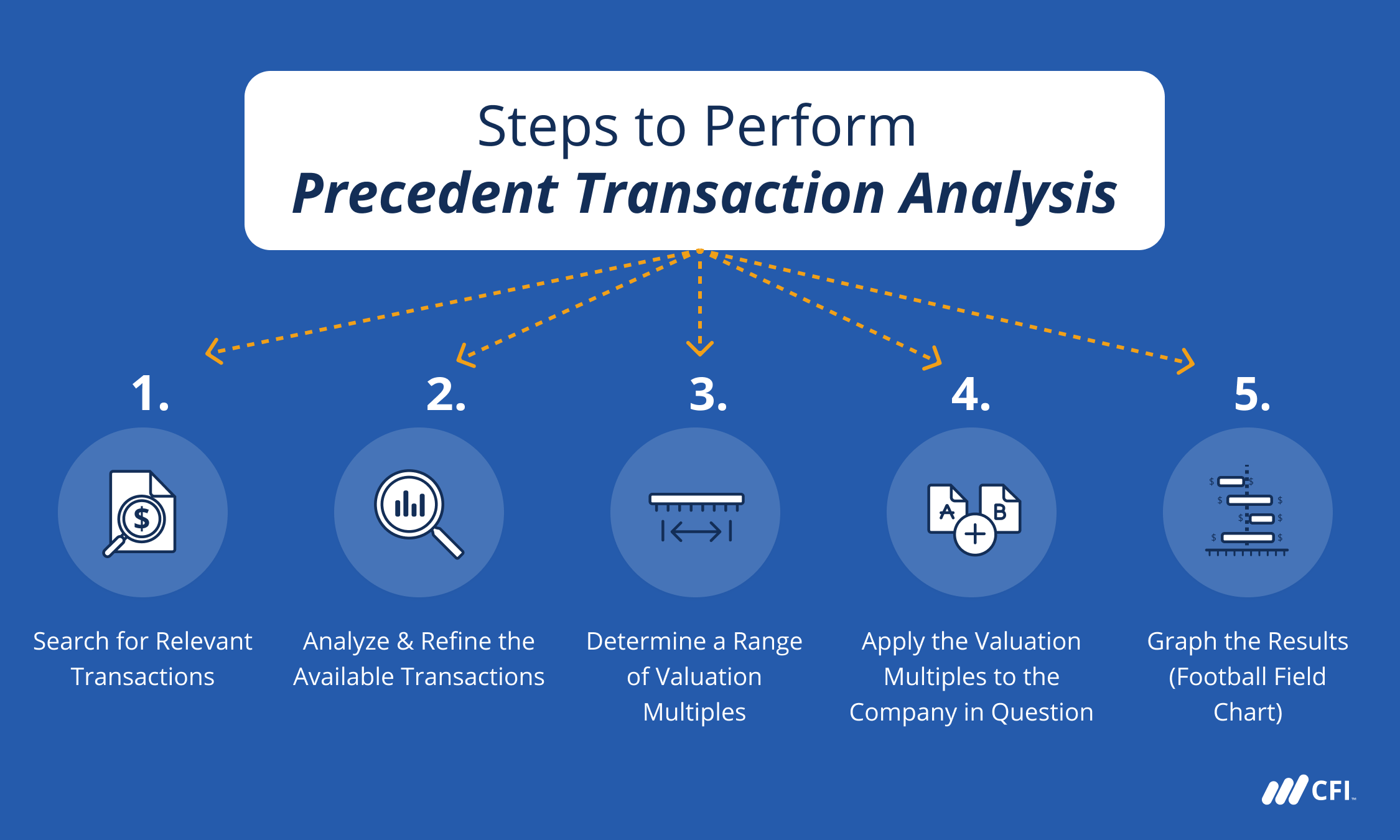
2. Step 1: Selecting the Universe of Comparable Acquisitions
The credibility of your entire analysis hinges on selecting a high-quality set of comparable M&A deals. This process is both a science and an art, requiring careful judgment. The goal is to find deals where the acquired company (the "target") was as similar as possible to the company you are valuing.
To see how this works in practice, let's watch an overview.
Precedent Transactions Analysis – CH 2 Investment Banking Valuation Rosenbaum
To start, watch this introductory segment from the 'Precedent Transactions Analysis' video by FinanceKid. It gives a great overview of the methodology and the key differences from CCA.
Watch the video from 00:43 to 04:25. Pay close attention to the discussion on why transaction comps tend to yield higher multiples (control premium and synergies) and the list of the five steps involved in the analysis.
As the video highlighted, selecting the universe of deals requires careful consideration of several factors. Let's break down the key criteria you must evaluate.
Key Selection Criteria
When screening for transactions, you must consider the following attributes of the target company and the deal itself:
- Industry and Business Characteristics: The target should operate in the same industry, serve similar customers, and have a comparable business model. Your experience in engineering, with its specific sub-disciplines like geotechnical or structural, provides a good parallel; you wouldn't use a bridge construction project as a direct cost comparable for a highway paving project. The same specificity applies here.
- Financial Profile & Deal Size: The target's size (in terms of revenue or EBITDA) and the overall transaction value should be in a similar range to the company you are valuing. A $50 billion mega-merger offers little relevant insight for the valuation of a $100 million company.
- Timing & Market Conditions: More recent transactions are far more relevant. A deal that closed last year reflects current market sentiment, financing availability, and economic conditions. A deal from 15 years ago occurred in a completely different world and is less comparable. A good rule of thumb is to look back 2-3 years, but you may go further if M&A activity in the sector is sparse.
- Deal Dynamics & Context: This is where the "art" of the analysis really comes in. You must understand the story behind the deal.
- Strategic vs. Financial Buyer: Was the acquirer a competitor (a strategic buyer) who could realize synergies and might pay more? Or was it a private equity firm (a financial sponsor) focused purely on financial returns?
- Sale Process: Was the company sold through a competitive auction designed to maximize price, or was it a privately negotiated sale with a single buyer? Auctions typically lead to higher prices.
- Buyer/Seller Motivations: Was the target in financial distress and forced into a fire sale? Or was the seller divesting a non-core asset to focus its strategy? These motivations heavily influence price.
- Purchase Consideration: Was the deal all-cash, or did it include a significant stock component? Sellers often accept a lower price in a stock deal if they believe in the future upside of the combined company.
Precedent Transactions Analysis – CH 2 Investment Banking Valuation Rosenbaum
The 'FinanceKid' video provides an excellent, in-depth discussion on these critical selection criteria. It explains the nuances that separate a good analysis from a superficial one.
Watch the segment from 04:25 to 14:21. This is the most important part of the video for today's lesson. Focus on how market conditions, deal dynamics (strategic vs. financial, auction vs. negotiated), and purchase consideration impact the transaction price.
3. Step 2: Sourcing Transaction Data
Once you know what you're looking for, the next question is where to find it. Professionals have access to powerful, expensive financial databases, but there are also public sources you can use.
Professional Financial Databases
Investment bankers, FP&A professionals in corporate development, and equity researchers rely on services that aggregate M&A data. The most common are:
- Capital IQ (from S&P Global)
- FactSet
- Bloomberg
- SDC Platinum (from LSEG)
These platforms allow users to screen for transactions using the very criteria we just discussed (industry, geography, size, date) and download the results into Excel.
Precedent Transaction Analysis: The Full Guide and Excel Examples
The video 'Precedent Transaction Analysis: The Full Guide' from Mergers & Inquisitions / Breaking Into Wall Street demonstrates how to use a service like Capital IQ and, crucially, what to do if you don't have access.
Watch from 04:14 to 09:26. Observe how an analyst sets up a screen in Capital IQ. Most importantly, pay close attention to the alternative methods discussed for finding data, particularly by searching for a 'fairness opinion' in SEC filings.
Publicly Available Sources
As you just saw, you can still find high-quality data without a subscription. This requires more detective work, but it's a valuable skill. The primary sources are public regulatory filings submitted to the U.S. Securities and Exchange Commission (SEC).
Precedent Transaction Analysis: Tutorial and Excel Examples
The Breaking Into Wall Street article on this topic provides a great text-based summary of how to find transactions, reinforcing what you just saw in the video.
Read the section titled 'Step 1: Find Precedent Transactions'. This will solidify your understanding of using Capital IQ and the alternative of searching for Fairness Opinions in SEC filings.
Here’s a breakdown of the key documents and what they contain:
- Proxy Statements (Schedule 14A): When a public company is acquired, it files a proxy statement to provide shareholders with information before they vote on the deal. This document is a goldmine. It nearly always includes a "Fairness Opinion" from an investment bank, which describes the valuation analyses performed—including a list of the precedent transactions the bank considered relevant.
- Tender Offer Filings (Schedule TO & 14D-9): These are used when an acquirer makes an offer directly to a target's shareholders. The target's response (Schedule 14D-9) will also contain a board recommendation and often a fairness opinion.
- Current Reports (Form 8-K): Companies file an 8-K to announce major events, including the signing of a merger agreement. It provides the key terms of the deal.
- Annual/Quarterly Reports (10-K/10-Q): These reports from the acquiring company may discuss recent acquisitions.
Finally, don't underestimate specialized industry reports from accounting/consulting firms (e.g., PwC, Deloitte) or news archives, which often summarize M&A trends and notable deals within a sector.
Test your understanding!
You are valuing a U.S.-based software company with $50 million in annual revenue. You are looking for precedent transactions. Which of the following would be the most relevant comparable?
a) The acquisition of a European software company with $60 million in revenue that occurred 5 years ago.
b) The acquisition of a U.S. hardware manufacturer with $500 million in revenue that occurred last month.
c) The acquisition of a U.S. software company with $75 million in revenue that occurred last year in a competitive auction process.
d) The merger of two giant U.S. software companies, each with over $20 billion in revenue, which was announced yesterday.
Show answer
Answer: c) The acquisition of a U.S. software company with $75 million in revenue that occurred last year in a competitive auction process.
Reasoning:
- Choice (a) is less relevant due to different geography (European vs. U.S.) and timing (5 years ago is dated).
- Choice (b) is in a different industry (hardware vs. software) and a vastly different size class.
- Choice (d) is irrelevant due to the massive size disparity. A mega-merger's dynamics are completely different.
- Choice (c) is the best fit. It matches the industry (software), geography (U.S.), is reasonably close in size ($75M vs. $50M), and is recent (last year). The fact that it was an auction is a key piece of "deal dynamics" information you would note in your analysis.
Conclusion
You've now learned the critical first step in performing a Precedent Transaction Analysis. Unlike simply pulling stock tickers for a CCA, selecting the right set of M&A deals requires a deeper level of investigation into the context and story behind each transaction.

Key Takeaways:
- Precedent Transaction Analysis values a company based on prices paid in historical M&A deals.
- It typically results in higher valuations than CCA due to control premiums and synergies.
- Selecting the right transactions is crucial. You must screen based on industry, size, timing, and deal dynamics (e.g., strategic vs. financial buyer, auction vs. negotiated sale).
- Professionals use databases like Capital IQ, but you can find a wealth of data in public SEC filings, especially the "Fairness Opinion" section of proxy statements.
Preview of the Next Lesson:
Now that we know how to find our set of comparable transactions, what's next? In our next lesson, we will focus on the second and third steps of the process: "Calculate and standardize transaction multiples from precedent transactions, adjusting for control premiums." We will take the data we've sourced and turn it into the valuation multiples needed to complete our analysis.