Hello! Welcome back to our module on Discounted Cash Flow (DCF) Valuation.
In our last lesson, we mastered the art of calculating the individual costs of a company's capital: the Cost of Equity () and the After-Tax Cost of Debt (). We have the "material properties" for each component of the company's funding. Now, we need to create the composite material.
This lesson focuses on blending those individual costs into a single, comprehensive discount rate. We will address the learning outcome: Calculate the Weighted Average Cost of Capital (WACC) based on a target capital structure. The WACC is the denominator in our DCF formula, and it's the rate we'll use to discount our Unlevered Free Cash Flow (UFCF) projections to their present value.
1. The WACC Formula: Blending the Costs
The Weighted Average Cost of Capital is exactly what its name implies: an average of the costs of a company's different sources of capital (primarily debt and equity), weighted by the proportion each source represents in the company's overall financing.
Think of it like creating a high-performance concrete mix. The final strength (the WACC) depends not just on the quality of the cement (equity) and aggregate (debt), but on the precise ratio in which you combine them.
The core formula for WACC is as follows:
Where:
- E = Market Value of Equity
- D = Market Value of Debt
- = Cost of Equity (which we calculate using CAPM)
- = Pre-Tax Cost of Debt
- T = Marginal Tax Rate
The terms and are the weights for equity and debt, respectively.
For a thorough walkthrough of the formula and its components, the WACC guide from Wall Street Prep is an excellent resource.
WACC Guide | Formula + Calculation Example
This guide, which we used in the last lesson, provides a clear introduction to the WACC formula and its intuition. It reinforces why we use an after-tax cost for debt.
Please read the sections 'WACC Formula', 'How Does the Capital Structure Impact WACC?', and 'How the Interest Tax Shield Affects WACC'. Focus on understanding the intuition behind weighting each component and the role of the tax shield.
Some companies also use preferred stock, which is a hybrid security with features of both debt and equity. In such cases, the formula is expanded to include it:
Where V = E + D + P (Total firm value), P is the market value of preferred stock, and is the cost of preferred stock. For most of our work, we will focus on the more common debt and equity structure.
2. Determining the Weights: The Capital Structure
The most critical new element in this lesson is determining the weights for debt and equity. Two crucial principles guide this process:
-
Use Market Values, Not Book Values: The weights must be based on the market values of debt and equity. Book values are historical accounting figures and do not reflect the current economic value that investors have placed on the company's securities. The WACC is a market-based, forward-looking rate, so its inputs must also be market-based.
- Market Value of Equity (E): This is straightforward. It's the company's market capitalization (Share Price × Number of Shares Outstanding).
- Market Value of Debt (D): This can be trickier. If the company's bonds are publicly traded, their market value is the most accurate figure. However, for many firms, bank loans and non-traded debt are significant. In these cases, the book value of debt from the balance sheet is often used as a reasonable proxy, provided the company is not in distress and interest rates haven't changed dramatically since the debt was issued.
-
Use a Target Capital Structure: The WACC is used to discount cash flows far into the future. A company's current capital structure might be temporary. Therefore, for a robust valuation, we should use the target capital structure—the mix of debt and equity that the company aims to maintain in the long run.
How do we determine this target?
- Company Guidance: Sometimes, management will explicitly state their target capital structure.
- Industry Average: The most common approach is to look at the median or average capital structure of a peer group of comparable, mature companies. This assumes the company will eventually revert to the industry norm.
The Macabacus resource below emphasizes the importance of using a target structure.
Weighted-Average Cost of Capital (WACC)
This article from Macabacus provides a concise, professional overview of WACC, with a strong emphasis on using a target capital structure.
Read the introductory section and the 'Calculation of WACC' section. Note the explicit statement that the discount rate 'must reflect the long-term targeted capital structure'.
This is how an analyst would approach it in Excel. They would gather the market cap and net debt for a set of comparable companies to calculate the industry's median Debt-to-Capital ratio.

Test your understanding!
You are analyzing a company with the following characteristics:
- Market Value of Equity (Market Cap): $800 million
- Market Value of Debt: $200 million
- Cost of Equity (): 10%
- Pre-Tax Cost of Debt (): 6%
- Marginal Tax Rate: 25%
Calculate the company's WACC based on its current capital structure.
Show answer
-
Calculate Total Capital (V):
- V = E + D = $800M + $200M = $1,000M
-
Calculate the Weights:
- Weight of Equity () = $800M / $1,000M = 80%
- Weight of Debt () = $200M / $1,000M = 20%
-
Calculate After-Tax Cost of Debt:
- = 6% × (1 - 0.25) = 6% × 0.75 = 4.5%
-
Calculate WACC:
- WACC = ( × ) + ( × × (1-T))
- WACC = (80% × 10%) + (20% × 4.5%)
- WACC = 8.0% + 0.9% = 8.9%
3. Putting It All Together: A WACC Calculation Example
Now let's synthesize everything. We have the components from the last lesson (, , T) and the weighting methodology from this one. The image below shows how these inputs flow together in a typical Excel model.
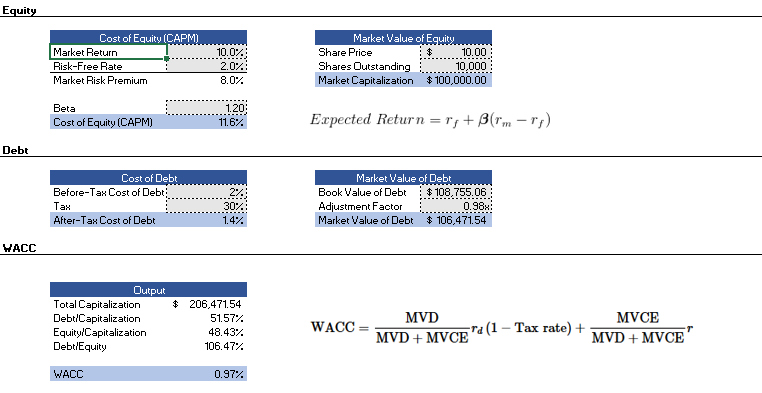
Let's walk through the steps shown in the calculator:
- Calculate Cost of Equity: It uses the CAPM formula, taking inputs for the risk-free rate, beta, and equity risk premium.
- Calculate After-Tax Cost of Debt: It takes the pre-tax cost of debt and multiplies it by (1 - Tax Rate).
- Determine Market Values and Weights: It calculates the market value of equity and debt, sums them to get total capital, and then computes the percentage weight of each.
- Calculate WACC: It applies the main WACC formula, multiplying the cost of each capital source by its respective weight and summing the results.
Finally, to see this applied to a well-known company, let's look at the Apple example from the Wall Street Prep guide.
WACC Guide | Formula + Calculation Example
This final section of the WSP guide provides a worked example of calculating WACC for Apple Inc. and shows how sensitive the final valuation is to the WACC assumption. This directly connects our calculation to its ultimate purpose in the DCF model.
Read the section 'WACC Calculation Example: Apple (AAPL)'. Notice how the different inputs we've discussed are brought together. Also, review the sensitivity analysis table, which powerfully illustrates why getting WACC right is so critical.
Conclusion
Congratulations! You have now constructed the final piece of the DCF discount rate. The WACC is one of the most important and frequently debated numbers in finance, and you now understand how to build it from the ground up.
Key Takeaways:
- The WACC is the blended cost of a company's capital, weighted by the market value proportions of debt, equity, and any other capital sources.
- The formula is: WACC = ( × ) + ( × × (1-T)).
- It is crucial to use market values for the weights, not book values.
- Best practice is to use a target capital structure, often derived from the median of a peer group, to reflect the company's long-term financing policy.
We now have our projected Unlevered Free Cash Flows (the numerator) and our discount rate, WACC (the denominator). We are almost ready to calculate the value of the firm. However, a DCF model has two parts: the explicit forecast period and the period after that, which extends into perpetuity.
In our next lesson, we will tackle the final major component of our valuation: how to estimate terminal value using both the perpetuity growth method and the exit multiple method. This will allow us to capture the value of all cash flows beyond our explicit forecast horizon.