Hello! Welcome back to our module on Discounted Cash Flow (DCF) Valuation.
In our previous lesson, we constructed the "numerator" of the DCF model by learning how to project Unlevered Free Cash Flow (UFCF). You now know how to forecast the cash a business will generate. Our next task is to determine the value of those future cash flows in today's terms. To do that, we need a discount rate—the "denominator" of the DCF.
This lesson addresses the learning outcome: Calculate the Cost of Equity using the Capital Asset Pricing Model (CAPM) and the after-tax Cost of Debt. These are the two primary components of the discount rate we will use, the Weighted Average Cost of Capital (WACC).
Think of this process like designing a structure. In the last lesson, we calculated the loads (the cash flows). Now, we need to determine the properties of the materials (the costs of capital) we'll use to support those loads.

1. The Cost of Equity: What Return Do Shareholders Require?
The Cost of Equity is the return that equity investors require for investing in a company. Unlike debt, there are no contractually required payments to shareholders. Instead, their return comes from dividends and stock price appreciation. This makes quantifying their required return more theoretical. The most common method used in finance is the Capital Asset Pricing Model (CAPM).
To get a clear, practical introduction to CAPM, let's start with a guide from Wall Street Prep.
WACC Guide | Formula + Calculation Example
This article, 'WACC Guide', provides an excellent overview of the components of WACC. We'll start by focusing on the Cost of Equity and the CAPM formula.
Please read the sections 'How to Calculate Cost of Equity Ratio' and 'Capital Asset Pricing Model (CAPM)'. Focus on the core idea behind CAPM and the breakdown of its formula.
As the article explains, the CAPM formula is:
Where:
- = Risk-Free Rate
- = Beta (a measure of the stock's systematic risk)
- ERP = Equity Risk Premium (also called Market Risk Premium)
Let's dissect each of these inputs, drawing on the expert resources you requested.
a) The Risk-Free Rate ()
The risk-free rate is the theoretical rate of return of an investment with zero risk. In practice, we use the yield on a long-term government bond from a country with negligible default risk.
For a company that operates primarily in the U.S. and is being valued in USD, the yield on the U.S. 10-year or 30-year Treasury bond is the standard proxy.
Estimating this rate becomes more complex for companies in emerging markets where the government itself has default risk. Professor Aswath Damodaran of NYU Stern is a leading authority on this topic.
Valuation MBA Webcasts - Spring 2025
This video from Professor Damodaran's valuation course, 'Estimating a risk free rate', explains the nuances of choosing a risk-free rate, especially in currencies without a default-free government entity. This is a critical concept for global financial analysis.
Watch the video 'Estimating a risk free rate'. Pay attention to his logic for adjusting a country's government bond rate for its default spread to arrive at a true risk-free rate.
Key principle: The risk-free rate must be in the same currency as your cash flows. If you are valuing a company in Ghanaian Cedi, you cannot use the U.S. Treasury rate directly. You would start with the Ghanaian government bond yield and then subtract the country's default spread.
b) The Equity Risk Premium (ERP)
The ERP is the extra return that investors demand for investing in the overall stock market instead of the risk-free asset. It answers the question: "How much more do I expect to earn for taking on the general risk of investing in stocks?"
The ERP is a critical and debated number. There are two main ways to estimate it:
- Historical ERP: Looking at the actual historical excess returns earned by stocks over government bonds over a long period.
- Implied ERP: A forward-looking approach that solves for the discount rate that equates the current level of a stock index (like the S&P 500) to the present value of its expected future cash flows.
Professor Damodaran provides updated data and a deep explanation of this concept.
Valuation MBA Webcasts - Spring 2025 (Lecture Notes)
Professor Damodaran's lecture notes provide a thorough analysis of Equity Risk Premiums. This reading covers the drivers of ERPs and different estimation methods.
Please review the lecture notes 'Lecture note packet 1: Pages 38-55'. Focus on understanding the difference between historical and implied premiums, and the concept of a Country Risk Premium (CRP), which is added to the ERP for companies with exposure to riskier countries.
For practical purposes, many analysts use a widely accepted range for the U.S. ERP, typically between 4% and 6%. Damodaran's website is the go-to source for current implied ERPs and country risk premiums.
c) Beta ()
Beta measures a stock's sensitivity to overall market movements (i.e., systematic risk).
- A beta of 1 means the stock moves in line with the market.
- A beta > 1 means the stock is more volatile than the market.
- A beta < 1 means the stock is less volatile than the market.
While you can find a "historical beta" for any public company by regressing its stock returns against market returns, this number is often statistically noisy and backward-looking. A more robust method, especially for an "Ivy League quality" analysis, is to use a bottom-up beta.
This involves:
- Finding a group of comparable public companies.
- Taking their historical betas and unlevering them to remove the effect of their individual debt levels.
- Averaging the unlevered betas to get an industry-average unlevered beta.
- Relevering this industry beta using your target company's specific capital structure.
This process gives you a beta that reflects the fundamental business risk of the industry, not the noise of one company's stock price history.
WACC Guide | Formula + Calculation Example
Let's return to the Wall Street Prep guide for a step-by-step breakdown of how to calculate and apply beta, including the critical formulas for unlevering and relevering.
Read the section 'How to Calculate Beta (Systematic Risk)' through to the end. Pay close attention to the 'Industry Beta Approach' and the formulas for 'Unlevering Peer Group Beta' and 'Relevering Beta'.
The formulas are:
- Unlevered Beta:
- Relevered Beta:
Where T is the tax rate, and D/E is the Debt-to-Equity ratio.
2. The Cost of Debt: What Return Do Lenders Require?
The Cost of Debt is the effective interest rate a company would have to pay if it borrowed money today. This is more straightforward to estimate than the cost of equity.
a) Estimating the Pre-Tax Cost of Debt ()
There's a hierarchy of methods to find a company's pre-tax cost of debt:
- If the company has publicly traded bonds: Use the Yield to Maturity (YTM) on its long-term debt. This is the most accurate measure.
- If there are no public bonds, but the company has a credit rating: Find the default spread associated with that rating (e.g., 'AA', 'BBB') and add it to the risk-free rate.
- If there is no rating: You can create a "synthetic rating" by calculating the company's Interest Coverage Ratio (EBIT / Interest Expense) and using a table (like those provided by Damodaran) to map that ratio to a rating and default spread.
WACC Guide | Formula + Calculation Example
The Wall Street Prep guide clearly outlines these practical methods for finding the pre-tax cost of debt.
Read the section 'How to Calculate Cost of Debt Ratio'. Focus on the three distinct methods for estimating the cost of debt depending on the company's situation.
b) The After-Tax Cost of Debt
Interest payments on debt are tax-deductible, creating a "tax shield" that reduces the effective cost of debt for the company. To reflect this benefit, we multiply the pre-tax cost of debt by (1 - Tax Rate).
After-Tax Cost of Debt =
When choosing the tax rate, it's generally best to use the marginal tax rate—the rate the company is expected to pay on its next dollar of income—as this best reflects the tax benefit of future interest payments.
Test your understanding!
You are calculating the cost of capital for a company to use in a DCF valuation. You have gathered the following information:
- 10-Year U.S. Treasury Bond Yield: 3.5%
- Equity Risk Premium (ERP): 5.0%
- Company's Relevered Beta (): 1.2
- Company's Pre-Tax Cost of Debt (): 6.0%
- Company's Marginal Tax Rate: 25%
Calculate the company's Cost of Equity and its After-Tax Cost of Debt.
Show answer
1. Calculate Cost of Equity () using CAPM:
- Formula:
- Calculation:
- The Cost of Equity is 9.5%.
2. Calculate After-Tax Cost of Debt:
- Formula: After-Tax Cost of Debt =
- Calculation: After-Tax Cost of Debt =
- After-Tax Cost of Debt =
- The After-Tax Cost of Debt is 4.5%.
Conclusion
In this lesson, we have assembled the fundamental building blocks of the discount rate. You now understand the theory and practical steps needed to estimate the cost of a company's two main sources of capital.
Key Takeaways:
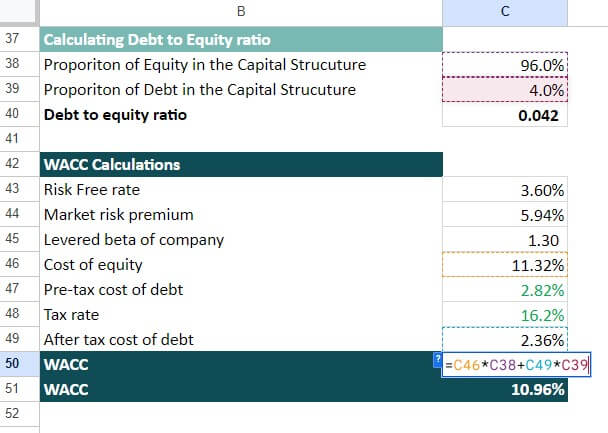
- The Cost of Equity () is the return shareholders require and is best estimated using the Capital Asset Pricing Model (CAPM): .
- Estimating CAPM inputs requires careful judgment, especially for the Risk-Free Rate, Equity Risk Premium, and Beta. Using a bottom-up beta is the most robust approach.
- The Cost of Debt () is the company's current borrowing rate, found using YTM, credit ratings, or synthetic ratings.
- Because interest is tax-deductible, we use the After-Tax Cost of Debt = in our valuation.
We have now calculated the projected cash flows (UFCF) and the individual costs of the capital needed to fund the business. The final step in deriving our discount rate is to blend these costs together based on the company's financing mix.
In our next lesson, we will do just that by learning how to calculate the Weighted Average Cost of Capital (WACC) based on a target capital structure.