Hello! Welcome back to our module on DCF Valuation.
In our last few lessons, we've been assembling the essential building blocks for our valuation model. We've projected the Unlevered Free Cash Flows (UFCF), calculated the Weighted Average Cost of Capital (WACC), and estimated the Terminal Value (TV). Now, it's time to bring these components together to arrive at a value for the company.
This lesson focuses on the heart of the Discounted Cash Flow method, directly addressing the learning outcome: Discount the projected free cash flows and terminal value to derive the enterprise value. This is the step where we translate all our future projections into a single, present-day value.
1. The Core Principle: The Time Value of Money
As you've covered in your MBA studies, the fundamental principle underpinning this entire exercise is the time value of money: a dollar today is worth more than a dollar tomorrow. Discounting is the mechanism we use to quantify this principle. We take the future cash flows we've projected and systematically reduce their value to reflect the risk and opportunity cost of not having that cash in hand today.
The formula for calculating Present Value (PV) is:
Where:
- FV = Future Value (our projected UFCF or Terminal Value)
- r = Discount Rate (our WACC)
- n = Number of periods into the future
Our goal is to apply this formula to every cash flow in our two-stage model (the explicit forecast period and the terminal period) and sum the results.
DCF Model Training | Excel Tutorial Guide
To start, let's review the high-level framework and the role of discounting. This article from Wall Street Prep provides a concise overview of the 6-step DCF process, positioning our current task within the larger context.
Please read the section 'How to Build a DCF Model: 6-Step Framework'. Pay close attention to Step 3, 'Discounting the cash flows to the present at the WACC,' as this is the focus of our lesson.
2. Calculating Enterprise Value: A Step-by-Step Guide
The Enterprise Value (EV) in a DCF model is the sum of two components:
- The Present Value of the UFCFs in the explicit forecast period.
- The Present Value of the Terminal Value.
Let's break down the calculation.
Step 1: Discount the Explicit Period Cash Flows
First, we take each of the UFCFs from our explicit forecast (typically 5-10 years) and discount them back to today (Year 0).
For each year i in the forecast period, the calculation is:
We perform this calculation for every year in our forecast and then sum the results. This gives us the Present Value of Explicit UFCFs.
A Note on Discounting Convention: Mid-Year vs. End-of-Year
In academic settings, cash flows are often assumed to arrive at the end of the year (as in the formula above). However, in practice, cash is generated throughout the year. To reflect this, professional analysts often use a mid-year discounting convention. This assumes cash flows are received, on average, at the middle of each period.
The adjustment is simple: you subtract 0.5 from the exponent.
This results in a slightly higher present value because the cash is received, on average, six months earlier. While not a dramatic change, it's a detail that adds precision expected in high-level financial analysis.
Step 2: Discount the Terminal Value
Next, we must discount the Terminal Value. Remember from our last lesson that the TV is a lump-sum value calculated as of the end of the final forecast year (Year n). Therefore, we need to discount it back n years to find its value today.
The formula is:
Note that even if you use a mid-year convention for the explicit UFCFs, the Terminal Value is still discounted by the full number of years (n), as it represents a value at the end of that final period.
Step 3: Sum the Present Values to Find Enterprise Value
The final step is to add the two components together.
The resulting Enterprise Value represents the total value of the company's core business operations, attributable to all capital providers (both lenders and shareholders).
DCF Model: Full Guide, Excel Templates, and Video Tutorial
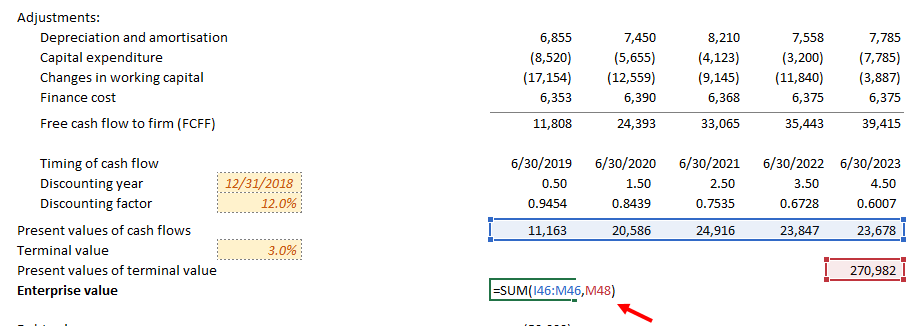
This guide from Mergers & Inquisitions provides an exceptionally clear, visual breakdown of this process. It shows exactly how the discounting formulas are applied to each component.
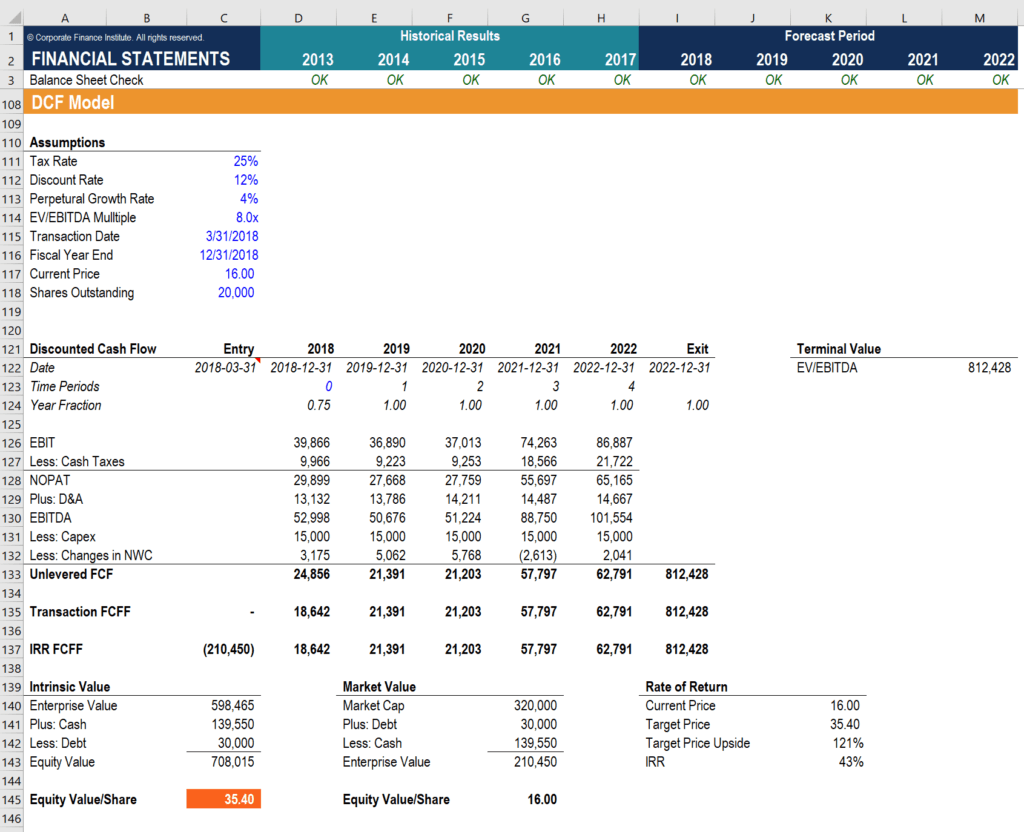
Please read from the sub-section starting 'you can now use this Discount Rate to take the Present Value of each UFCF' through the end of 'DCF Model, Step 3: The Terminal Value'. Focus on the two images ('Present Value of Unlevered Free Cash Flow' and 'DCF Model - Terminal Value') which clearly show the UFCFs and TV being discounted and then summed to derive the Enterprise Value.
3. A Practical Example
Let's look at another practical layout of this calculation.
Test your understanding!
You are finishing a DCF for a company with a 5-year explicit forecast period. You have the following information:
- WACC: 9.0%
- UFCF Projections:
- Year 1: $110m
- Year 2: $120m
- Year 3: $130m
- Year 4: $135m
- Year 5: $140m
- Terminal Value (at end of Year 5): $2,100m
Using the standard end-of-year discounting convention, calculate the company's Enterprise Value.
Show answer
First, calculate the Present Value (PV) of each explicit UFCF:
- PV(UFCF 1) = $110 / (1.09)^1 = $100.92m
- PV(UFCF 2) = $120 / (1.09)^2 = $100.99m
- PV(UFCF 3) = $130 / (1.09)^3 = $100.39m
- PV(UFCF 4) = $135 / (1.09)^4 = $95.64m
- PV(UFCF 5) = $140 / (1.09)^5 = $90.98m
Sum of PV of Explicit UFCFs = $100.92 + $100.99 + $100.39 + $95.64 + $90.98 = $488.92m
Next, calculate the Present Value of the Terminal Value:
- PV(TV) = $2,100 / (1.09)^5 = $1,364.76m
Finally, calculate the Enterprise Value:
- Enterprise Value = $488.92m + $1,364.76m = $1,853.68m
Conclusion
Congratulations! You have now completed the core calculation of a Discounted Cash Flow valuation, bringing together all the pieces we have painstakingly assembled.
Key Takeaways:
- Enterprise Value in a DCF is the sum of the present values of all future Unlevered Free Cash Flows (both during the explicit forecast and in the terminal period).
- The WACC is the appropriate discount rate for UFCF because it reflects the blended risk and required return for all capital providers.
- The process involves two main calculations:
- Discounting each year's explicit UFCF to the present and summing them up.
- Discounting the single Terminal Value lump sum to the present.
- Professional models often use a mid-year discounting convention for explicit cash flows to better reflect the reality that cash is earned throughout the year.
We have now arrived at a value for the entire enterprise. But for investors, the key question is often: what is the value of the equity?
In our next lesson, we will complete the valuation by learning how to construct a bridge from enterprise value to equity value and calculate the implied share price. This will allow us to compare our DCF-derived value to the company's current stock price.