Hello! Welcome back to our module on Discounted Cash Flow (DCF) Valuation.
In our previous lesson, we accomplished the central task of a DCF analysis: we calculated the company's Enterprise Value (EV) by projecting and discounting its Unlevered Free Cash Flows and Terminal Value. This gave us a value for the company's core business operations.
Now, we need to translate that enterprise-level value into a number that is meaningful for an equity investor: the value per share. This lesson focuses on the final and crucial steps of the valuation process, directly addressing the learning outcome: Construct a bridge from enterprise value to equity value and calculate the implied share price.
1. Recap: From Future Cash Flows to Enterprise Value
Just to quickly recap, we started with forecasts of future cash flows, selected a discount rate (WACC) that reflects the risk of those cash flows, and calculated a Terminal Value to capture the company's value beyond our explicit forecast period. By discounting all of these components back to the present, we arrived at the Enterprise Value.
Now, let's build the bridge from this value to the one that equity shareholders truly care about.
2. The Bridge: From Enterprise Value to Equity Value
Enterprise Value represents the value of a company's core operating assets and is attributable to all providers of capital (both lenders and shareholders). Equity Value, on the other hand, is the value that belongs solely to the common shareholders.
To get from EV to Equity Value, we must account for all non-equity claims and any non-operating assets. The formula for this "bridge" is:
Equity Value = Enterprise Value - Total Debt - Preferred Stock - Non-controlling Interests + Cash & Cash Equivalents + Non-Operating Assets
This can be simplified for many companies as:
Equity Value = Enterprise Value - Net Debt (where Net Debt = Total Debt - Cash)
Let's look at the components of this bridge.
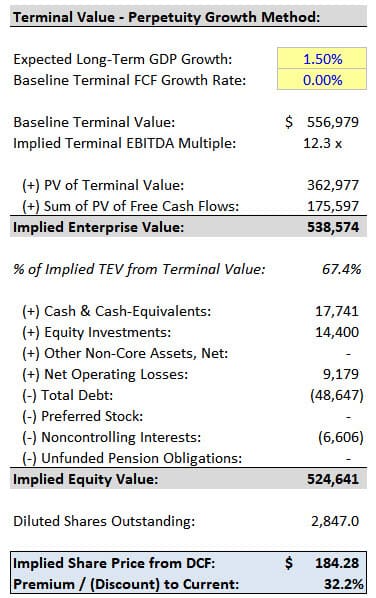
Components of the Bridge:
- Start with Enterprise Value: This is the value we calculated in the last lesson.
- Subtract Debt & Debt-like Items: Debt holders have a senior claim on the company's assets over equity holders. We must subtract the market value of all debt, including short-term debt, long-term debt, and capital leases.
- Subtract Other Senior Claims: For a truly comprehensive analysis, as expected in top-tier finance, you should also consider other non-equity claims. These can include:
- Preferred Stock: A class of equity with a fixed dividend that has priority over common stock.
- Non-controlling Interest (or Minority Interest): This represents the portion of a subsidiary that the parent company does not own. Since a DCF based on consolidated financials values 100% of the subsidiary, we must subtract the portion of that value not attributable to our shareholders.
- Unfunded Pension Obligations or Lawsuit Liabilities: These are real claims on future cash flows that must be settled before anything is available to equity holders.
- Add Cash & Cash Equivalents: Enterprise Value reflects the value of operating assets. Excess cash is generally considered a non-operating asset. Since it's not required for the day-to-day running of the business, its value belongs to the shareholders. Therefore, we add it back.
- Add Other Non-operating Assets: This could include investments in other companies or property not used in operations.
CHAPTER 16 ESTIMATING EQUITY VALUE PER SHARE
For a structured overview of this process and a deeper dive into the specific claims you might encounter, let's turn to a chapter from Professor Aswath Damodaran of NYU's Stern School of Business. This text provides the academic rigor you appreciate from your MBA program.
Please read the section titled 'Firm Value and Equity Value'. Focus on the discussion under the sub-heading 'What non-equity claims should be subtracted out?'. This provides a thorough list of items to consider beyond just simple debt.
3. Calculating the Implied Share Price
Once we have the Equity Value, the final step seems simple: divide by the number of shares.
The key complexity here lies in determining the correct number of shares. We must use the Diluted Shares Outstanding, not just the basic share count. Dilution refers to the potential increase in the number of shares if all dilutive securities—like stock options, warrants, or convertible bonds—were exercised or converted.
The Treasury Stock Method (TSM)
The most common method for calculating the impact of stock options and warrants is the Treasury Stock Method (TSM). The logic is as follows:
- Assume the company receives proceeds from all "in-the-money" options being exercised (i.e., options where the exercise price is below the current stock price).
- Assume the company uses these cash proceeds to buy back its own shares from the open market at the current stock price.
- The net new shares created is the difference between the shares issued for the options and the shares repurchased.
Net New Shares = Options Outstanding - (Proceeds / Share Price)
This calculation introduces a circularity problem: you need the share price to calculate the number of diluted shares, but you need the number of diluted shares to calculate the share price. In Excel, this can be solved by enabling iterative calculations or by starting with the current market price and iterating manually until the Implied Share Price converges.
Equity Value Per Share | Formula + Calculator
The article from Wall Street Prep provides a concise, practitioner-focused view on calculating equity value per share and introduces the Treasury Stock Method.
Please read the sections 'How to Calculate Equity Value Per Share', 'Equity Value Per Share Formula', and the 'Equity Value Per Share Calculation Example'. This will give you a clear, step-by-step practical guide that mirrors what's done on the job.
Professor Damodaran's chapter (LINK) also provides a more detailed discussion on handling outstanding options, contrasting the Treasury Stock Method with other approaches. He recommends valuing the options directly using an option pricing model (like Black-Scholes) and subtracting their value from the Equity Value before dividing by the basic shares outstanding. This is a more theoretically sound but complex method. For most practical purposes, the TSM is the accepted standard.
Test your understanding!
You have completed a DCF valuation and derived an Enterprise Value of $5,000 million. You also have the following data from the company's balance sheet and filings:
- Total Debt: $1,200 million
- Cash & Cash Equivalents: $200 million
- Preferred Stock: $100 million
- Non-controlling Interest: $50 million
- Basic Shares Outstanding: 250 million
- In-the-money options outstanding: 20 million shares with a weighted average exercise price of $10.
First, calculate the company's Implied Equity Value. Then, using the Treasury Stock Method, calculate the Implied Share Price. For the TSM calculation, use the implied share price you derive as the "current price" for the buyback (this will require a bit of algebra).
Show answer
1. Calculate Implied Equity Value:
- Equity Value = EV - Debt + Cash - Preferred Stock - NCI
- Equity Value = $5,000m - $1,200m + $200m - $100m - $50m = $3,850 million
2. Calculate Diluted Shares and Implied Share Price:
Let P = Implied Share Price.
The formula is:
First, calculate the proceeds from option exercise:
- Proceeds = 20 million options * $10/option = $200 million
Next, calculate the number of shares the company can repurchase with these proceeds:
- Shares Repurchased = Proceeds / P = $200m / P
Then, calculate the net new shares created by the options:
- Net New Shares = Options Issued - Shares Repurchased = 20m - ($200m / P)
Now, substitute this into the share price formula:
The Implied Share Price is $15.00.
Conclusion: The Final Output
You have now successfully navigated the entire DCF process, from forecasting future cash flows to arriving at an implied value per share.
Key Takeaways:
- The bridge from Enterprise Value to Equity Value adjusts for all claims senior to common equity (like debt and preferred stock) and adds back non-operating assets (like cash).
- The final Implied Share Price is calculated by dividing the Equity Value by the Diluted Shares Outstanding.
- The Treasury Stock Method is the standard approach for calculating the dilutive effect of stock options.
- The ultimate goal is to compare your Implied Share Price to the company's Current Market Price to determine if the stock appears undervalued, overvalued, or fairly valued based on your analysis.
This single price target is a powerful output, but it's built on a tower of assumptions. What if our growth rate assumption is too optimistic? What if the WACC is slightly higher? Understanding how sensitive our final valuation is to these inputs is critical for making a robust recommendation.
In our next and final lesson for this module, we will address this uncertainty by learning how to perform sensitivity analysis on key valuation assumptions (e.g., WACC, growth rate) using data tables.