In the previous lesson, you saw that the governor’s power to fill an office depends on the office’s governing rule: an agency director may require Senate confirmation, while a vacancy in certain elected statewide offices requires approval from both legislative houses. Judicial selection follows a different set of rules.
This lesson compares California’s superior court judges with its Court of Appeal and Supreme Court justices. The central distinction is between an election in which candidates can compete for a judgeship and a retention election in which voters decide whether a particular justice should continue serving.
Two routes to the bench
Superior courts are California’s trial courts. The Courts of Appeal and the Supreme Court review cases at the appellate level. California calls the people serving on superior courts judges and those serving on its appellate courts justices. That difference in title is a useful cue to check which selection procedure applies.
For a quick orientation, watch this short comparison from LAist’s A Guide to the LA County Judges on Your November 2026 Ballot. Its account of the two kinds of ballot will help you interpret the more precise rules below.
A guide to the LA County judges on your November 2026 ballot | LAist Voter Game Plan
LAist contrasts superior court contests with appellate retention elections.
Watch the comparison. Focus on whether another candidate can run for the seat and what choice voters are asked to make.
The California Courts Newsroom infographic provides a visual overview. Use it as a map, rather than as a complete statement of election timing: an unopposed superior court incumbent may not appear on the ballot, and the timing of an appellate appointee’s first retention vote depends on the seat’s election cycle.
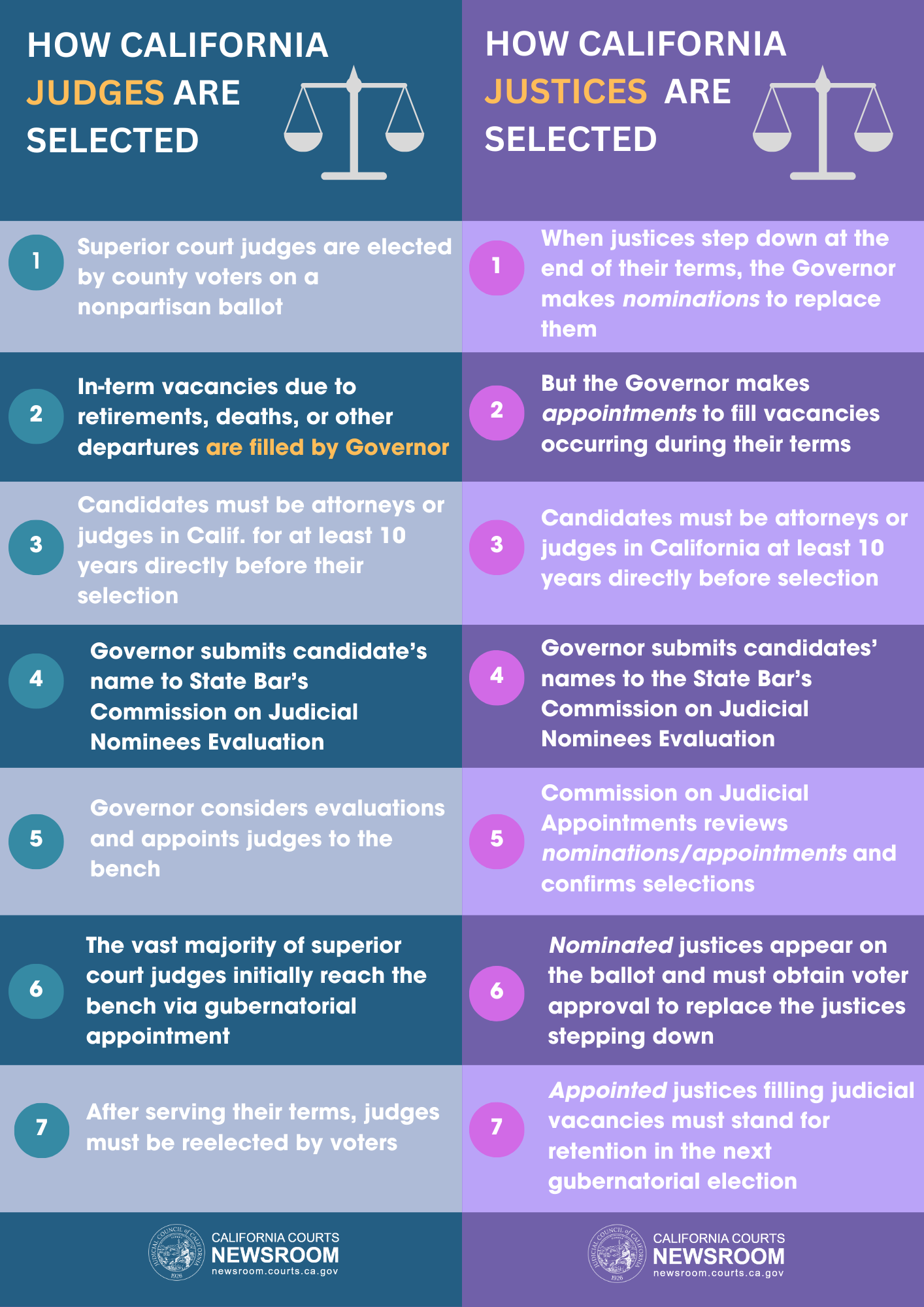
Both routes give the governor a substantial role. Neither gives the governor unrestricted control over who remains on the bench. To see the difference, start with the trial courts.
Superior court judges: contested elections and vacancy appointments
Read the “Superior Court Judges” section of Judicial Selection: How California Chooses Its Judges and Justices from the California Courts Newsroom. It sets out the ordinary election rule alongside the important fact that many judges first take office by appointment.
Judicial Selection: How California Chooses Its Judges and Justices | California Courts Newsroom
Read the California Courts Newsroom's account of superior court selection to separate how a judge first reaches the bench from how a judge later keeps the seat.
Under “Superior Court Judges,” read the full account, from the opening sentence about judgeships through the paragraph on candidate qualifications. Pay particular attention to midterm vacancies, six-year terms, and the circumstance in which an incumbent's name does not appear on the ballot.
County voters elect superior court judges in nonpartisan elections for six-year terms. A person can win an open seat through an election. But when a judge retires, dies, or otherwise leaves during a term, the governor fills the vacancy by appointment. According to the courts’ account, this is how the vast majority of superior court judges initially reach the bench.
Those facts fit together rather than contradicting each other. Appointment describes how a midterm vacancy is filled; it does not turn the superior court judgeship into a permanently appointed office. The California Constitution governs when the seat next goes to election and when an appointed judge must first stand. Judges who have been elected must stand for reelection at the end of their six-year terms.
A superior court election can be contested: another eligible person may run for the seat. There is a practical qualification, though. If the incumbent—including a judge originally appointed by the governor—runs unopposed, the incumbent’s name does not appear on the ballot. “Must stand for reelection” therefore does not mean “will necessarily be listed on every voter’s ballot.”
Before selection, a superior court candidate must have been admitted to practice law in California or served as a California judge for at least ten years immediately preceding election or appointment. For prospective gubernatorial appointees, the State Bar’s Commission on Judicial Nominees Evaluation investigates background and qualifications. That evaluation is a screening step; it is not a Senate confirmation vote, and it is not the election through which voters can choose a superior court judge.
Appellate justices: confirmation and a yes-or-no vote
The Court of Appeal and Supreme Court use a different arrangement. Continue with the “Supreme Court and Court of Appeal Justices” section of the same California Courts Newsroom article.
Judicial Selection: How California Chooses Its Judges and Justices | California Courts Newsroom
Continue the California Courts Newsroom article to see how an appellate justice reaches office and why the subsequent vote is unlike a superior court contest.
Under “Supreme Court and Court of Appeal Justices,” read the selection account. Begin with appointment and confirmation, then follow the explanation of twelve-year seat cycles, retention elections, and the separate rules for an end-of-term departure and a vacancy during a term.
For a vacancy during an appellate justice’s term, the governor appoints a replacement, but the selection requires confirmation by the Commission on Judicial Appointments. This is not the State Senate and not the State Bar’s evaluation commission. The Commission on Judicial Appointments includes the Chief Justice and Attorney General, along with a presiding Court of Appeal justice as specified for the court concerned.
The Court of Appeal’s explanation of its selection process shows what confirmation adds after the professional evaluation.
How Appellate Court Justices are Selected | District Courts of Appeal
Read the California Courts of Appeal's description of the Commission on Judicial Appointments to distinguish evaluating a candidate from confirming a selection.
In the paragraph beginning “After receiving the Commission's evaluation,” read the confirmation account through the sentence about taking the oath of office. Notice the public hearing, the opportunity for comment, and the commission's confirmation decision.
Keep the two commissions’ jobs distinct. The Commission on Judicial Nominees Evaluation assesses a prospective justice’s qualifications and reports its evaluation to the governor. The Commission on Judicial Appointments reviews the selection at a public hearing and decides whether to confirm it. Confusing these bodies would make it seem either that screening itself confers office or that the governor’s choice needs no confirmation.
Voters then have a different role from the one they have in superior court elections. An appellate justice faces a retention election: the ballot asks whether that justice should continue in office. Voters answer yes or no; another candidate does not run against the justice for that seat. A justice appointed during a term must stand at the first applicable appellate election for which there was sufficient time to file. These elections occur in gubernatorial-election years.
Appellate seats operate on twelve-year election cycles. Because a vacancy does not restart a seat’s cycle, a justice’s initial period following appointment and election may be the remainder of that cycle rather than a fresh twelve years. An incumbent subsequently seeking another full term faces another retention vote.
There is also an end-of-term route that should not be mistaken for filling a midterm vacancy. When a Supreme Court or Court of Appeal justice will complete a term but not seek reelection, the governor nominates a successor to appear on the ballot, subject to the judicial selection process and voter approval. When a justice leaves during a term, the governor instead makes an appointment to fill the vacancy. In neither case do voters choose between competing candidates for that appellate seat.
Putting the rules side by side
The easiest way to classify a judicial selection is to identify the court, then whether the seat became vacant during a term. Only after that should you ask what approval or election follows.
| Superior court judge | Court of Appeal or Supreme Court justice | |
|---|---|---|
| Ordinary voter choice | Candidates can compete in a nonpartisan election | Yes-or-no retention vote on one justice |
| Vacancy during a term | Governor appoints a judge | Governor appoints a justice, subject to Commission on Judicial Appointments confirmation |
| Continuing in office | Six-year terms; reelection rules apply, though an unopposed incumbent may not appear on the ballot | Twelve-year seat cycle; retention elections, with an appointee’s first vote timed to the applicable election |
| Legislative confirmation of the judicial selection | Not the procedure described here | Not the procedure described here; a judicial commission confirms |
Consider the contrast in concrete terms. If a superior court judge retires partway through a term, the governor can appoint a replacement. That judge later comes under the superior court election rules, under which a challenger may run. If a Court of Appeal justice leaves partway through a term, a gubernatorial appointee needs confirmation by the Commission on Judicial Appointments and later faces a yes-or-no retention vote. Calling both selections “gubernatorial appointments” is accurate but incomplete: it leaves out the different checks that follow.
These procedures also connect to the larger question of gubernatorial limits. The governor has influence over judicial membership through appointments and nominations, but cannot treat the courts as an executive agency staffed solely at the governor’s discretion. Screening, appellate confirmation, and voter decisions each have their own place in the selection rules.
Key takeaways
Superior court judges may first reach office through a contested election or a gubernatorial appointment to a vacancy; they serve six-year terms under reelection rules. Court of Appeal and Supreme Court justices enter through a gubernatorial selection process involving confirmation by the Commission on Judicial Appointments, and voters decide whether they continue through uncontested, yes-or-no retention elections tied to twelve-year seat cycles. The State Bar’s evaluation commission and the confirming commission perform different jobs.
The next lesson shifts from how judges take office to what courts can do when a governor’s action exceeds legal authority or violates a constitution.