Hello. This module examines how California decides what the state may spend and who has the authority to make that decision. The governor leads the executive branch and proposes a budget, but a proposal is not permission to spend. In this lesson, you will follow the annual budget from its January submission to enactment, then examine the constitutional rule that limits General Fund spending. The next lesson will look more closely at the governor’s power to reduce or eliminate particular appropriations.
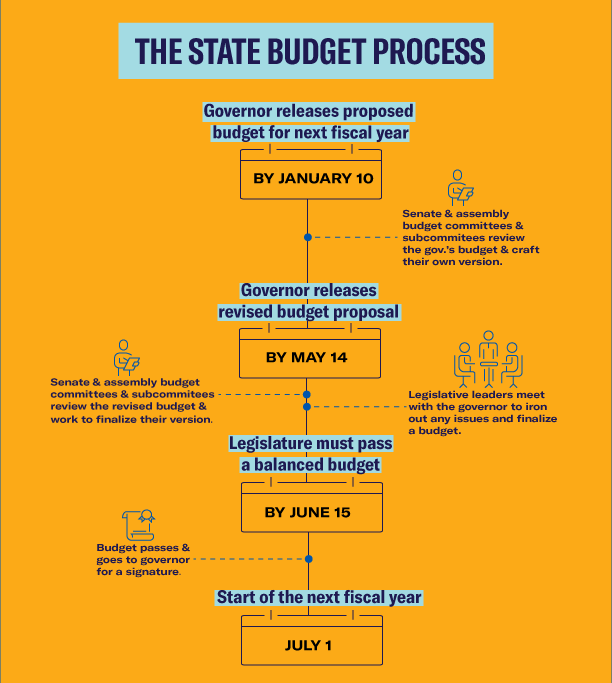
The governor proposes; the Legislature considers
California’s fiscal year runs from July 1 through the following June 30. By January 10, the governor submits a budget for the fiscal year that will begin that July. It estimates revenues and recommends expenditures—how much the state expects to receive and how it proposes to use those funds. An accompanying budget bill puts recommended spending into legislative form.
The distinction between the two documents matters. The governor’s budget explains a plan; the budget bill is a proposed law. Neither the governor’s announcement nor the introduction of a bill authorizes spending on its own.
Read the Senate’s account of the opening stages before following what happens in the two houses.
Budget Process - Senate.ca.gov
Read this California Senate guide for the annual timetable and the roles of the governor, legislative committees, and fiscal analysts.
On p. 2, under “How the Budget Process Works” and “The Governor’s Budget Proposal,” read the January proposal. Continue on pp. 3–4 through “Legislative Budget Committee Hearings”: begin with “After its introduction, the Legislature has until June 15 to pass the budget” and read the committee review. Focus on what legislators can change and why the May Revision arrives before their work is finished; you may skim the guide’s advice about contacting legislators.
Once identical budget bills are introduced in the Assembly and Senate, each house examines the proposal. Budget committees and their subject-area subcommittees hold hearings, weigh alternatives, and recommend changes. The Legislative Analyst’s Office supplies nonpartisan fiscal analysis to the Legislature. The governor’s Department of Finance and state agencies also provide information. This is a substantive check on executive power: legislators need not accept the governor’s spending priorities merely because the governor prepared the first draft.
Revenue estimates can change between January and spring. By May 14, the governor provides an updated forecast and proposed changes, commonly called the May Revision. That update informs legislative deliberation; it does not replace the Legislature’s decisions.
From competing versions to a passed bill
Each house considers and votes on a version of the budget bill. If the versions differ, legislators must agree on a single version for both houses to pass. A conference committee has traditionally been one way to work through differences; legislative negotiations and amendments can also produce an agreed bill. Related trailer bills may be needed when implementing the budget requires changes to other statutes. They are separate bills, not spending authority created simply by attaching a label to the budget.
Budget Process - Senate.ca.gov
Return to the California Senate guide to see how legislative revisions become a bill that can be presented to the governor.
On pp. 5–7, start with “The full committee may accept the report or amend it.” Read the account of agreement, including “Legislative Conference Committee” and “Leadership Meetings.” Concentrate on the requirement that both houses approve the final version and on why statutory changes in trailer bills require separate passage. Treat the guide’s description of a conference committee as a traditional procedure, not as the only possible route to agreement.
The Constitution sets midnight on June 15 as the deadline for the Legislature to pass the budget bill. Passage requires a majority of the membership of each house, voting by recorded roll call. June 15 is not a deadline by which the governor must sign it: legislative passage and enactment are different events.
That difference identifies who controls spending. The Legislature authorizes appropriations by passing bills that become law, including the budget bill; the governor participates through approval or veto rather than by issuing spending authority through a proposal. Some spending is also authorized under laws already in force, so not every expenditure depends on a new line in that year’s budget bill.
What “balanced” requires
“Balanced budget” can sound like a simple rule that every proposed dollar of spending must equal a proposed dollar of revenue. California’s constitutional text is more specific. It directs the governor to identify proposed expenditures and estimated revenues. If proposed expenditures exceed estimated revenues, the governor must recommend sources for the additional revenue. For the budget bill ultimately sent to the governor, a separate rule imposes a General Fund ceiling.
The constitutional wording is worth reading alongside the Senate guide’s shorter description.
Constitution of California—Article IV 207
Read the governing rules in Article IV rather than relying only on a summary of the process.
In Section 12 on printed pp. 217–218, begin with the governor’s submission requirement in subsection (a): read proposal and revenues. Then read subsection (c), from bill and deadline. In subsection (e)(1), find the sentence beginning “Notwithstanding any other provision” and read the vote rule. In subsection (g), beginning “For the 2004–05 fiscal year,” read the General Fund limit. Finally, in Section 10(a) on printed p. 215, read the approval and veto rule.
Under Section 12(g), the Legislature may not send the governor—and the governor may not sign—a budget bill if the resulting General Fund total exceeds the General Fund revenues estimated when the bill passes. The total counts the bill’s General Fund appropriations together with General Fund appropriations already made for that fiscal year and the specified transfer to the Budget Stabilization Account. The estimated revenue figure must appear in the passed budget bill.
Consider a simplified ledger, with all figures in billions of dollars:
| General Fund measure for the fiscal year | Amount |
|---|---|
| Estimated revenues at passage | 120 |
| Appropriations already made | 12 |
| Proposed budget-bill appropriations | 106 |
| Specified reserve transfer | 3 |
The counted total would be , exceeding estimated revenue by . As written, that budget bill could not be sent to the governor or signed. Reducing proposed appropriations to would bring this simplified total within the ceiling. A revised revenue estimate would matter only if it were the estimate used at passage and set out in the bill; the governor could not simply disregard the limit.
This is a rule about estimated revenue at a particular point in time, not a guarantee that actual tax receipts will match the forecast months later. It is also a rule stated specifically in terms of the General Fund and the other amounts Section 12(g) names, not a claim that every state fund operates identically. The Senate guide’s description of a “balanced budget proposal” is a useful shorthand, but Section 12(a) supplies an important qualification: a governor proposing expenditures above estimated revenues must recommend where the additional revenue would come from.
Enactment is the final legal step
After both houses pass the agreed budget bill, it goes to the governor. A signature makes it law; a veto can be overcome if two-thirds of the membership of each house votes to override. Constitutional rules can also allow a presented bill to become law without a signature if the governor does not return it within the applicable period. The governor therefore has an important check, but not an exclusive power to make—or permanently block—the budget.
The budget bill can take effect immediately upon signature, or on a date specified in the legislation. July 1 is the start of the fiscal year, not a substitute for enacting spending authority. The Constitution’s June 15 passage deadline leaves time for gubernatorial consideration before then, but passage by that date does not itself mean the budget is already law.
The governor can also reduce or eliminate individual items of appropriation while approving the rest of a bill. That is distinct from writing a new budget unilaterally, and it raises its own boundary questions. The next lesson will examine exactly what that item-level power can—and cannot—do.
Takeaways
California’s budget begins with a governor’s proposal, undergoes legislative review and revision, and requires passage by both houses followed by enactment. Spending authority comes from law, not from the governor’s January or May announcement. The June 15 deadline governs legislative passage; the fiscal year begins July 1. Throughout the process, Section 12(g) prevents a budget bill from being sent or signed if its counted General Fund commitments exceed the revenues estimated at passage.