Hello. Last lesson established that the governor can influence legislation without controlling the Legislature. This lesson puts that boundary to work: once California’s Assembly and Senate pass a bill, what can the governor do, and when can legislators make it law despite a veto?
By the end, you should be able to identify whether a bill has become a statute from four facts: whether both houses passed it, what the governor did, when the governor acted, and whether both houses voted to override a veto.
Before the bill reaches the governor
A proposal does not become law just because one house approves it. The Assembly and Senate must pass the bill through their legislative process. If one house changes a bill that the other has passed, they must resolve the difference before sending it to the governor. This matters when reading a scenario: “the Assembly passed the bill” is not enough information to conclude that it is ready for a signature or veto.
The Assembly’s diagram shows the routes a bill can take through the two houses and, at the center, the governor’s role after legislative passage. Use it for orientation rather than trying to memorize every committee box.
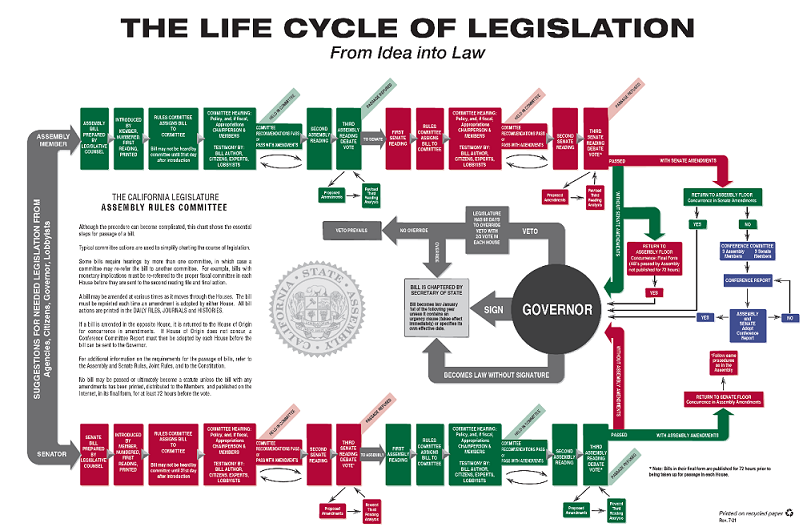
Read the Assembly’s explanation of what happens when the second house amends a bill, then its account of the governor’s choices. The Assembly describes the ordinary 12-day window; the constitutional reading below will add timing exceptions.
Legislative Process | California State Assembly
Read the California State Assembly’s “Legislative Process” for a practical account of how a bill gets to the governor and what happens there.
Immediately before “Step 5: You Can Still Act After Your Bill Goes To The Governor,” read the amendment passage. Notice why an amendment can require further agreement between the houses. Then, under “Step 5,” read the governor passage. Focus on the three possible responses and the vote required after a veto.
Once a bill has passed the Legislature and is presented to the governor, the governor has a defined decision-making role. Presentation is an important starting point for the rules below: do not start counting the ordinary response period merely from a vote in one house.
Three responses—and a legislative response to a veto
The most direct outcome is a signature. California’s Constitution says a bill passed by the Legislature becomes a statute if the governor signs it. The governor need not agree with every provision to sign; legally, the relevant fact is that the bill was signed.
The governor can instead veto the bill by returning it, with objections, to the house where it originated. A timely veto prevents that bill from becoming a statute unless the Legislature overrides it. To override, each house must pass the bill again by a roll-call vote recorded in its journal, with two-thirds of that house’s membership concurring. A strong vote in just one house is insufficient. Nor does a bare majority in each house overcome the veto.
Finally, the governor may take no action. In California, that does not necessarily kill a bill. If the governor does not return it within the applicable constitutional period, the bill becomes a statute without a signature. The deadline is therefore as important as the absence of a signature.
The operative rules are in Article IV, Section 10 of the California Constitution. Read the governing text now, giving particular attention to the difference between a veto returned on time and a bill left unreturned past its deadline.
California Code, CONS SEC. 10.
Read the constitutional rule itself to distinguish a signed bill, an overridden veto, and a bill that becomes a statute through gubernatorial inaction. Section 10(b) also states when the ordinary deadline changes.
Under “ARTICLE IV LEGISLATIVE,” find “SEC. 10.” In subsection (a), read the signature and veto rule. In subsection (b), read paragraphs (1) through (3), from the recess provision through the ordinary rule. Compare the starting point of each deadline. Then read paragraphs (4) and (5), from the special-session and holiday provisions. You do not need the later subsections on legislative deadlines or appropriations for this lesson.
This is a check, not a transfer of lawmaking power to the governor. Legislators must pass the bill; the governor can approve it or object; legislators can enact a vetoed bill if they reach the constitutionally required vote in both houses.
Which deadline applies to inaction?
For most bills, the rule is straightforward: if a bill presented to the governor is not returned within 12 days, it becomes a statute. But “the governor always has 12 days” is too broad. Section 10(b) provides these main timing rules:
| Situation | If the governor does not return the bill… |
|---|---|
| An ordinary bill not covered by a special deadline | Within 12 days of presentation, it becomes a statute. |
| A qualifying bill passed before the Legislature’s joint recess between the two calendar years of its session and still with the governor after that recess begins | Within 30 days after the recess date, it becomes a statute. The provision excludes bills changing election-district boundaries. |
| A bill passed before September 1 of the session’s second calendar year and in the governor’s possession on or after September 1 | On or before September 30 of that year, it becomes a statute. |
Notice that the 30-day period is measured from the recess date, not automatically from the day the governor received the bill. The September rule has its own cutoff date. If a scenario gives dates, first decide which category the bill fits; only then decide whether the governor’s return was timely.
Two narrower details prevent misleading shortcuts. If adjournment of a special session prevents the usual return of a veto message, the Constitution provides a way to veto by depositing the bill and message with the Secretary of State within 12 days of presentation. And if the twelfth day under the specified 12-day provisions falls on a Saturday, Sunday, or holiday, the deadline extends to the next day that is none of those. Neither rule means that a bill automatically dies because legislators have gone home.
Reading a bill scenario accurately
A reliable way to analyze a short scenario is to separate the stages rather than treating “passed,” “signed,” and “in effect” as interchangeable.
- Has the Legislature passed the bill? Check that both houses have agreed to the bill before applying the governor’s signature, veto, or inaction rules.
- Was it signed? If so, it became a statute.
- Was it vetoed within the applicable period? If so, check for a two-thirds override vote in each house. Without both votes, it does not become a statute through that bill.
- If neither signed nor timely vetoed, has the applicable deadline expired? If so, it became a statute without the governor’s signature.
Consider a bill passed by both houses and presented during an ordinary part of the session. The governor neither signs nor returns it, and the applicable 12-day period expires. It becomes a statute, despite the lack of a signature. By contrast, if the governor returns it with objections within that period, and only the Assembly votes to override, it does not become a statute: the Senate’s two-thirds vote is also required.
A statute’s enactment is not always the same as the date its requirements take effect. For the scenarios in this lesson, “does it become law?” asks whether it becomes a statute through signature, inaction, or override—not whether someone must comply with it that same day.
Conclusion
The governor has three principal responses to a California bill presented after legislative passage: sign it, veto it, or leave it unreturned. A signature makes it a statute; a timely veto stops it unless two-thirds of each house’s membership votes to override; and an unreturned bill becomes a statute when its applicable constitutional deadline passes. The ordinary deadline is 12 days, but recess and end-of-session circumstances can change the timing.
Next, the course turns from bills generally to the state budget: who proposes it, who authorizes spending, and how the balanced-budget requirement limits both the governor and the Legislature.