Hello. This course examines what California’s governor can do and who can limit those powers. The question raised by a commutation is a useful starting point: the governor can have authority to change a state sentence without having authority to decide guilt, write criminal laws alone, or direct a court’s judgment.
This first lesson establishes the boundaries. You will see why heading the executive branch gives the governor substantial power, but not command over the legislature, the courts, or every official who performs executive work. Later lessons will examine particular powers—bills, budgets, appointments, and clemency—within that framework.
The constitutional starting point
California’s constitution divides state government into legislative, executive, and judicial powers. Its separation-of-powers provision says that people charged with exercising one of these powers may not exercise either of the others except as the constitution permits. Read the provision itself before considering what it means in practice.
Article III, California Constitution - Ballotpedia
Read the text of Article III, Section 3, reproduced by Ballotpedia. Its short rule is the foundation for the distinctions in this lesson.
Under “Section 3,” read the provision. Stop before “Section 3.5,” which addresses a different issue. Pay particular attention to the final exception: separation of powers allows constitutionally assigned checks between branches; it does not mean the branches never interact.
The distinction is between having influence over another branch’s work and possessing that branch’s power. The legislature makes laws; the governor can participate in lawmaking through powers the constitution assigns to the office, including approving or vetoing bills. A veto is a check on legislation, not a general power to replace legislators or enact any law the governor prefers. Similarly, the governor has executive responsibilities, but cannot resolve a lawsuit by directing a judge to rule a particular way.
The constitutional exception matters because “separate” does not mean “sealed off.” California’s institutions are designed to interact. What matters is the source and scope of a claimed power: a constitutional provision or valid law may give the governor a defined role in another branch’s process, without transferring control of that branch to the governor.
Influence over legislation is not control of the legislature
California’s legislature consists of the Assembly and Senate. Legislators are elected to their own offices; they do not report to the governor as agency staff. They can introduce, debate, amend, and vote on bills regardless of whether the governor supports them. The governor can urge lawmakers to pursue a policy, negotiate with them, and use constitutionally granted powers when legislation reaches the governor’s desk. None of those acts lets the governor command a legislator’s vote.
Consider a governor who wants a change to criminal sentencing. The governor can advocate for a bill and, within the office’s legal authority, administer existing law. The governor cannot simply announce that the statutory sentences chosen by the legislature have been rewritten. Clemency, which we will study later, is a distinct and limited power concerning particular cases; it is not a substitute for general lawmaking.
This is why political descriptions such as “the governor’s agenda” need care. An agenda may be influential, especially when the governor and many legislators agree. Agreement is not subordination. The legislature retains its own authority and can refuse, revise, or enact proposals through the lawmaking process.
Appointment does not make courts subordinate
Courts exercise judicial power: they decide cases under the law. California’s state courts have trial and appellate levels, shown in this court-system diagram.
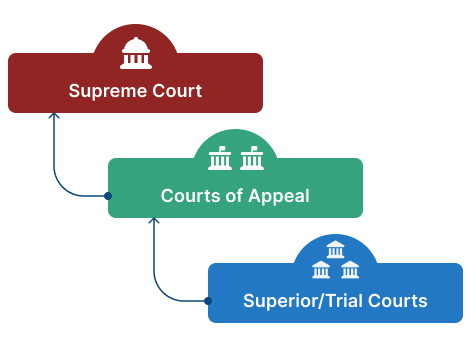
A governor has a role in selecting some judges and justices. That role does not carry a continuing right to dictate their decisions. Once a judge hears a case, the question is what the applicable law and facts support—not what outcome would assist the governor. California also uses elections and, for appellate justices, confirmation and retention procedures; a later lesson will distinguish those selection rules.
Suppose an executive order claims a power that a statute does not give the governor. A court hearing a proper challenge may decide whether the order exceeds that statutory authority or violates the state or federal constitution. It can block an unlawful action even if the governor strongly favors the policy. Conversely, a court does not invalidate an action merely because judges would have chosen a different policy. Judicial independence protects legal judgment, not judicial control of every policy choice.
This distinction helps clarify the commutation example. Courts decide convictions and sentences in cases before them. A governor’s constitutionally granted clemency power may affect punishment after sentencing, subject to its own limits. It does not make the governor the judge who determined guilt.
Not every executive official serves at the governor’s direction
The executive branch is not a single office staffed entirely by people whom the governor hires and fires. California’s constitution provides for separately elected statewide officers alongside the governor. The attorney general, controller, treasurer, secretary of state, and other statewide officers have their own electoral mandates and legally assigned duties. Holding an executive office does not, by itself, make an officer the governor’s subordinate.
The following reading places that arrangement alongside the three-branch structure. Read only its opening discussion for now; it briefly mentions budget powers that the next module will examine more closely.
The California Constitution: For the People | State Court Report
Read the opening of “Governance under California’s constitution” from State Court Report. It adds a second limit to the idea of a single, all-directing executive: California divides executive responsibilities among separately elected offices.
In “Governance under California’s constitution,” start at the paragraph beginning “Like most, if not all, state constitutions.” Read the opening discussion, stopping before the example about state finance. Focus on the difference between belonging to the executive branch and being subject to the governor’s personal direction.
For example, the attorney general has legal responsibilities attached to that office; the controller has responsibilities concerning the state’s accounts. The governor may work with these officers, disagree with them, or exercise a specific power that law grants in a particular situation. But a disagreement does not itself let the governor remove a separately elected officer or take over that officer’s legally assigned decisions.
The boundary is not “the governor controls nothing.” The governor directs parts of the executive branch within the authority provided by the constitution and statutes, and has appointment powers over certain positions. The more precise rule is that executive leadership is bounded by law and by the independent authority of other offices. In a later lesson, you will look at which appointments require additional approval and what happens when an independently elected office becomes vacant.
A way to read claims about gubernatorial power
When a news report says the governor “ordered,” “blocked,” or “changed” something, the verb alone does not identify the legal power involved. Distinguish the institution whose work is affected from the authority the governor actually holds:
| If the matter concerns… | The boundary to keep in view |
|---|---|
| A proposed law | Legislators decide how to vote; the governor has defined powers in the bill process. |
| A court case | Judges decide legal disputes independently, even when the governor appointed a judge. |
| A separately elected state officer | That officer’s duties do not become the governor’s merely because both offices are executive. |
| An agency under gubernatorial direction | The governor’s direction must still stay within constitutional and statutory limits. |
These boundaries can operate at the same time. A governor might ask legislators to change a law, direct an agency in administering the law as it stands, and defend that agency’s action in court. The governor’s role in each setting is different. Treating them as one unrestricted “executive power” obscures the checks built into California government.
Conclusion
Heading California’s executive branch gives the governor important responsibilities, but not authority over all of state government—or even unilateral control of every executive office. Legislators exercise their own lawmaking power; judges decide cases independently; separately elected officers carry out duties assigned to their offices. The governor can influence and sometimes check their work only through powers the constitution and law actually provide.
Next, you will apply one of those defined powers to concrete bill scenarios: determining when a bill becomes law through a signature, veto, or gubernatorial inaction, and when the legislature can override a veto.