Hello! Welcome back to our course on the foundations of digital marketing.
In our last lesson, we opened up the digital marketer's toolkit and identified the core channels you'll be using, like SEO, social media, and email marketing. Today, we're going to build on that by asking a crucial question: how do you know which tool to use and when? The answer lies in understanding the customer journey.
This lesson will introduce you to the stages a person goes through, from first discovering a brand to becoming a loyal fan. By the end of our session, you'll be able to describe the key stages of this journey—Awareness, Consideration, Decision, and Retention—and understand how they form the backbone of any effective marketing strategy. This framework is essential for a freelancer, as it allows you to create targeted campaigns that meet customers where they are, making your marketing efforts far more successful.
What is the Customer Journey?
Before you can guide someone along a path, you need a map. In marketing, this is called the "customer journey map." It's a visual representation of the entire experience a customer has with a brand.
The concept is quite intuitive. Think about any significant purchase you've made. You likely didn't just wake up and buy it. You probably first became aware of a need, researched different options, and then finally decided to purchase. Marketers formalize this process to better understand and serve their customers.
To get a clear picture of what a journey map is, let's start with a quick video.
Customer Journey Mapping Tutorial
This clip from SiteGround's "Customer Journey Mapping Tutorial" provides a concise and clear definition of a customer journey map.
Watch the segment from the beginning. The mountain-climbing analogy is a great way to think about the process: you can't teleport to the peak; you need to follow a route.
Now that you have a high-level idea, let's get a more formal definition. It's also important to understand that this journey is rarely a straight line from A to B.
5 Stages Of The Customer Journey
This article from Factors.ai will be our main guide for this lesson. It provides excellent definitions and context.
Start by reading the initial definition under the main image, from the first few paragraphs. Then, jump to the section "The Evolution of Customer Journey Stages" and read about its non-linear nature. This is a key insight: modern customers often loop back and forth between stages.
The Core Stages of the Customer Journey
While the journey can be complex, we can use a model to understand its most critical phases. The most common and useful model breaks the journey into five stages: Awareness, Consideration, Decision, Retention, and Advocacy.
The following video provides a great overview of the first four of these stages. As you watch, listen for what the customer is thinking and doing at each stage, and what the brand's goal should be.
Customer Journey Mapping Tutorial
We return to the "Customer Journey Mapping Tutorial" from SiteGround for a detailed walkthrough of the stages.
Watch the segment explaining the four main stages, starting at "Define the stages". Pay close attention to the descriptions of customer feelings (e.g., uncertainty, anxiety) and the brand's role in addressing them.
The video covered the first four stages brilliantly. Now let's use our article to solidify those definitions and add the final, crucial stage: Advocacy.
5 Stages Of The Customer Journey
The Factors.ai article provides clear, actionable descriptions for each of the five stages.
Please read the following sections: Awareness Stage Consideration Stage Decision Stage For the final two stages, please read the summary points under the heading "Optimize Your Customer Journey for Better Conversions": Point #4, which begins Retention Point #5, which begins Advocacy
To bring this all together, let's walk through a simple example and connect these stages to the channels we learned about in the last lesson.
Example: Buying a new pair of noise-canceling headphones.
-
Awareness: You're trying to work from home, but you keep getting distracted by noise. You realize you have a problem. You google "how to focus when working from home" and find a blog post that suggests noise-canceling headphones.
- Customer mindset: "I have a problem, but I don't know the solution yet."
- Channels used: SEO, Content Marketing.
-
Consideration: Now that you know a possible solution, you start researching. You search for "best noise-canceling headphones 2024," read review articles, and watch YouTube comparison videos. You identify 2-3 top brands.
- Customer mindset: "What are my options? Which one is the best for me?"
- Channels used: SEO, Content Marketing (reviews, comparisons), Social Media (influencer videos).
-
Decision: You've picked your favorite brand. You visit their website, check the price, and look for any discounts. A pop-up offers you 15% off your first order if you sign up for their newsletter. That's the final nudge you need. You make the purchase.
- Customer mindset: "I'm ready to buy. Is this the right choice? Can I get a good deal?"
- Channels used: Website (product pages), SEM (retargeting ads that follow you around), Email Marketing (the discount offer).
-
Retention: After your purchase, you receive a series of emails: a thank-you note, shipping confirmation, and a guide on "getting the most out of your new headphones." They also invite you to follow them on social media.
- Customer mindset: "Did I make a good purchase? How do I use this thing?"
- Channels used: Email Marketing, Content Marketing (user guides), Social Media.
-
Advocacy: You love the headphones. They've transformed your workday. You post a photo of your new home office setup on Instagram and tag the brand, telling your friends it was a great purchase.
- Customer mindset: "This product is great, and I want to share my experience!"
- Channels used: Social Media (User-Generated Content), Word-of-mouth.
This journey shows how a customer interacts with different marketing channels at each stage. As a marketer, your job is to create a smooth and helpful experience across all of them.
The Role of AI Across the Customer Journey
As we've discussed, AI is not a separate channel but a powerful assistant that enhances every stage of this journey. AI helps you personalize the experience for each customer, making your marketing more efficient and effective.
The diagram below maps specific AI technologies and their benefits to each stage of the customer journey.
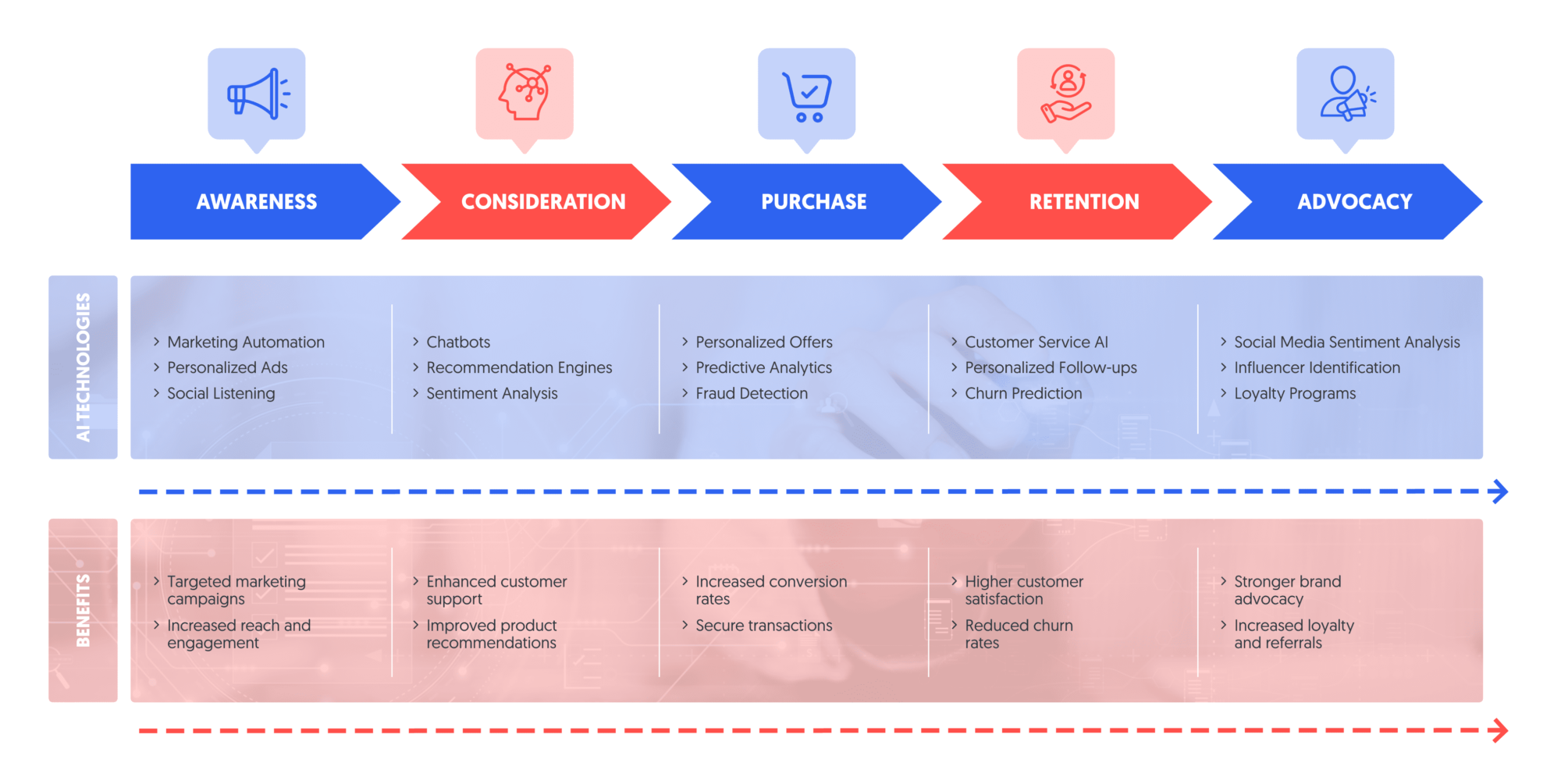
Let's look at a couple of examples from the diagram:
- Awareness: The chart lists "Personalized Ads" and "Social Listening" as key AI technologies. AI can analyze user data to show ads only to people likely to be interested (making them more relevant and less annoying). It can also monitor social media conversations ("social listening") to find people who are talking about problems your product solves.
- Retention: Here, "Churn Prediction" is a powerful AI application. AI can analyze customer behavior to identify signals that a customer is unhappy and might stop using your service (i.e., "churn"). This allows you to proactively reach out with support or a special offer to keep them.
As we go through this course, we will continuously return to this journey map and explore how to use AI tools to execute these strategies in a hands-on way.
Conclusion
Today, we've mapped out the fundamental path that customers follow. You've learned that:
- The customer journey is the process a person goes through from initial awareness to loyal advocacy.
- It's most often broken down into five key stages: Awareness, Consideration, Decision, Retention, and Advocacy.
- At each stage, the customer has a different mindset and different needs.
- Effective marketing involves using the right channels with the right message to meet those needs.
- AI is a critical tool for personalizing and optimizing the customer experience at every stage.
Understanding this framework is your first step toward building strategic, results-driven marketing campaigns—the kind that clients will pay for.
In our next lesson, we will build on this by classifying the marketing channels we use. We'll explore the difference between owned, earned, and paid media, which will give you another layer of strategic understanding for planning your campaigns.