Hello! In our last lesson, we established a clear understanding of what digital marketing is and how its precision, measurability, and cost-effectiveness set it apart from traditional marketing. You now have a solid "why" for the value you'll offer future clients.
Today, we're moving from the "why" to the "what." We will identify the main digital marketing channels that form the core of any online strategy. Think of these channels as the essential tools in your professional toolkit. We'll explore the five most important ones—Search Engine Optimization (SEO), Search Engine Marketing (SEM), Content Marketing, Social Media Marketing, and Email Marketing—and define the specific role each one plays in helping a business grow.
The Digital Marketer's Toolkit: An Overview
Before we examine each tool individually, let's get a quick, high-level tour of the entire digital marketing landscape. The following video provides a fast-paced introduction to the key channels we'll be discussing today. Don't worry about catching every detail; the goal here is to simply familiarize yourself with the terminology.
Digital Marketing In 5 Minutes | What Is Digital Marketing? | Learn Digital Marketing | Simplilearn
This "Digital Marketing in 5 Minutes" video from Simplilearn gives a rapid-fire overview of the major channels and how they fit together.
Watch from the beginning to the end. As you watch, just listen for the names of the different channels mentioned: SEO, PPC (or SEM), Content, Social Media, and Email marketing. We will unpack each of these in detail throughout this lesson.
As you saw in the video, digital marketing isn't a single activity but a collection of specialized disciplines. A successful strategy rarely relies on just one; it orchestrates several channels to work together. Now, let's open up the toolkit and examine each one more closely.
We'll be using an excellent beginner's guide from Equinet Academy as our main reference. It provides clear, structured explanations of each channel.
Digital Marketing Channels Explained: A Beginner's Guide to Online ...
This article provides foundational definitions for the core online marketing channels.
To start, please read the introductory sections, What is Digital Marketing? and Core Online Marketing Channels. These sections will set the stage for our deep dive.
1. Search Marketing: Capturing Active Demand
When someone has a problem or a need, one of the first things they do is turn to a search engine like Google. This is called "active demand." Search marketing is the practice of making sure a business shows up at the exact moment a potential customer is looking for a solution. It's divided into two key disciplines: SEO and SEM.
Search Engine Optimization (SEO)
SEO is about earning visibility in the unpaid or "organic" search results. The goal is to signal to search engines that your website is the most relevant and authoritative answer to a user's query. This is a long-term strategy that builds a sustainable source of traffic.
Digital Marketing Channels Explained: A Beginner's Guide to Online ...
This section of the guide explains the fundamentals of SEO.
Read the section Search Engines (SEO). Focus on understanding that the core objective is to improve visibility in unpaid results for users who are actively searching.
Search Engine Marketing (SEM)
SEM, often used interchangeably with Pay-Per-Click (PPC), is about buying visibility through paid ads that appear at the top of search results. Unlike SEO, SEM provides immediate traffic and control, but that traffic stops the moment you stop paying.
It's common for beginners to confuse SEO and SEM. SEO is about earning your spot, while SEM is about buying your spot. Both are crucial, but they serve different purposes.
This image provides a simple, clear distinction between SEO, SEM, and Social Media Marketing (SMM), which we'll cover shortly.
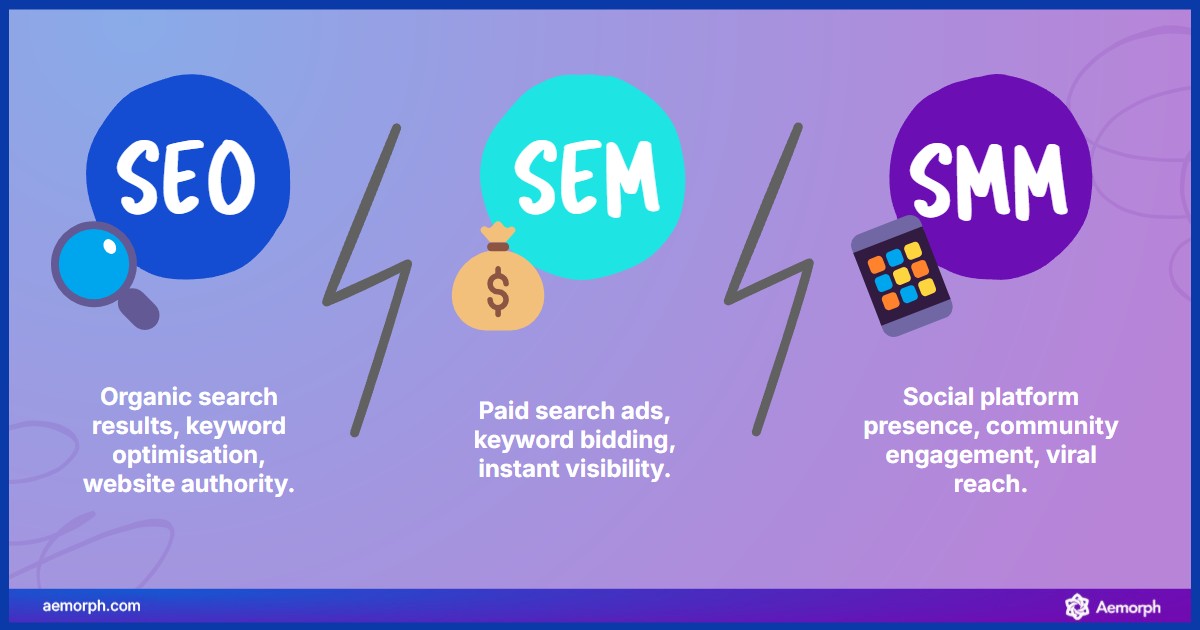
Now, let's get the formal definition of SEM from our guide.
Digital Marketing Channels Explained: A Beginner's Guide to Online ...
This part of the article defines SEM and its relationship with SEO.
Read the section titled Search Engine Marketing (SEM) / PPC. Note the key tradeoff: SEM offers speed and control, while SEO provides long-term growth.
2. Content Marketing: The Engine of Digital Marketing
If search marketing is about being there when people look for you, content marketing is about giving them a reason to look in the first place. It is the foundational practice of creating and sharing valuable, relevant information—like blog posts, videos, guides, and podcasts—to attract an audience and build trust. Good content is the fuel for SEO, the material you share on social media, and the value you provide in emails.
Digital Marketing Channels Explained: A Beginner's Guide to Online ...
This section explains the purpose of content marketing and lists common formats.
Read the section Content Marketing. The key idea here is that content's role is to "educate, inform, and build trust rather than push direct sales."
3. Social Media Marketing: Building Communities
Social media marketing uses platforms like Instagram, LinkedIn, Facebook, and TikTok to build brand presence, engage with an audience, and distribute content. Its primary role is not direct sales but fostering a community, creating two-way conversations, and increasing brand awareness. Like search marketing, it has both an organic (posting content) and a paid (running ads) component.
Digital Marketing Channels Explained: A Beginner's Guide to Online ...
This section covers the role of social media marketing and highlights the different purposes of major platforms.
Read the section on Social Media Marketing. Pay attention to how each platform serves a different purpose (e.g., LinkedIn for professional networking, Instagram for visual content).
4. Email Marketing: Owning Your Audience
Email marketing is a direct communication channel used to nurture relationships with potential customers and retain existing ones. Unlike social media or search engines, where algorithms control your reach, your email list is an asset you own. It is one of the most effective channels for turning interested prospects into customers and one-time buyers into repeat fans.
Digital Marketing Channels Explained: A Beginner's Guide to Online ...
This section defines email marketing and explains its high return on investment (ROI).
Read the section on Email Marketing. The most important concept to grasp is that with email, "businesses control access to their audience."
Weaving It All Together with AI
You now have a foundational understanding of the five core digital marketing channels. It's crucial to understand that these channels rarely work in isolation. A strong strategy combines them. For instance, you might use content marketing (a blog post) to fuel your SEO efforts, then promote that post on social media, and use email to notify your subscribers about it.
As you requested, we'll be incorporating AI throughout this course. AI is not a separate marketing channel, but rather a powerful enabler that accelerates and enhances the work you do within each channel.
This image perfectly illustrates how AI applications map directly to the channels we've just learned about.
Let's connect this to what we've covered:
- Content Creation & Optimization: AI tools can help you brainstorm ideas, write drafts, and refine copy for your Content Marketing efforts.
- SEO & Keyword Research: AI can analyze vast amounts of data to help you find the best keywords to target for your SEO strategy.
- Social Media Management: AI can help schedule posts, analyze the best times to publish, and even help you draft engaging captions for Social Media Marketing.
- Data Analysis & Reporting: AI can process performance data from all your channels to identify trends and provide actionable insights, making you a more effective marketer.
- Graphic Design & Visuals: AI can generate images and visuals for your content and social media posts, even without design expertise.
In future lessons, we will get hands-on with AI tools to perform these very tasks.
Conclusion
In this lesson, we opened up the digital marketer's toolkit and examined the five most essential tools. You learned that:
- SEO and SEM are channels focused on capturing customers who are actively searching for a solution, through organic and paid methods respectively.
- Content Marketing is the foundation, focused on creating valuable information to attract and build trust with an audience.
- Social Media Marketing is used to build community, foster engagement, and increase brand awareness.
- Email Marketing is a powerful, direct channel for nurturing leads and retaining customers, giving you a line of communication you fully control.
- AI acts as a powerful assistant that can be applied across all these channels to improve efficiency and effectiveness.
As a freelancer, your value will come from not just knowing what these channels are, but from understanding which combination of tools is right for each client's unique goals.
In our next lesson, we will introduce the concept of the customer journey. Now that we know the channels, we'll explore the path a customer takes from first hearing about a brand to becoming a loyal advocate. This will help us understand when and where to use each of the channels we've learned about today.