Welcome back! In our previous lesson, we established a solid foundation by learning how to define and call Python functions using the def keyword. You learned how to pass data using positional and keyword arguments and how to return results, which are fundamental skills for writing modular code.
Today, we'll build on that by exploring two of Python's most powerful features for writing concise and elegant code: list comprehensions and lambda functions. Your experience with JavaScript array methods like .map() and .filter() will provide a great reference point, as you'll see how Python achieves similar outcomes with its own unique and expressive syntax. By the end of this lesson, you'll be able to transform and filter lists with a single line of code, a skill that is invaluable for the kind of data processing we'll be doing in our AI project.
List Comprehensions: The "Pythonic" Way to Build Lists
Often, you'll find yourself writing a for loop just to create a new list based on an existing one. For example, to create a list of squared numbers:
squares = []
for i in range(10):
    squares.append(i**2)


# squares is now [0, 1, 4, 9, 16, 25, 36, 49, 64, 81]
This works perfectly fine, but Python offers a more compact and readable way to achieve the same result, known as a list comprehension. This video from Bro Code provides an excellent side-by-side comparison.
Learn Python LIST COMPREHENSIONS in 10 minutes! 📃
This video clearly demonstrates the benefit of list comprehensions over traditional loops.
Watch the segment from the beginning of the example. Notice how the five lines of the for loop are condensed into a single, expressive line.
The Anatomy of a List Comprehension
The structure of a list comprehension is designed to be readable, almost like plain English. It consists of three main parts, as illustrated in the image below.
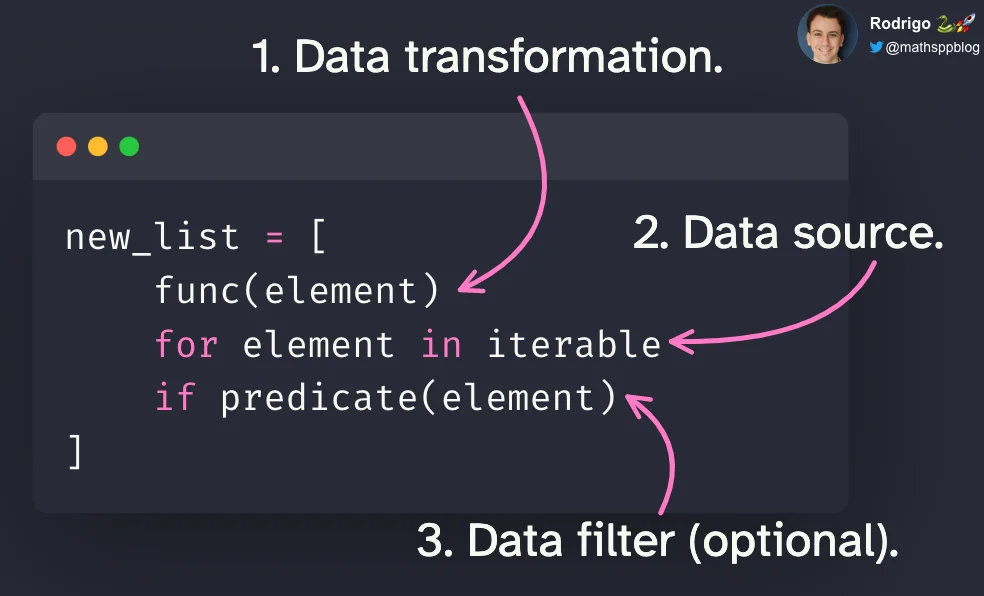
The basic syntax is: [expression for item in iterable]
Let's break this down:
expression: The operation you want to perform on each item (e.g.,item * 2). This is the "data transformation."for item in iterable: The loop itself, specifying the source list (or any iterable) and the variable name for each element. This is the "data source."
Adding a Filter with if
List comprehensions become even more powerful when you add a conditional filter. This allows you to include only the elements that meet a certain criterion.
The syntax for this is: [expression for item in iterable if condition]
The if condition part acts as a gatekeeper, only allowing items that evaluate to True to be processed by the expression.
This video continues with several great examples, including filtering for positive numbers and even numbers.
Learn Python LIST COMPREHENSIONS in 10 minutes! 📃
This part of the Bro Code video introduces the optional if condition.
Watch the section on working with conditions. Pay attention to how the if clause is added at the end of the comprehension to filter the list.
From JavaScript's .map() and .filter() to Python Comprehensions
Your background with JavaScript gives you a head start here. In JS, you might chain methods like .filter().map() to first select elements and then transform them. A Python list comprehension combines both of these steps into one operation.
This article provides a direct comparison that will feel very familiar.
Python Guide for JS-devs - DEV Community
This article from DEV Community is written specifically for developers transitioning from JavaScript to Python.
Please read the section titled List (and Dict) comprehension. The author shows a JavaScript example of filtering for even numbers and then doubling them, and then presents the elegant Python list comprehension equivalent.
Conditional Expressions: if/else in a Comprehension
What if you want to do one thing if a condition is true, and something else otherwise? For this, Python uses a conditional expression (sometimes called a ternary operator) within the expression part of the comprehension.
The syntax is: [expression_if_true if condition else expression_if_false for item in iterable]
Notice the key difference:
- A simple filter (
if) goes at the end of the comprehension. - A conditional transformation (
if/else) goes at the beginning, as part of the expression itself.
Let's see an example. Suppose we want to square numbers less than 5, but keep the original number for those 5 or greater.
# Traditional for loop
result = []
for x in range(10):
    if x < 5:
        result.append(x**2)
    else:
        result.append(x)


# result is [0, 1, 4, 9, 16, 5, 6, 7, 8, 9]


# With a list comprehension
result_comp = [x**2 if x < 5 else x for x in range(10)]


# result_comp is [0, 1, 4, 9, 16, 5, 6, 7, 8, 9]
This pattern is extremely useful for more complex data wrangling.
Lambda Functions: Small, Anonymous Functions
In the previous lesson, we learned to define functions with def. Python also has a way to create small, one-line functions without a name. These are called lambda functions or anonymous functions.
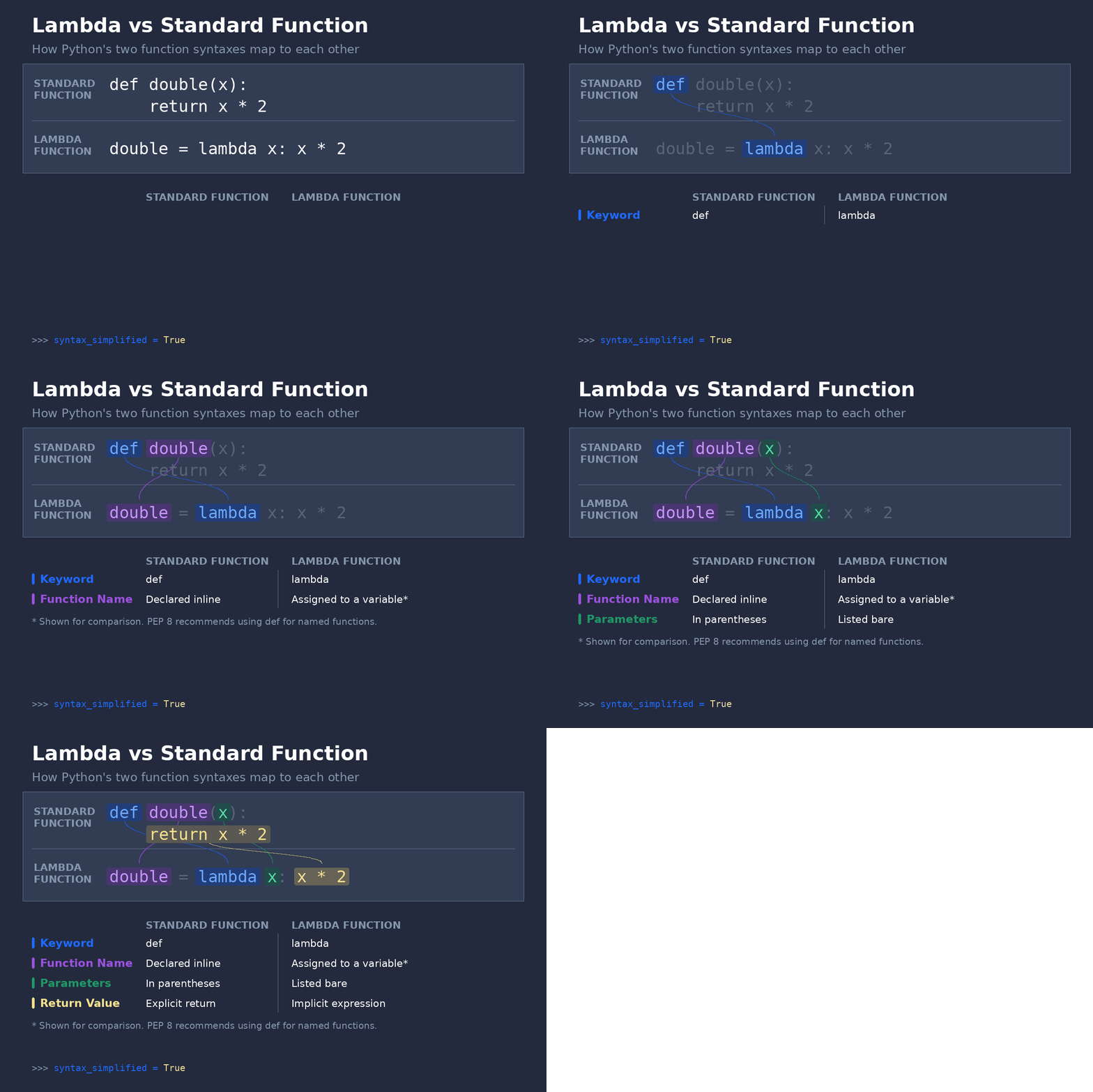
The syntax for a lambda function is: lambda arguments: expression
lambda: The keyword that signifies you're creating a lambda function.arguments: A comma-separated list of parameters the function accepts.:: Separates the arguments from the expression.expression: A single expression whose result is automatically returned.
Crucially, a lambda function can only contain a single expression, not a block of statements. This is a key difference from JavaScript's arrow functions, which can have multi-line bodies.
This video from Tech With Tim provides a clear introduction.
Python Lambda Functions Explained
This video quickly covers the syntax and purpose of lambda functions.
Watch the first segment of the video from the beginning to see how to define and use a basic lambda function with one or more parameters.
Where to Use Lambda Functions
Lambda functions are most useful when you need a simple function for a short period, typically as an argument to a higher-order function (a function that takes another function as an argument). Common examples include sorted(), map(), and filter().
While list comprehensions are often preferred over map() and filter() in modern Python for their readability, it's very common to see lambdas used with these functions, so it's important to recognize the pattern.
More importantly, a fantastic and very common use case is with the sorted() function. Imagine you have a list of tuples, and you want to sort them based on the second element in each tuple. A lambda function is perfect for this.
points = [(1, 5), (9, 2), (4, 7)]


# Sort by the second element (y-coordinate)
sorted_points = sorted(points, key=lambda point: point[1])


# sorted_points is now [(9, 2), (1, 5), (4, 7)]
The key argument expects a function that takes one item from the list and returns the value to sort by. The lambda lambda point: point[1] does this elegantly without needing a separate def function.
This final clip from the same video demonstrates this powerful technique.
Python Lambda Functions Explained
This segment shows a very practical application of lambda functions for custom sorting.
Watch the part explaining how to use a lambda as a key function for sorting. This is a pattern you will use frequently when dealing with complex data structures.
Conclusion
In this lesson, we've added two powerful tools to your Python toolkit that promote concise, readable, and efficient code.
Key Takeaways:
- List Comprehensions provide a compact syntax for creating a new list from an iterable. The general form is
[expression for item in iterable if condition]. - They can replace simple
forloops and often combine the logic of JavaScript's.map()and.filter()into a single, readable line. - For
if/elselogic within a comprehension, use the structure[true_expr if condition else false_expr for item in iterable]. - Lambda Functions are small, anonymous functions defined with the syntax
lambda arguments: expression. - They are limited to a single expression and are most useful when passed as arguments to higher-order functions like
sorted(),map(), andfilter().
As we move forward, we'll start building more complex logic for our project. The next step is to ensure our code is robust. In the next lesson, we will cover error handling using try/except blocks, which will allow us to gracefully manage situations where things don't go as planned, such as when dealing with invalid data or failed network requests.