In our previous lesson, we surveyed the main philosophical positions on the mind-body problem, organizing them into the broad camps of dualism and physicalism. We noted that within physicalism, a spectrum of theories exists, from the radical eliminativist view to the more dominant functionalist account. Today, we will zoom in on one of the most direct and historically significant physicalist theories: the mind-brain identity theory.
This lesson will reconstruct the identity theory's core claims and motivations, treating it as a scientific hypothesis about the nature of the mind. We will then analyze what is widely considered its most formidable challenge: the multiple realizability objection. Understanding this objection is crucial, as it not only highlights a potential flaw in the identity theory but also serves as the primary motivation for functionalism, the view we briefly introduced as the "software/hardware" model of the mind. Our goal is to dissect both the theory and the objection with the analytical precision they deserve.
1. The Identity Theory: A Scientific Hypothesis about the Mind
At its core, the identity theory proposes a refreshingly straightforward solution to the mind-body problem: mental states simply are brain states. The feeling of pain isn't merely caused by a brain state; it is that brain state. This is an ontological reduction: it claims that two apparently different things are, in fact, one and the same.
This position, championed by philosophers like U.T. Place, J.J.C. Smart, and Herbert Feigl in the mid-20th century, was presented not as a truth of language or logic, but as a contingent scientific hypothesis. Much like science discovered that lightning is an atmospheric electrical discharge, or that water is H₂O, neuroscience, they argued, would eventually discover that consciousness is a specific type of brain process.
To grasp the philosophical substance of this claim, we need to unpack the precise nature of the "is" being used. The following video by philosopher Jeffrey Kaplan provides a lucid and systematic analysis of U.T. Place's foundational arguments, which hinge on crucial linguistic and logical distinctions. Given your background in formal systems, you will find this structured approach particularly insightful.
The Mind-Brain Identity Theory
This video, "The Mind-Brain Identity Theory," walks through U.T. Place's original formulation of the theory, paying close attention to the logical distinctions required to defend it.
Please watch the following segments carefully: The Core Thesis (introduction): This introduces the basic claim that conscious mental states are identical to brain processes. Scope of the Theory (Place's focus): Note that Place originally applied his theory only to conscious experiences (like sensations and pain), suggesting that behaviorism might suffice for cognitive states like beliefs. This is a subtle but important detail. The "Is" of Identity vs. Predication (first distinction): This is a crucial logical point. The theory claims "pain is a brain state" in the same way "Superman is Clark Kent" (identity), not in the way "Superman is strong" (predication). The "Is" of Definition vs. Composition (second distinction): This is the heart of Place's defense. He argues the identity is one of composition (a contingent, scientific fact, like "His table is an old packing case") not of definition ("A square is an equilateral rectangle"). The Defense (scientific hypothesis): See how Place uses these distinctions to argue that the identity theory is a scientific hypothesis that cannot be refuted by purely logical or conceptual arguments (e.g., "I can talk about pain without knowing anything about brains, so they can't be the same thing"). Place's Rebuttal (thought experiments): This final section shows Place anticipating and refuting common objections by showing they mistakenly treat the identity claim as one of definition rather than composition. The analogy with a cloud being a mass of water droplets is particularly effective here.
As the video makes clear, the identity theory's strength lies in its framing as an empirical claim. It respects the scientific intuition that the world is fundamentally physical and offers a parsimonious explanation that avoids the thorny interaction problems of dualism.
To solidify these concepts, let's turn to a concise textual summary from the Stanford Encyclopedia of Philosophy.
The Mind/Brain Identity Theory
This entry from the Stanford Encyclopedia of Philosophy provides a scholarly overview of the identity theory.
Please read the introductory paragraphs, which reinforce the core idea that experiences are brain processes, not just correlated with them. Then, read the section titled "2. The Nature of the Identity Theory" (Section 2). This will review the key points from the video about contingent identity and the meaning/reference distinction, using Frege's classic example of Venus as the "morning star" and "evening star."
Before proceeding, it is vital to distinguish between two versions of the theory:
- Type Identity Theory: This is the stronger, more reductive claim. It asserts that every type of mental state is identical to a specific type of physical state. For example, the mental state type
painis identical to the brain state typeC-fiber firing. - Token Identity Theory: This is a weaker claim. It asserts that every particular instance (token) of a mental state is identical to some particular instance (token) of a physical state. My headache right now is a token brain state, and your feeling of excitement right now is a token brain state, but the theory doesn't claim that all headaches are the same type of brain state.
The most famous objection to the identity theory, multiple realizability, is primarily an attack on Type Identity Theory.
2. The Multiple Realizability Objection
Soon after the identity theory was proposed, philosopher Hilary Putnam formulated a powerful and intuitive objection that has become a cornerstone of modern philosophy of mind. The argument, in essence, is this: if mental states can be "realized" in creatures with very different physical makeups, then a mental state type cannot be identical to any single physical state type.
Consider the mental state of being in pain. According to a simple type identity theory, we might hypothesize:
But is it plausible that only creatures with C-fibers can experience pain?
- Across Species: Octopuses have a complex nervous system and exhibit sophisticated pain-avoidance behaviors, yet their neuroanatomy is radically different from ours. It seems plausible they feel pain.
- Hypothetical Beings: We can easily conceive of an advanced AI made of silicon chips or an alien with a completely different biology that could experience pain.
- Brain Plasticity: Even within a single human, if the brain region normally associated with a function is damaged, other regions can sometimes take over. The function is realized differently.
If any of these cases are possible, then pain cannot be strictly identical to C-fiber firing, because you can have one (pain) without the other (C-fiber firing). The mental state type pain is multiply realizable.
The following video provides a concise explanation of this argument and how it leads directly to functionalism.
Functionalism and multiple realizability
This video clearly presents the multiple realizability argument as a direct response to the identity theory.
First, watch the brief definition of type identity theory (from this point). Next, see how the multiple realizability argument is used to object to it (the main objection), using the excellent octopus example. Finally, watch the introduction to functionalism (as the solution). This shows how functionalism defines mental states by their causal role, neatly accommodating multiple realizability.
Your background in physics and computational projects makes the central analogy here particularly apt. A computational function, like a sorting algorithm, is defined by its abstract role—taking an unsorted list as input and producing a sorted list as output. This same function can be implemented (realized) in countless ways: by a quicksort algorithm in Python, a merge sort algorithm in C++, or even mechanically with a series of gears and levers. The abstract function sort() is not identical to any single physical implementation. Functionalists argue that mental states are just like this: they are abstract causal roles that can be implemented in different "hardware."
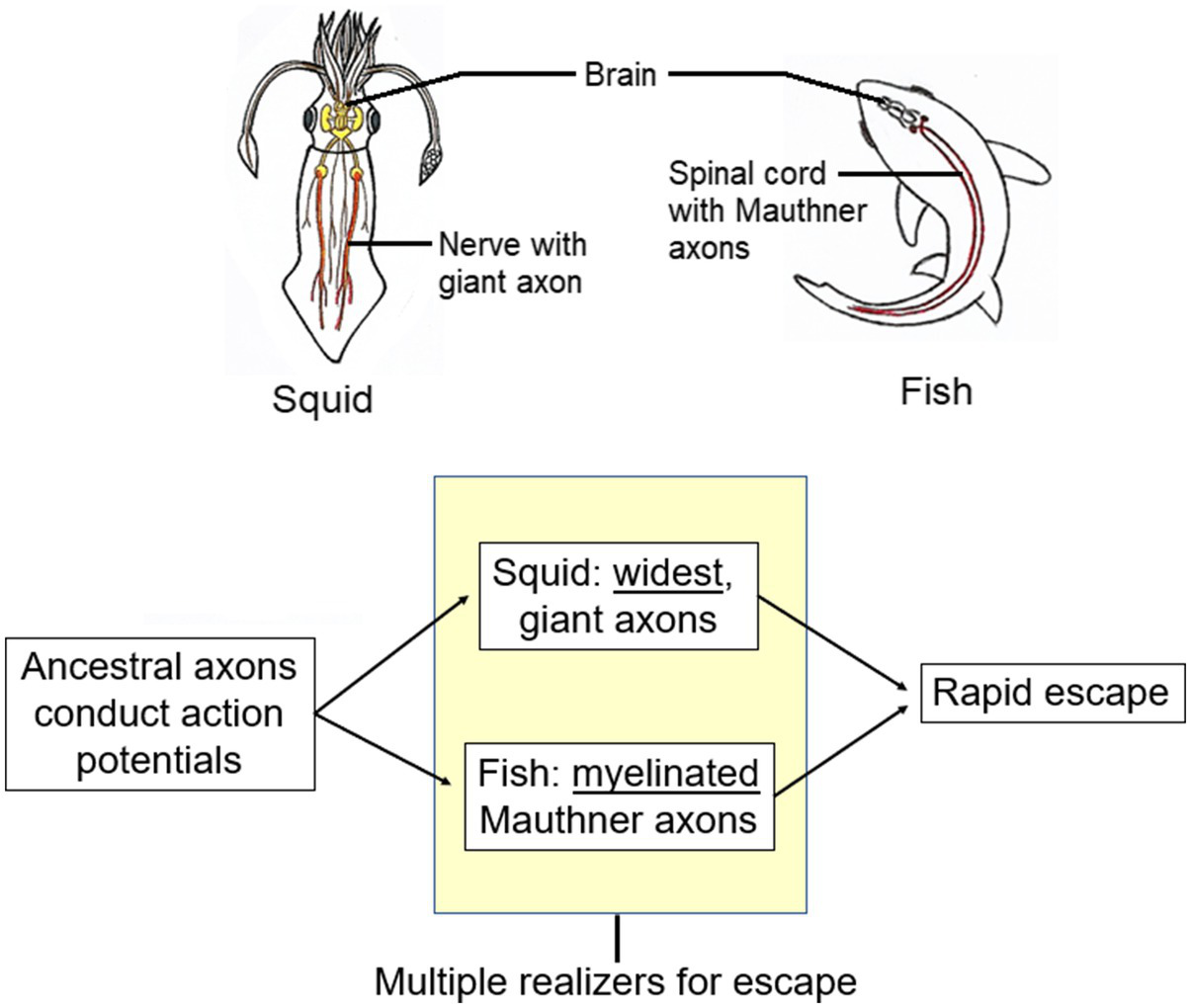
This image from a study on convergent evolution provides a concrete biological example of multiple realization.
3. The Structure and Aftermath of the Argument
The multiple realizability argument can be stated in a formal, deductively valid structure:
- If mental state type M is identical to physical state type P, then it is not possible for M to occur without P occurring.
- It is possible for a mental state type M (e.g., pain) to occur in a system that lacks a specific physical state type P (e.g., C-fiber firing).
- Therefore, mental state type M is not identical to physical state type P.
The widespread acceptance of this argument led to a decline in the popularity of type identity theory and fueled the rise of functionalism as the dominant physicalist view for several decades.
However, the debate is not entirely settled. Proponents of identity theory have developed several sophisticated responses. For a more complete picture, it's worth being aware of these counter-arguments.
Multiple Realizability - Stanford Encyclopedia of Philosophy
This Stanford Encyclopedia of Philosophy entry is the definitive resource on the topic. It lays out the arguments and the main replies with academic rigor.
First, review section 1.2, "Initial Multiple Realizability Arguments". This formally presents Putnam's argument. Next, read section 1.3, "Early Multiple Realizability Arguments for Functionalism", which explicitly connects the objection to the rise of functionalism. Finally, and most importantly, scan the sub-headings and read the introductory paragraphs of the replies in section 2, "Replies to Multiple Realizability Arguments". Pay special attention to section 2.2, "Domain-Specific Identities and Reductions". This is a key strategy for defending a modified version of identity theory. The idea is to restrict the identity claim: perhaps "human pain" is one type of brain state, while "octopus pain" is another. This saves a form of identity but sacrifices its universal scope. Also note section 2.4, "Challenging the Individuation of Mental Kinds", which questions whether we are justified in calling the mental states in different species the same type.
Conclusion
In this lesson, we have moved from a general map of the mind-body problem to a detailed analysis of one of its most important crossroads. We have reconstructed the mind-brain identity theory and the powerful multiple realizability objection that challenged it.
- Key Takeaways:
- The Type Identity Theory is a physicalist view claiming that mental state types are identical to brain state types (e.g., pain = C-fiber firing).
- It is presented as a contingent scientific hypothesis (an "is" of composition), not a conceptual definition. This defends it against purely logical objections based on the different meanings of mental and physical terms.
- The Multiple Realizability Argument is the primary objection to type identity theory. It argues that since the same mental state type (like pain) can be realized by different physical structures (in humans, octopuses, AIs), it cannot be identical to any single one of them.
- This objection was a major impetus for the development of Functionalism, which defines mental states by their abstract causal role rather than their physical makeup.
- Defenders of identity theory can respond by retreating to token identity, proposing domain-specific identities, or questioning whether the mental states in different realizers are genuinely of the same type.
Preview of the Next Lesson:
We have now seen how one physicalist theory (identity theory) was challenged, leading to another (functionalism). Both of these theories, however, share a fundamental assumption: that the world is, at bottom, entirely physical. But why should we believe this? In our next lesson, we will step back to examine the core thesis of physicalism itself and analyze the powerful causal argument for physicalism, which aims to show that any non-physical mental properties would be causally inert and explanatorily redundant.