Welcome to the first lesson of our new module, "Philosophy of Mind and Consciousness." In our previous module, we concluded with Karl Marx's sweeping theories of societal structure and historical change, focusing on the collective dynamics of class and production. Now, we pivot from the grand scale of the polis to the intricate, inner world of the psyche. We will move from asking how society is structured to asking what it is that thinks, feels, and experiences that society.
Our starting point is one of the most fundamental and persistent questions in all of philosophy: the mind-body problem. At its heart, the question is simple: What is the relationship between the mental world of thoughts, feelings, and consciousness, and the physical world of brains, bodies, and matter?
In this lesson, we will dissect this question to understand precisely why it is such a difficult problem. We will then construct a map of the major theoretical positions that philosophers have proposed as solutions. Your background in physics and formal systems will be an asset here, as we will approach the problem analytically, framing it as a fascinating logical puzzle involving a set of individually plausible but mutually inconsistent claims. Our goal is to explain the mind-body problem and classify the major positions one might take in response to it, such as dualism, physicalism, and functionalism.
1. Defining the Terms of the Debate
Before we can tackle the problem, we must be clear about what we mean by "mind" and "body" (or "the physical").
Philosophers typically identify two key features that distinguish the mental from the merely physical. These are often called the "marks of the mental." A rigorous overview of these is provided in the opening sections of an essay by Kirk Ludwig.
The Mind–Body Problem: An Overview
This chapter provides a structured, academic framework for understanding the mind-body problem.
Please read section 1.2, "Marks of the Mental." Focus on the descriptions of consciousness and intentionality. Then, briefly read section 1.3, "The Physical," to understand the challenge of defining 'physical' in this context.
As you've read, the two primary marks of the mental are:
- Consciousness: This refers to the subjective, qualitative, "first-person" feel of experience. It is the "what-it's-like-ness" of seeing red, feeling pain, or tasting coffee. These subjective qualities of experience are often called qualia. There is something it is like to be you, but presumably, there is nothing it is like to be a rock. This subjective character seems radically different from the objective, third-person properties described by physics.
- Intentionality: This is a technical term for the "aboutness" or "directedness" of many mental states. Your beliefs are about the world, your desires are for certain outcomes, and your thoughts are of certain things. This power of a mental state to represent or be about something else, including things that don't exist (like unicorns), is a puzzling feature not typically found in purely physical objects. A neuron firing isn't intrinsically about Paris in the way a thought can be.
The "physical" side of the problem also requires careful definition. As Ludwig notes, defining it as "what current physics describes" is problematic, since physics is an evolving field. A more stable approach is to think of the physical realm as comprising properties like mass, charge, shape, and motion, and anything that can be constructed from or explained in terms of these—the domain of objective, publicly observable phenomena.
2. A Logical Dilemma: Why It's a "Problem"
The mind-body problem isn't just a question; it's a deep-seated philosophical problem because the most intuitive answers seem to contradict each other. We can formalize this difficulty by presenting it as a set of propositions that are each highly plausible on their own, but are logically inconsistent when taken together. This framing turns the issue into a puzzle that any coherent theory must solve by rejecting at least one of the propositions.
The following text lays out this elegant formulation.
The Mind–Body Problem: An Overview
This section presents the mind-body problem as a formal inconsistency among four compelling theses.
Please read section 1.5, "The Mind–Body Problem." Focus carefully on the four theses and the explanation of why they are individually appealing but jointly inconsistent.
Let's summarize the dilemma. The problem arises from the mutual inconsistency of these four theses:
- Realism: Mental properties exist. (e.g., pains, beliefs, and conscious experiences are real features of the world).
- Conceptual Autonomy: Mental properties are not conceptually reducible to physical properties. (The concept of 'pain' cannot be fully analyzed or defined in the language of physics or neuroscience alone).
- Constituent Explanatory Sufficiency: A complete physical description of a thing's basic constituents and their interactions entails all of its properties. (The "micro-physics" of a system fully determines its "macro" properties. This is a core assumption of much of the scientific worldview).
- Constituent Non-mentalism: The basic constituents of matter (e.g., quarks, electrons) do not have mental properties. (Physics has found no need to attribute thoughts or feelings to fundamental particles).
The Inconsistency:
If we accept (4) that fundamental particles are not mental, and (3) that the complete physics of those particles explains everything about a system, it follows that all properties of the system must be explicable in purely physical terms. But if we also accept (2) that mental properties are not explicable in physical terms, then it seems we must conclude that mental properties do not exist, which contradicts (1). You cannot hold all four theses simultaneously without contradiction.
Therefore, any proposed solution to the mind-body problem must involve rejecting at least one of these powerful, common-sense intuitions. This framework gives us a clear system for classifying the major philosophical positions.
3. A Map of the Main Positions
We can visualize the landscape of possible solutions using a flowchart. The fundamental branching point is whether one accepts a purely physical ontology or allows for something more.
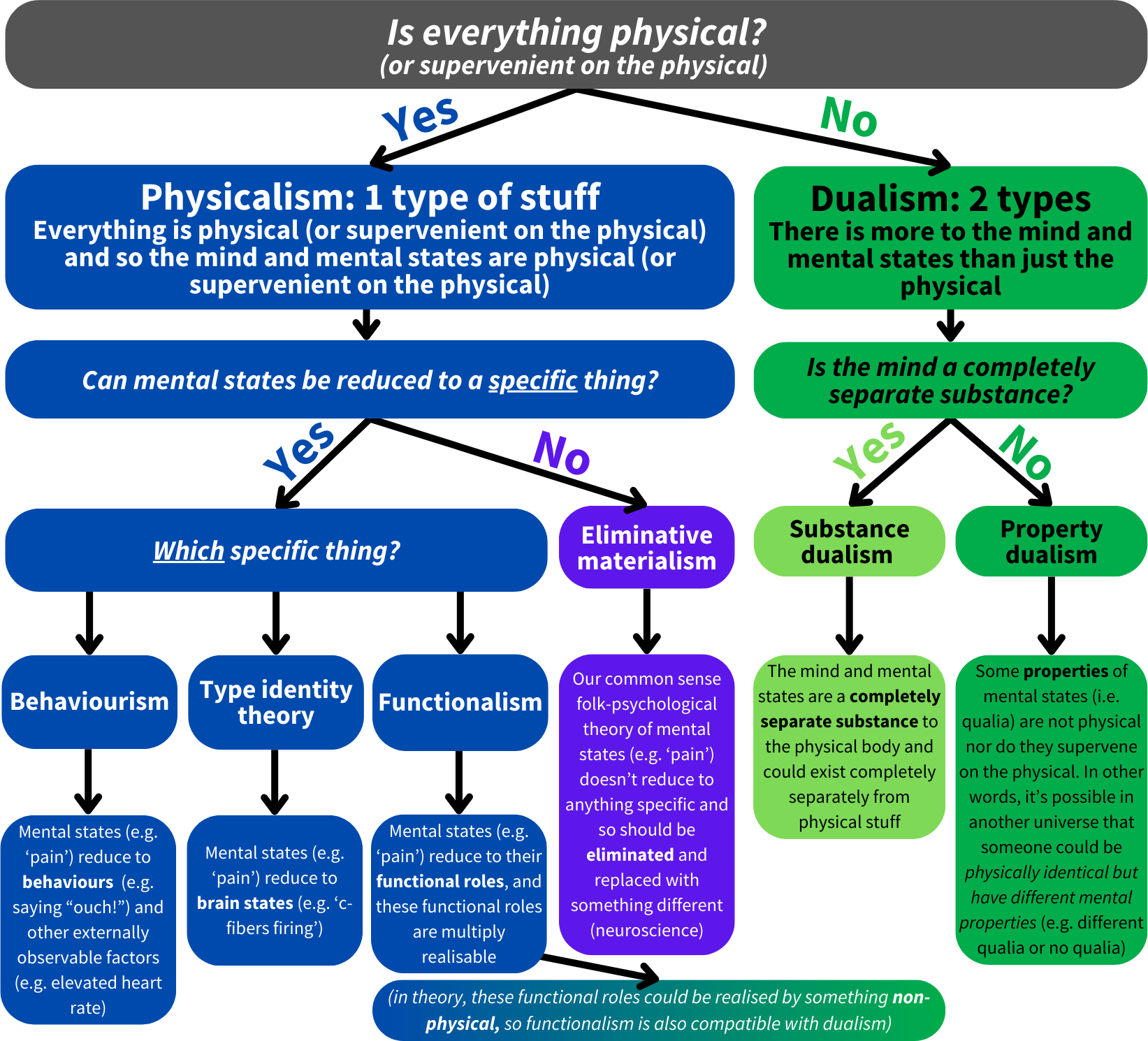
Let's use this map to navigate the primary schools of thought, relating them back to the four propositions of our logical dilemma.
I. Dualism: The Mind and Body are Distinct
Dualist theories maintain a sharp distinction between the mental and the physical. They wholeheartedly accept Realism (1) and Conceptual Autonomy (2). The mental is real and irreducible. Their solution to the dilemma involves challenging the purely physicalist worldview encapsulated by propositions (3) and (4).
There are two main forms of dualism:
-
Substance Dualism: This is the classic view most associated with René Descartes. It holds that the universe contains two fundamentally different kinds of substance: physical substance (matter, which is extended in space) and mental substance (mind, which is non-extended and thinks). Your body is a complex physical machine, but you are a non-physical thinking substance, a "soul." This view directly rejects Constituent Non-mentalism (4) and Constituent Explanatory Sufficiency (3) by positing the existence of non-physical entities and laws. The primary challenge for substance dualism is the problem of interaction: How can a non-physical substance causally interact with a physical one? How can your non-physical decision to raise your arm cause your physical arm to move?
-
Property Dualism: This is a more modern and subtle form of dualism. It agrees that there is only one kind of substance—physical substance. However, it claims that this substance can have two fundamentally different kinds of properties: physical properties (like mass and charge) and non-physical mental properties (like the feeling of pain). On this view, when matter is organized in a sufficiently complex way (like in a brain), genuinely new, irreducible, non-physical properties emerge. This position rejects Constituent Explanatory Sufficiency (3), arguing that even a complete physical description won't entail these emergent mental properties; they are governed by further, fundamental "bridge laws" of nature.
For a brief overview of these positions, you can watch the following segment.
Mind Basics: What is a mind and how do we know anything about it?
Professor Matt McCormick provides a concise explanation of the different types of dualist theories.
Please watch the segment from this point, where he distinguishes between substance dualism and property dualism.
II. Physicalism (or Materialism): The Mind is Physical
Physicalism is the view that everything that exists is physical, or is necessitated by the physical. This is the default ontology for most contemporary scientists and many philosophers. Physicalists accept Constituent Explanatory Sufficiency (3) and Constituent Non-mentalism (4). To resolve the dilemma, they must reject either Realism (1) or, more commonly, Conceptual Autonomy (2). They argue that mental properties, despite appearances, can be accounted for within a purely physical world.
The key concept for many modern physicalists is supervenience. To say that mental properties supervene on physical properties means that there can be no difference in mental states without a difference in physical states. If you create a physically identical duplicate of a person, atom-for-atom, that duplicate will necessarily have the exact same mental life. The mental is determined by the physical.
Physicalist theories diverge on how the mental relates to the physical.
-
Eliminative Materialism: This is the most radical form of physicalism. It solves the problem by rejecting Realism (1). Eliminativists argue that our common-sense concepts of the mind ("folk psychology")—beliefs, desires, feelings—are part of a primitive, pre-scientific theory that is fundamentally flawed. Just as science eliminated concepts like "phlogiston" and "demonic possession," a mature neuroscience will eventually eliminate our talk of the mind and replace it with a more accurate vocabulary of brain states.
-
Reductive Physicalism (Identity Theory): This is a less radical view that seeks to reduce the mental to the physical, thereby rejecting Conceptual Autonomy (2).
- The Type Identity Theory claims that mental state types are identical to brain state types. For example, "pain" just is the firing of C-fibers. However, this view faces a powerful objection known as multiple realizability. It seems plausible that an octopus, an alien, or a future AI could be in pain, even if they have a completely different biology and lack C-fibers. If so, pain cannot be identical to any single physical state type.
-
Functionalism: This is arguably the most influential physicalist theory today. It was developed in response to the problem of multiple realizability. Functionalism rejects Conceptual Autonomy (2) in a very sophisticated way.
- Core Idea: Mental states are defined not by their internal constitution (what they're made of), but by their function—their causal role in a system. A mental state is defined by its relationship to sensory inputs, behavioral outputs, and other mental states.
- The Computer Analogy: For functionalism, the mind is to the brain as software is to hardware. A mental state like "believing it will rain" is like a state in a computer program. It's caused by certain inputs (seeing dark clouds) and, in combination with other states (desiring to stay dry), causes certain outputs (carrying an umbrella).
- Solving Multiple Realizability: This analogy beautifully explains multiple realizability. The same software (e.g., Microsoft Word) can run on different hardware platforms (a PC, a Mac). Similarly, the same mental state (pain) can be "realized" in different physical systems (a human brain, an octopus brain, a silicon-based AI), as long as the system implements the correct functional role.
The following lecture excerpt from John Searle provides a brilliant, systematic account of the move from identity theory to functionalism and its connection to the computational theory of mind. Given your background, you will find his structured explanation particularly clear.
Searle: Philosophy of Mind, lecture 4
In this lecture, philosopher John Searle explains the intellectual progression from identity theory to functionalism and the computational theory of mind.
First, watch the explanation of the identity theory from this timestamp. Pay attention to the distinction between type and token identity and the powerful "neuronal chauvinism" objection. Next, see how functionalism arises as a solution from this segment. Searle explains that mental states are defined by their causal relations, providing a way to identify the same mental state across different physical implementations. To understand the foundations of functionalism, watch the discussion on multiple realizability and levels of description from this point. This directly addresses how the same higher-level program can be run on different lower-level hardware. Finally, see how this culminates in the core thesis of computational functionalism from this timestamp, summarized by the equation: "the mind is to the brain as the program is to the hardware."
Conclusion
We have mapped the rugged intellectual terrain of the mind-body problem. We've seen that it's not merely a vague question but a sharp logical dilemma stemming from four plausible but incompatible propositions. The major philosophical schools of thought can be understood as attempts to resolve this dilemma by rejecting one of these foundational beliefs.
- Key Takeaways:
- The mind-body problem asks how mental phenomena (consciousness, intentionality) relate to physical phenomena (brains, matter).
- It can be framed as a conflict between four theses: Realism, Conceptual Autonomy, Constituent Explanatory Sufficiency, and Constituent Non-mentalism.
- Dualism resolves the conflict by rejecting a purely physicalist worldview, maintaining that the mental is fundamentally non-physical. It comes in two main forms: Substance Dualism and Property Dualism.
- Physicalism maintains that everything is physical or supervenes on the physical. It resolves the conflict by challenging the autonomy or even the reality of the mental.
- Key physicalist theories include Eliminative Materialism (which denies the reality of mental states), Type Identity Theory (which identifies mental types with physical types), and Functionalism (which defines mental states by their causal role, akin to software).
Preview of the Next Lesson:
We have now established the major positions. In our next lesson, we will deepen our analysis by examining the core arguments more closely. We will start with the identity theory of mind, exploring its motivations and the details of the powerful multiple realizability objection that functionalism was designed to overcome.