Welcome to our final lesson in the module on political philosophy. In our last two lessons, we navigated the terrain of modern liberal political thought, contrasting John Rawls's argument for a patterned, redistributive justice with Robert Nozick's defense of a historical, libertarian justice. Both theories, however, operate within the general framework of a market-based society, debating the proper arrangement of rights and resources within it. Today, we step outside that framework entirely to engage with a thinker who offers a fundamental critique of the system itself: Karl Marx.
Instead of asking what a just distribution of property looks like, Marx asks why society is structured around private property and class division in the first place. His critique is not about fine-tuning the rules of the game, but about changing the game itself. In this lesson, we will explore two of his most influential and foundational concepts: the theory of alienation and the doctrine of historical materialism. Together, they provide a powerful, if controversial, lens for understanding the human condition within capitalist society and the grand sweep of historical change.
1. The Theory of Alienation
We'll begin with Marx's diagnosis of the ills of modern labor. He uses the term alienation to describe a specific kind of dysfunction that pervades life in capitalist society: a problematic separation between a subject and an object that properly belong together. For Marx, this is not merely a feeling of estrangement but an objective condition rooted in the material realities of work.
His analysis was heavily influenced by the philosopher Ludwig Feuerbach, who argued that humans become alienated through religion by projecting their own best qualities (power, knowledge, goodness) onto a divine being, God, and then worshipping this external creation as something separate from and superior to themselves. Marx took this powerful idea and applied it not to the heavens, but to the factory floor. He argued that the real source of alienation wasn't an error in thought, but the concrete, daily activity of alienated labor.
In his Economic and Philosophic Manuscripts of 1844, Marx outlines four dimensions of alienated labor. A clear and rigorous explanation of these can be found in the Stanford Encyclopedia of Philosophy.
Karl Marx - Stanford Encyclopedia of Philosophy
This entry from the Stanford Encyclopedia of Philosophy provides a comprehensive and philosophically precise account of Marx's theory of alienation.
Please read the section on "Alienation and Human Flourishing". Focus on the introductory part explaining the basic idea. Then, pay close attention to the four dimensions of alienated labour that Marx identifies. Finally, consider the connection made between alienation and human flourishing.
As you've read, Marx's account is built on a specific, "thick" conception of human nature, or what he sometimes called our "species-essence" (Gattungswesen). He believed that humans flourish through free, conscious, creative, and social activity. Alienation is the frustration of this nature. Let's systematically unpack the four separations:
-
Alienation from the Product of Labor: The worker creates a product that they do not own, control, or even design. The product, once made, enters a market where it stands opposed to the worker as an alien object. The more the worker produces, the more powerful the world of objects becomes, and the poorer the worker becomes in their own inner life. The worker's own life-activity is embodied in an object that is now a source of power over them.
-
Alienation from the Activity of Labor: The work itself is not voluntary but coerced; it is a means to an end (a wage) rather than an end in itself. The worker does not affirm but denies themselves in their work. It is not fulfilling but debilitating, "a mortification of the body and a ruin of the mind." They are only free in their "animal functions"—eating, drinking, procreating—while in their distinctively human function of production, they are reduced to an animal level.
-
Alienation from Other Human Beings: Capitalist relations of production pit individuals against each other. Workers compete for jobs, and the relationship between the worker and the capitalist is inherently antagonistic. Rather than seeing others as partners in a collective social project, individuals are socialized to view each other as instruments or obstacles to their own private ends.
-
Alienation from Human Nature ("Species-Essence"): This is the culmination of the other three. By being alienated from their product, their activity, and each other, humans are ultimately alienated from their own nature. Free, conscious activity is what distinguishes humans from animals. Under capitalism, this essential characteristic is stifled. Work becomes a mere means for survival, not a site of self-realization.
Crucially, Marx does not blame technology. His critique is aimed at the social relations of capitalism—private ownership of the means of production and the wage-labor system. Technology, for Marx, is part of the solution, not the problem, as it creates the potential for a world beyond scarcity.
The following lecture excerpt provides a vivid narration of how these ideas connect to Marx's broader philosophical project.
Great Minds - Part 4 - Marx and the Problem of Alienation and Ideology
This video from Dr. Michael Sugrue's "Great Minds" series explains how the ruling class generates ideology to justify its existence, a concept deeply intertwined with alienation.
Watch the segment from this timestamp. Dr. Sugrue explains how the economic system generates a "false consciousness" or "ideology" that legitimizes the exploitative relations of production. This is the cultural and intellectual dimension of alienation.
2. Historical Materialism: A "Science" of History
If alienation is Marx's diagnosis of the human condition under capitalism, historical materialism is his grand theory explaining how such conditions arise and how they might be overcome. You have a strong background in physics and formal systems, so you may find it helpful to think of this as Marx's attempt to formulate a set of general laws governing the dynamics of social systems through history. He sought to move history from the realm of contingency and "great men" to a science, much as physicists had done for the natural world.
His method was dialectical, a concept he borrowed from the idealist philosopher G.W.F. Hegel. For Hegel, history was the story of Spirit (Geist) coming to self-consciousness through a dialectical process of thesis, antithesis, and synthesis. Marx famously claimed to have turned Hegel "on his head," arguing that the driving force of history is not ideas, but material conditions—specifically, the way human beings produce their means of subsistence.
The core of historical materialism is the relationship between a society's economic base and its superstructure.
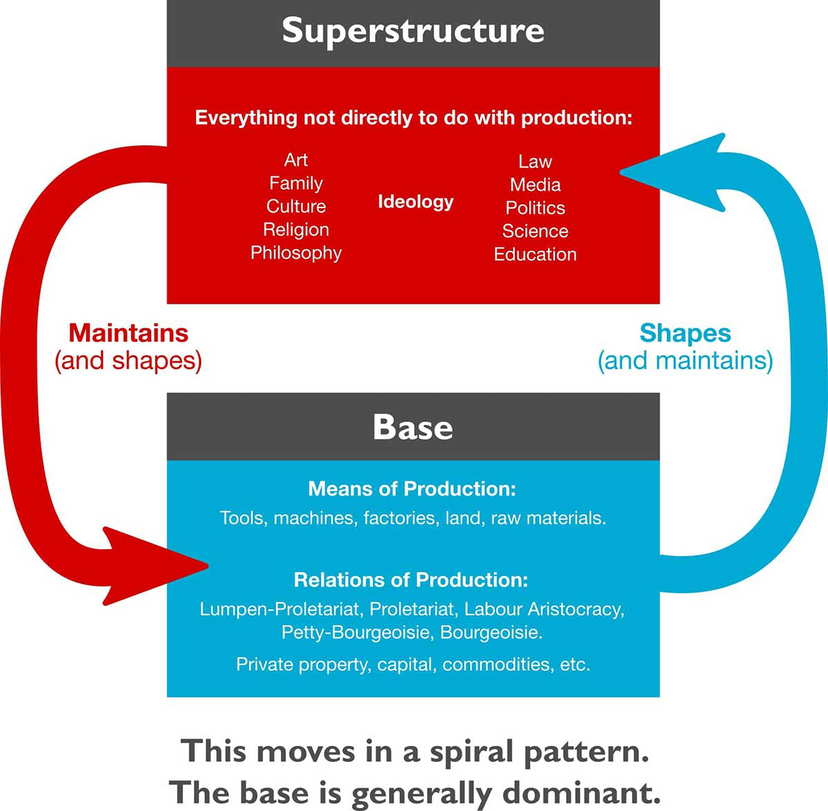
To understand this model, we must define its components:
- Forces of Production: These are the technological and material capacities of a society. They include tools, machinery, factories, raw materials, and land, but also, crucially, human labor power, which encompasses strength, skill, and scientific knowledge.
- Relations of Production: These are the social structures that organize production. They consist of property relations (who owns the means of production) and the resulting class divisions (e.g., master/slave, lord/serf, bourgeois/proletarian).
- Economic Base (or Mode of Production): This is the combination of the forces and relations of production. It is the "real foundation" of society.
- Superstructure: This includes all the other aspects of society: its legal system, political institutions, culture, art, religion, and philosophy. For Marx, the form and content of the superstructure are determined by the economic base. Its primary function is to stabilize and reproduce the existing relations of production. For example, the legal system's defense of private property is a superstructural element that reinforces the capitalist base.
The central drama of history unfolds in the conflict between the forces and relations of production. Dr. Darren Staloff provides an excellent "rational reconstruction" of this process, which should resonate with your analytical approach.
Dr. Darren Staloff, Marx's Historical Materialism
In this video, Dr. Darren Staloff systematically reconstructs Marx's historical materialism, treating it as a scientific theory.
First, watch the section from this point, where Dr. Staloff defines the theory's two fundamental entities (persons and forces of production) and explains how they combine into the concepts of 'means of production', 'relations of production', and 'economic structure' (the base). Then, watch from this segment to understand how the base determines the 'superstructure' and how this entire system constitutes a 'mode of production'.
This dynamic can be summarized by a few "laws of development," which you can think of as the core principles of the system's evolution:
- The Development Thesis: The forces of production have an inherent tendency to develop over time. Human ingenuity constantly improves technology and our ability to manipulate nature.
- The Primacy Thesis: The nature of the relations of production is explained by the level of development of the forces of production. A certain level of technology corresponds to a certain social structure (e.g., hand-mills correspond to feudalism; steam-mills to capitalism).
- The Contradiction and Revolution: The relations of production persist as long as they foster the development of the productive forces. However, at a certain point, the existing relations become a "fetter"—a chain—on the further development of those forces. At this point, a period of social revolution begins. The class that represents the new, more potent productive forces overthrows the old ruling class, shatters the old relations of production, and establishes a new economic base and superstructure.
History, then, is a succession of modes of production, each giving way to the next through revolutionary conflict: for example, the transition from the ancient (slave-based) mode to the feudal mode, and then from feudalism to capitalism. Marx argued that capitalism, despite being the most productive mode in history, contains its own fatal contradiction. It develops the forces of production to an incredible degree, making it possible to eliminate scarcity. Yet its relations of production—private ownership and production for profit—lead to crises and prevent the rational use of this productive capacity for human need. This, for Marx, sets the stage for the final revolution and the transition to communism, which he saw as the end of this "prehistory" of class struggle.
For a textual summary that connects these components, you can review the following resource.
The Validity of Karl Marx's Theory of Historical Materialism
This student paper by Kevin Shimp provides a concise summary of the core concepts.
Please read section III, "What is Historical Materialism?". This will reinforce your understanding of the interplay between productive forces, relations of production, superstructure, and class struggle.
Conclusion
Marx offers a powerful and comprehensive theory of society and history that stands in stark contrast to the liberal tradition we've studied. Where Rawls and Nozick see society as an association of individuals, Marx sees it as an arena of contending classes. Where they seek principles for just distribution, Marx seeks to understand the underlying system of production that makes that distribution necessary.
- Key Takeaways:
- Alienation describes the objective condition of workers under capitalism, characterized by four separations: from the product, the activity of labor, other people, and their own human nature. This stems from a system of private property and wage labor.
- Historical Materialism is Marx's theory of history, which posits that societal development is driven by the material conditions of production.
- The economic base (forces and relations of production) determines the legal and political superstructure.
- History progresses through different modes of production. Change occurs through social revolution when the existing relations of production begin to "fetter" the development of the productive forces.
- Class struggle is the political and social expression of this fundamental economic contradiction.
This lesson concludes our module on political philosophy. We have journeyed from the social contract theories of Hobbes, Locke, and Rousseau, through the sophisticated liberalisms of Rawls and Nozick, and ended with Marx's radical critique of the entire liberal-capitalist order.
Preview of the Next Module:
Having explored the structure of the just society, we will now turn inward. Our next module, "Philosophy of Mind and Consciousness," shifts focus from the collective to the individual, from the polis to the psyche. We will begin by tackling one of philosophy's most enduring puzzles: the mind-body problem. How does the conscious, thinking mind relate to the physical, biological brain? This question will lead us into the heart of contemporary debates about physicalism, consciousness, and what it means to be a thinking being.