Welcome back to our exploration of the philosophy of mind. In our last lesson, we examined how the type-identity theory of mind, while elegantly simple, faced a formidable challenge from the multiple realizability argument. This objection catalyzed the rise of functionalism, a view that defines mental states by their causal role rather than their specific physical makeup.
However, both identity theory and functionalism are varieties of a broader and more fundamental doctrine: physicalism. This is the view that the world is, at its most basic level, entirely physical. Before we delve into the most profound challenges to physicalism—namely, the nature of consciousness itself—it's crucial to understand why this doctrine has become the default starting point for so many contemporary philosophers and scientists.
Today's lesson addresses that very question. We will define the thesis of physicalism more precisely and then reconstruct what is widely considered its most powerful justification: the causal argument for physicalism. This argument attempts to show, on grounds that are deeply intertwined with the progress of modern science, that any non-physical phenomena would be causally redundant. Your background in physics will be especially valuable here, as the argument's key premise rests on empirical claims about the nature of the physical world.
1. What is Physicalism?
At its simplest, physicalism is the metaphysical thesis that "everything is physical." A more precise and widely used formulation states that all facts, including mental, biological, and social facts, are ultimately determined by or supervene on physical facts.
The concept of supervenience is key. To say that property set A supervenes on property set B means that there can be no difference in A-properties without a corresponding difference in B-properties. If you were to create a particle-for-particle duplicate of our universe, with every physical entity and law exactly the same, a physicalist would claim that this duplicate universe would necessarily contain all the same mental states, biological life, and economic systems as ours. The physical facts fix all the facts.
This idea is deeply analogous to principles within physics itself. The macroscopic properties of a system—like the temperature of a gas or the hardness of a diamond—are fixed by the microscopic properties and arrangement of its constituent particles. You cannot change the temperature without changing the kinetic energy of the molecules. Physicalism applies this logic to reality as a whole.
The following video offers a clear introduction to physicalism and the concept of supervenience.
The video "Why Believe Physicalism?" by Kane B provides an excellent starting point.
Please watch the introductory segment (What is physicalism?). Pay close attention to the explanation of supervenience, particularly the visual analogy using the image of Frank Zappa. The shapes in the image supervene on the arrangement of pixels; you can't change the shape without changing the pixels.
To visualize where physicalism fits within the broader landscape of theories about the mind, this flowchart is a helpful guide. It maps the major divisions we've discussed, from the primary split between dualism and physicalism down to the specific theories within each camp.
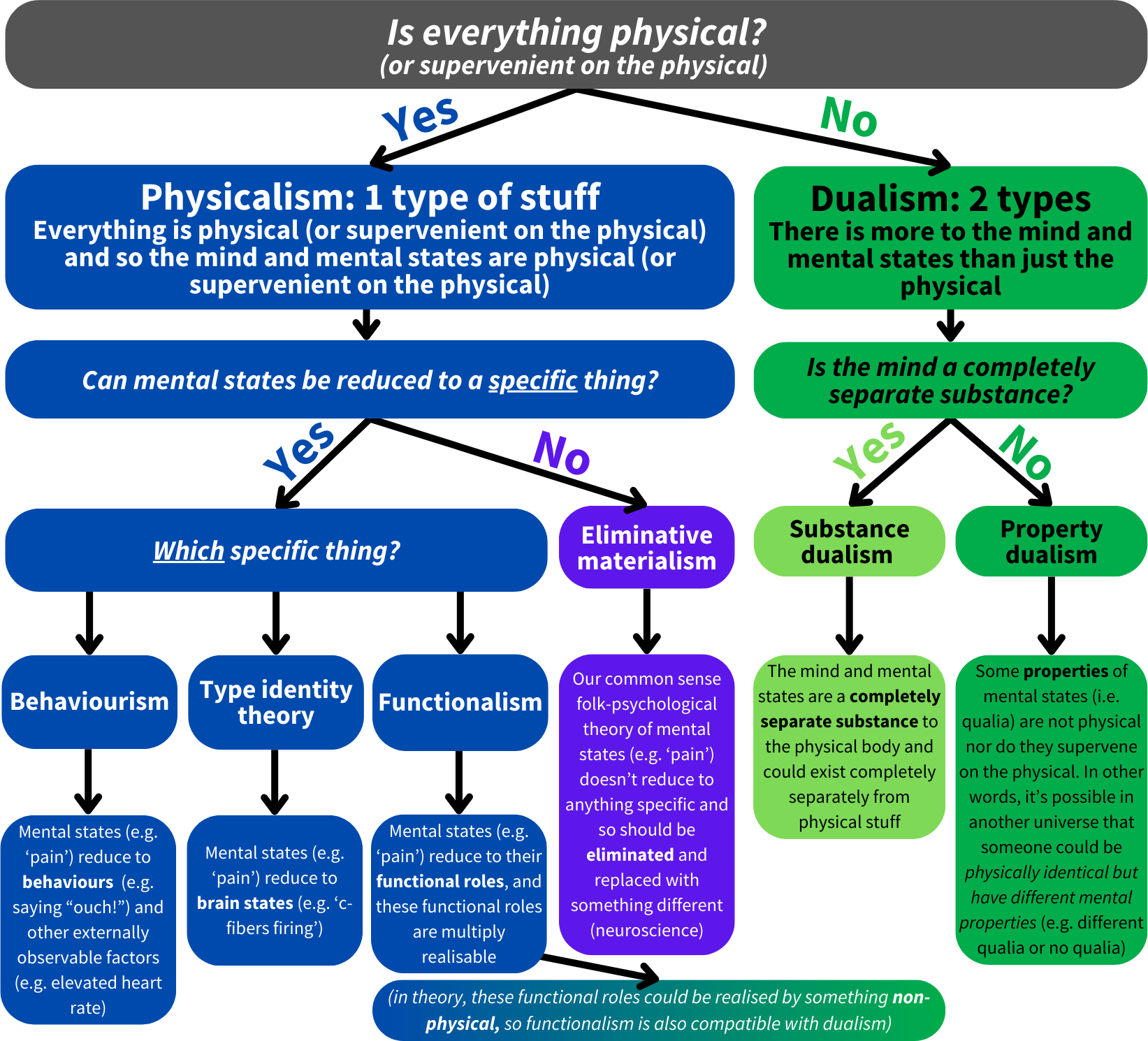
2. The Causal Argument for Physicalism
While there are several arguments for physicalism—such as an inductive argument from the past explanatory success of science—the most rigorous and influential is the causal argument. This argument, developed by philosophers like David Papineau and Jaegwon Kim, aims to demonstrate that if mental states have any effect on the physical world, they must themselves be physical.
The argument is best understood through its formal structure, which typically involves three premises. We will use a debate featuring David Papineau to walk through them.
Philosophers RESPECTFULLY debate physicalism and dualism
In this video, "Philosophers RESPECTFULLY debate physicalism and dualism," Dr. David Papineau presents a concise and authoritative version of the causal argument.
Please watch the following segments where Papineau lays out the argument's structure: Introduction and Premise 1: Efficacy of the Mental (The first premise). The first premise is that mental events have physical effects. My decision to speak causes my lips to move; my feeling of thirst causes me to reach for a glass. This seems like an undeniable feature of our experience. Premise 2: The Causal Closure of the Physical (The second premise). This is the crucial, empirically-grounded premise. It states that every physical effect has a sufficient physical cause. A physiologist explaining your arm movement would appeal to neural signals, muscle contractions, and brain activity—a complete causal story that never needs to leave the physical domain. Premise 3: No Systematic Overdetermination (The third premise). Given the first two premises, it seems a physical effect (like your arm moving) has both a mental cause (your decision) and a physical cause (brain events). Are these two separate causes? Overdetermination occurs when an effect has multiple, distinct causes, each of which would have been sufficient on its own (e.g., a person is shot and struck by lightning at the same instant). This premise states that it's implausible for every single mind-caused action to be systematically overdetermined in this way. Conclusion & Options for the Opponent (The conclusion). If a physical effect has a mental cause (P1), a physical cause (P2), and it isn't systematically overdetermined (P3), the only logical conclusion is that the mental cause is the physical cause. They are not two causes, but one cause described in two different ways. Papineau then outlines the only ways to reject this conclusion: deny one of the three premises.
Let's formalize the argument:
- Some mental events have physical effects. (Mental Causation)
- All physical effects have sufficient physical causes. (Causal Closure)
- The physical effects of mental causes are not systematically overdetermined by distinct causes. (No Overdetermination)
- Therefore, those mental events are identical with their physical causes. (Conclusion: Physicalism)
The power of this argument comes from the fact that its premises seem highly plausible, and its conclusion follows logically from them.
3. The Empirical Heart of the Argument: Causal Closure
The most debated and scientifically grounded premise is the second one: the causal closure of the physical, or what Papineau calls "the completeness of physics." The claim that the physical world is a closed causal system, where no non-physical forces are needed to explain physical events, is not an a priori philosophical assumption but a conclusion drawn from centuries of scientific progress.
David Papineau's paper "The Rise of Physicalism" provides a brilliant historical account of how this premise became scientifically established, leading directly to the modern dominance of physicalism.
The Rise of Physicalism - David Papineau
This paper by David Papineau explains how the widespread acceptance of physicalism is a relatively recent phenomenon, driven by empirical evidence for the completeness of physics.
Your physics background will make this reading particularly rewarding. Please focus on these sections: The Central Thesis: Papineau argues that physicalism's rise is not a matter of fashion but follows from an argument whose key empirical premise only became available to philosophers relatively recently. From Completeness to Physicalism: Read this section to see a formal statement of the completeness of physics and a clear explanation of how it forces the physicalist conclusion. Notice how it underpins the arguments of major 20th-century physicalists. The Causal Argument: This section presents the canonical form of the argument we just saw in the video, adding important philosophical nuances. The Empirical Evidence: This is the most critical section. Papineau details the "Argument from Fundamental Forces" and the "Argument from Physiology." He explains how, until the 20th century, concepts like special "vital forces" or "mental energy" were scientifically respectable. The gradual accumulation of evidence—from the conservation of energy to detailed neurophysiological research—closed the door on these non-physical causes, leaving a causally complete physical picture. Conclusion: This brief section summarizes the entire historical and philosophical case.
Papineau's historical analysis is powerful because it shows that interactionist dualism (the view that a non-physical mind intervenes in the physical world) isn't just philosophically cumbersome; it stands in opposition to a core principle consolidated by modern physics, chemistry, and biology. The image below shows an earlier, inductive version of this reasoning.

4. A Nuance on "No Overdetermination"
The third premise—no systematic overdetermination—is often the most confusing. Why should we rule it out? Couldn't the world just be set up with this strange double-causation?
The philosopher Alyssa Ney offers a crucial clarification. The objection to overdetermination in this context isn't just that it's unparsimonious. The deeper issue is that this specific kind of overdetermination—where a non-physical cause acts alongside a physical one—would itself be a violation of causal closure. If a complete causal explanation for a physical event must cite a non-physical cause in addition to a physical one, then the physical cause was not, by itself, sufficient. Thus, the "No Overdetermination" premise is best seen as a direct consequence of the "Causal Closure" premise.
A Defense of the Causal Argument for Physicalism
This paper by Alyssa Ney defends the causal argument and provides a sharp analysis of its premises.
Please read the section titled "The Motivation Behind the No Overdetermination Premise". This passage clarifies that the premise isn't a blanket ban on all overdetermination but specifically on the kind that would violate causal closure. Ney helpfully reframes the argument to make this dependency explicit.
This clarification strengthens the argument significantly. It shows that the main weight rests on just two pillars: that the mind has causal effects, and that the physical world is causally closed.
Conclusion
In this lesson, we have moved from the specific debates between physicalist theories to an examination of the foundations of physicalism itself. The causal argument provides a formidable case for why the mind, if it is to have any influence on the world we observe, must be part of the physical world.
- Key Takeaways:
- Physicalism is the metaphysical doctrine that everything is physical, or supervenes on the physical.
- The Causal Argument for Physicalism is a deductive argument considered one of the strongest justifications for this view.
- It rests on three premises: Mental Causation, Causal Closure of the Physical, and No Systematic Overdetermination.
- The Causal Closure premise is the empirical heart of the argument, supported by the history and findings of modern science, which has found no evidence for non-physical forces acting on the physical world.
- To reject the argument's conclusion, one must take on a difficult position:
- Epiphenomenalism (denying mental causation).
- Interactionist Dualism (denying causal closure, against scientific consensus).
- Systematic Overdetermination (accepting a seemingly miraculous and unparsimonious alignment of causes).
Preview of the Next Lesson:
We have now seen the most powerful argument for physicalism. It seems to place any non-physicalist view on the defensive. However, physicalism faces its own profound challenge, one that many believe is its Achilles' heel: the subjective, first-person character of conscious experience, or qualia. In our next lesson, we will explore this "hard problem" of consciousness and analyze two of the most famous arguments designed to show that no physicalist account can ever fully capture what it is like to have an experience.