Welcome to the first lesson of our module on Epistemology. In our previous module, we concluded with Kant's monumental synthesis, which sought to establish the foundations and limits of human knowledge by examining the mind's own structure. Kant was concerned with the question: How is knowledge possible at all? We now pivot from this high-level structural question to a more fine-grained analysis of the concept of knowledge itself. Our new question is more personal and specific: What does it take for an individual to know something?
This lesson delves into what has long been considered the standard answer to that question: the "Justified True Belief" account of knowledge. We will unpack its three core components and understand why each was thought to be essential. Then, we will explore the revolutionary counterexamples published by Edmund Gettier in 1963, which demonstrated that this traditional account, while appealing, is ultimately incomplete.
1. The Project of Analyzing Knowledge
Before we dissect a specific theory of knowledge, it's crucial to understand what philosophers are trying to do when they "analyze" a concept like knowledge. This project, central to the tradition of analytic philosophy, aims to identify the set of conditions that are individually necessary and jointly sufficient for the concept to apply. Your background in mathematics and logic will make this approach feel quite natural. We are looking for an "if and only if" statement of the form:
A subject S knows a proposition P if and only if _______.
The goal is to fill in the blank with a list of conditions that are met in all and only the cases of knowledge. The kind of knowledge we are concerned with here is propositional knowledge, or "knowing-that." This is distinct from "knowing-how" (like knowing how to ride a bicycle) or knowledge by acquaintance (like knowing a person or a city).
For a detailed introduction to this philosophical project, the Stanford Encyclopedia of Philosophy provides an excellent overview.
This entry from the Stanford Encyclopedia of Philosophy (SEP) by Jonathan Ichikawa and Matthias Steup sets the stage for our discussion. It clarifies what propositional knowledge is and outlines the "traditional" tripartite analysis we will be examining.
Please read the introduction, starting from the beginning, and the first part of section 1, Knowledge as Justified True Belief. This will formalize the task at hand and introduce the theory we are about to explore.
2. The Tripartite Analysis: Justified True Belief (JTB)
As you've just read, the traditional or "tripartite" analysis of knowledge proposes that three conditions must be met for someone to know a proposition. Knowledge is held to be Justified True Belief (JTB).
Let's break down the three components: S knows that P if and only if:
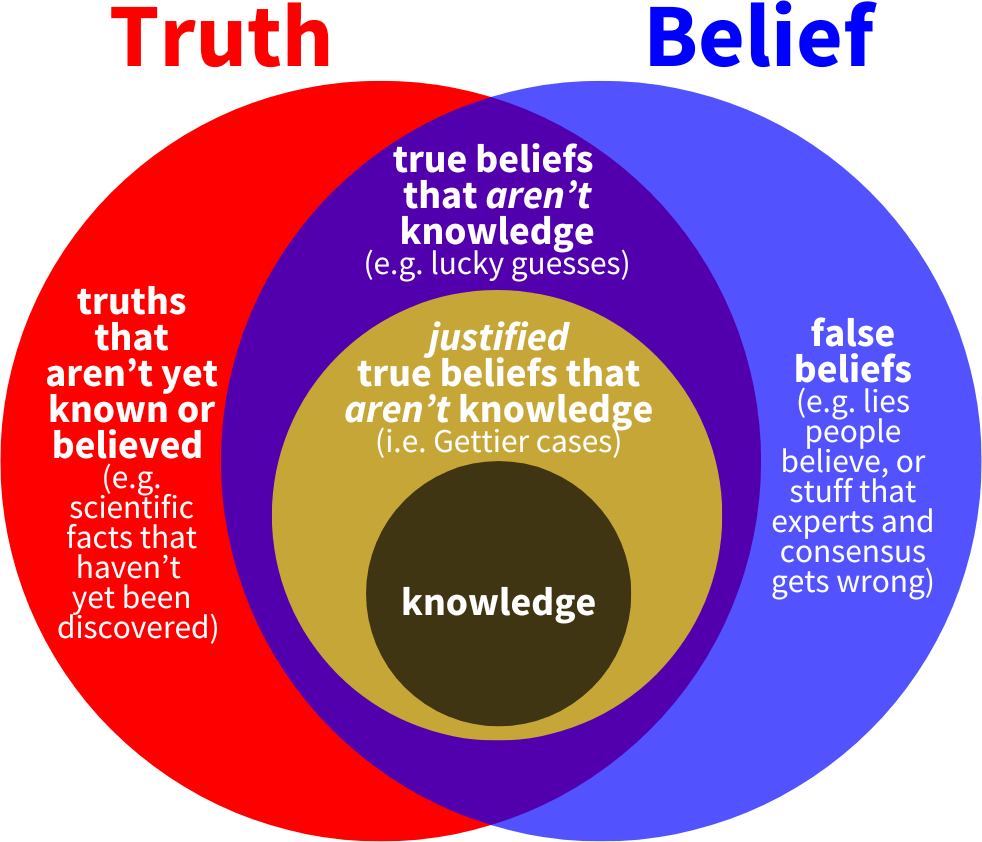
- P is True: Knowledge must be factive. You can only know things that are actually the case. If a belief is false, no matter how strongly you hold it or how good your reasons are, it isn't knowledge. This is a metaphysical condition—it's about the way the world is, independent of your mind.
- S believes that P: Knowledge requires a certain mental state from the subject. You must accept or assent to the proposition. If you do not believe that the Earth revolves around the Sun, you cannot be said to know it, even if you can recite the fact.
- S is justified in believing that P: This is the most complex and contested condition. It's what distinguishes knowledge from a lucky guess. If you form a belief for no good reason—say, on a whim—and it happens to be true, you don't have knowledge. Your belief must be epistemically appropriate, grounded in evidence, or formed by a reliable process.
The relationship between these concepts can be visualized as a series of intersections.
For a concise video summary of the JTB account and its motivations, please watch the following segment.
PHILOSOPHY - Epistemology: Analyzing Knowledge #1 (The Gettier Problem) [HD]
This video from Wireless Philosophy, presented by Jennifer Nagel, clearly explains the three conditions of the JTB analysis and why each one is considered necessary.
Watch the opening segment from the introduction of the JTB analysis.
3. The Gettier Problem
For much of the 20th century, the JTB analysis was the dominant theory of knowledge. However, in 1963, a philosopher named Edmund Gettier published a brief, three-page paper that sent shockwaves through epistemology. The paper, titled "Is Justified True Belief Knowledge?", argued decisively that the three conditions of the JTB analysis are not sufficient for knowledge.
Gettier did this by constructing clever counterexamples: hypothetical scenarios in which a person has a justified true belief, yet our intuition tells us they do not have knowledge. These "Gettier cases" all share a common feature: the subject's justification is, through a stroke of bad luck, disconnected from the truth of their belief, but a second stroke of good luck makes the belief true anyway.
The following video provides the historical context for Gettier's paper and explains the nature of his challenge using a simple, intuitive example.
Edmund Gettier - Is Justified True Belief Knowledge?
This video by philosopher Victor Gijsbers explains why Gettier's paper was so impactful and presents the classic "stopped clock" example, which functions as a very clear Gettier-style problem.
Please watch from the beginning of the video. Pay close attention to the explanation of counterexamples in analytic philosophy and how the stopped clock case meets the JTB criteria but fails to be knowledge.
As the video illustrates with the stopped clock example, you can have a belief that is true (it is 8:15), and you believe it (you look at the clock and form the belief), and you are justified (looking at a usually reliable clock is a good reason to believe the time). Yet, you don't know the time, because the clock is broken. Your belief is true purely by coincidence.
4. Gettier's Original Cases
The stopped clock case, while effective, was not one of Gettier's original examples. To fully appreciate his argument, it's best to engage with the primary text itself. His paper is remarkably concise and clear. We will focus on his first case, involving two job applicants, Smith and Jones.
Before presenting the case, Gettier makes two crucial preliminary points about the nature of justification that his argument relies on:
- Fallibilism about Justification: It is possible for a person to be justified in believing a proposition that is in fact false.
- Deductive Closure of Justification: If S is justified in believing P, and P entails Q, and S deduces Q from P and accepts Q as a result, then S is justified in believing Q.
With these two points in mind, let's examine Gettier's first case directly from his paper.
analysis 23.6 june 1963 - is justified true belief knowledge?
This is Edmund Gettier's original 1963 paper. Reading his own formulation of the problem is a core exercise in analytic philosophy.
Please read the two introductory points Gettier makes, starting from the two points. Then, read the section titled Case I.
Let's carefully reconstruct the argument from "Case I":
- Initial Justified Belief: Smith has strong evidence (the company president told him) for the proposition:
(d) Jones is the man who will get the job, and Jones has ten coins in his pocket.Smith is justified in believing (d). - A Logical Deduction: Proposition (d) logically entails:
(e) The man who will get the job has ten coins in his pocket.Because Smith sees this entailment and believes (e) on the basis of (d), he is justified in believing (e). - The Twist: As it turns out, (d) is false. Against all odds, Smith gets the job, not Jones. However, by sheer coincidence, Smith himself also has ten coins in his pocket.
- The Verdict:
- Proposition (e) is true (because Smith gets the job and has ten coins).
- Smith believes that (e) is true.
- Smith is justified in believing that (e) is true (due to the deductive closure from his justified belief in (d)).
Smith has a justified true belief in (e). But does he know it? The strong philosophical intuition is "no." His belief is true because of the number of coins in his own pocket, but his justification is based on the number of coins in Jones's pocket. The justification and the truth-maker are completely disconnected. It is, in the end, a lucky guess.
For a final, reinforcing walkthrough of this specific case, you can watch this segment from the Wireless Philosophy video.
PHILOSOPHY - Epistemology: Analyzing Knowledge #1 (The Gettier Problem) [HD]
This clip walks through Gettier's first case involving Smith and Jones, reinforcing the steps of the argument.
You can watch the explanation of Gettier's first counter-example.
Conclusion
Today we have dissected the classical account of knowledge and witnessed its downfall. The Justified True Belief analysis provides an elegant and intuitive model, but as Gettier's counterexamples show, it fails to capture a crucial element: the connection between the justification for a belief and the reason for its truth.
The lesson of the Gettier problem is that even a justified true belief can be lucky in a way that is incompatible with knowledge. This seemingly simple discovery ignited decades of philosophical work, as epistemologists scrambled to either repair the JTB analysis with a fourth condition (a "JTB+X" theory) or propose entirely new ways of thinking about knowledge.
Key Takeaways:
- The analysis of knowledge seeks to find necessary and sufficient conditions for a subject S to know a proposition P.
- The traditional tripartite analysis states that knowledge is Justified True Belief (JTB). Each of the three conditions—truth, belief, and justification—is considered necessary.
- Edmund Gettier showed that the JTB conditions are not jointly sufficient by providing counterexamples where a subject has a justified true belief that intuitively is not knowledge.
- Gettier cases exploit a form of epistemic luck, where the justification for a belief is disconnected from the facts that make the belief true.
Preview of the Next Lesson:
Gettier's paper raised more questions than it answered. If JTB is not knowledge, then what is? In our next lesson, we will begin exploring the aftermath of the Gettier problem by examining a more fundamental challenge to justification itself: the epistemic regress problem. This problem asks how any belief can be ultimately justified. We will analyze the two classic responses to this challenge—foundationalism and coherentism—which offer competing pictures of the very structure of our knowledge and belief systems.