Welcome to the second lesson in our module on Epistemology. In our previous session, we deconstructed the classical "Justified True Belief" account of knowledge and saw how Edmund Gettier's ingenious counterexamples revealed its insufficiency. The Gettier problem highlighted a subtle but critical flaw: the justification for a belief can be disconnected from the facts that make it true, turning knowledge into mere luck. This underscored just how pivotal, and problematic, the concept of justification truly is.
Today, we will delve deeper into this very concept. Instead of asking what connects justification to truth, we will take a step back and ask a more fundamental question: How is any belief justified in the first place? This inquiry leads us to one of the oldest and most formidable challenges in epistemology: the epistemic regress problem. Our goal is to reconstruct this problem, famously formulated as Agrippa's Trilemma, and to understand why it has served as such a powerful engine for philosophical skepticism.
1. The Regress of Reasons
At its heart, the problem of epistemic regress is remarkably intuitive. The demand for justification seems to trigger a chain reaction. If you claim to know a proposition, say , it is reasonable for me to ask for your reasons. You might offer another belief, , as justification. But this simply pushes the question back: what is your justification for believing ? You might then adduce , and so on.
This process, a perpetual game of asking "why?", forms the basis of the regress problem. To see this in action, let's watch a short video that illustrates how this line of questioning naturally arises.
The Epistemic Regress Problem - Epistemology | WIRELESS PHILOSOPHY
This video from Wireless Philosophy, presented by Kevin McCain, introduces the epistemic regress problem using the simple analogy of a child's endless "why" questions and a more formal example.
Please watch from the intuitive explanation of the regress. Pay close attention to how the simple act of providing reasons for a belief leads to three distinct structural possibilities for the chain of justification.
As the video explains, when we trace a chain of reasons for any given belief, we are faced with exactly three possibilities for how that chain might be structured:
- The chain goes on infinitely.
- The chain stops at some point.
- The chain circles back on itself.
The ancient Greek skeptic Agrippa (c. 1st century CE) argued that none of these options could successfully ground our claims to knowledge. This forces us into a trilemma—a choice between three equally unpalatable alternatives. This argument is also known in modern philosophy as the Münchhausen Trilemma, named after a fictional German baron who claimed to have pulled himself and his horse out of a swamp by his own hair—a potent analogy for the impossibility of self-justifying systems.
2. The Three Horns of the Trilemma
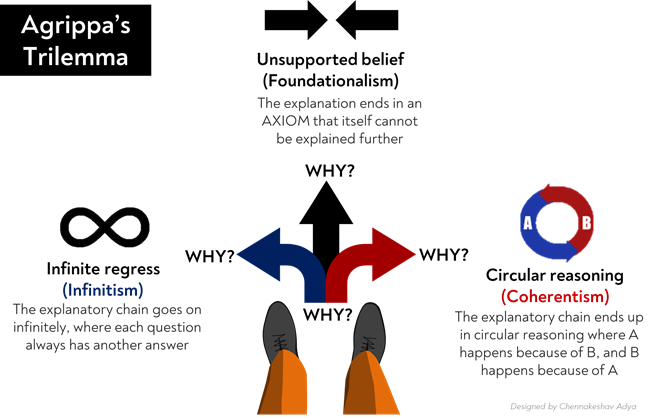
Agrippa's Trilemma challenges us to find a stable foundation for our beliefs. Let's examine each of the three "horns" of the dilemma, which represent the only possible structures for a chain of justification. The diagram below provides a clear visual summary of the problem we face.
-
Infinite Regress (Infinitism): The chain of justification goes on forever. For any belief , its justification is , which is justified by , and so on ad infinitum. The problem here is twofold. First, it seems psychologically impossible for a finite human mind to contain an infinite number of beliefs. Second, even if it were possible, justification seems to be perpetually deferred. If each belief's justification depends on the next, and the chain never ends, it's not clear how any belief in the chain ever becomes fully justified.
-
Unsupported Belief (Foundationalism): The chain of justification terminates in a "basic" belief—an axiom or dogma that is asserted without further justification. This approach stops the regress, but at what cost? If the foundational belief is itself unjustified, it appears arbitrary. How can an arbitrary, unjustified belief serve as the foundation upon which all other justified beliefs rest? It would be like building a skyscraper on a foundation of thin air.
-
Circular Reasoning (Coherentism): The chain of justification eventually loops back on itself. For instance, belief is justified by , is justified by , and is justified by . This structure avoids an infinite regress and arbitrary assumptions, but it's logically vicious. An argument that uses its own conclusion as a premise is a fallacy known as "begging the question." It fails to provide any independent support for the belief in question.
To see the formal structure of this skeptical argument laid out clearly, a few pages from a set of lecture notes on the topic will be useful.
These slides by Roberto Garcia reconstruct the Regress Argument and explicitly outline the three options presented by Agrippa.
Please read the section titled The Regress Argument. Focus on how the premises lead to the skeptical conclusion that knowledge is impossible, and how the three options—infinite regress, dogma (unsupported belief), and circularity—are presented as the only, and failing, possibilities.
3. A Formal Reconstruction
Your background in physics and mathematics has accustomed you to the power of rigorous, formal argumentation. Epistemology, particularly in the analytic tradition, strives for a similar level of precision. The argument from Agrippa's Trilemma can be reconstructed as a formal proof for skepticism.
The Stanford Encyclopedia of Philosophy provides an excellent, detailed reconstruction of the argument. It introduces precise terminology that will be essential as we move forward.
Skepticism - Stanford Encyclopedia of Philosophy
This entry by Juan Comesaña provides a rigorous overview of Pyrrhonian Skepticism and a formal reconstruction of Agrippa's Trilemma.
Please read the section on Pyrrhonian Skepticism, starting from the introduction to the topic. Then, carefully study the way the three "modes of Agrippa" are described and used to build the formal argument, presented in the paragraph starting "Before presenting a reconstruction...".
Let's break down the argument presented in the SEP entry. It hinges on a few key definitions:
- Inferentially Justified Belief: A belief justified by its relation to other beliefs.
- Justified Basic Belief: A belief that is justified, but not by its relation to other beliefs.
- Inferential Chain: The sequence of beliefs related by the "is justified by" relation.
The argument proceeds as follows:
- Any justified belief is either a justified basic belief or an inferentially justified belief. (This is definitional).
- There are no justified basic beliefs. (This is the mode of hypothesis or dogmatism—the skeptic claims any "basic" belief is just an unsupported assertion).
- Therefore, all justified beliefs are inferentially justified. (From 1 and 2).
- An inferential chain must be either infinite or circular. (Since we've ruled out a terminating, basic belief).
- Inferential chains cannot be infinite. (This is the mode of infinite regression).
- Inferential chains cannot be circular. (This is the mode of circularity).
- An inferentially justified belief can only be justified if it is part of a legitimate inferential chain (i.e., not infinite or circular).
- Therefore, there are no inferentially justified beliefs. (From 4, 5, 6, 7).
- Therefore, there are no justified beliefs at all. (From 3 and 8).
This is a powerful conclusion. If no belief can be justified, then according to the JTB account we explored, knowledge is impossible.
For an alternative formalization using the tools of propositional logic, the following video offers a concise demonstration.
This video from Carneades.org introduces the Münchhausen Trilemma and then reconstructs it as a formal proof.
First, watch from the beginning for the Baron Münchhausen analogy. Then, if you're interested in seeing the argument laid out in symbolic logic, watch the segment from the logical formalization. This maps directly onto the skills you developed in our logic modules.
Conclusion
Today we have confronted the epistemic regress problem, a fundamental challenge to the very possibility of justification. By asking for the reasons behind our beliefs, we initiate a chain of justification that, according to the skeptic, must terminate in one of three unsatisfactory ways: an infinite regress, an arbitrary assumption, or a circular argument. This is Agrippa's Trilemma. We have seen how this can be reconstructed as a formal argument for the deeply skeptical conclusion that no belief is ever truly justified, and thus knowledge is unattainable.
This skeptical challenge, however, is not the end of the story. For most epistemologists, it is the starting point. If we wish to avoid skepticism, we must find a flaw in the trilemma. This requires us to "bite the bullet" and defend one of the three horns as a viable option for structuring our belief systems.
Key Takeaways:
- The Epistemic Regress Problem arises from the demand that our beliefs be supported by good reasons, which in turn must be supported by other good reasons.
- Agrippa's Trilemma posits that any chain of justification must have one of three structures: it is infinite, it is circular, or it terminates in an unjustified belief.
- Skeptics argue that none of these structures can provide genuine justification, leading to the conclusion that knowledge is impossible.
- The three horns of the trilemma are:
- Infinite Regress: A psychologically and logically problematic endless chain of reasons.
- Dogmatism/Unsupported Belief: The chain ends at an arbitrary, unjustified starting point.
- Circularity: The chain of reasons begs the question by looping back on itself.
Preview of the Next Lesson:
The trilemma sets the stage for the major competing theories of justification in epistemology. In our next lesson, we will examine how non-skeptical philosophers respond to this challenge. We will see that each response corresponds to embracing one of the horns of the trilemma and arguing that it is, in fact, a tenable position.
- Foundationalism accepts that the regress must stop, but argues that the terminating beliefs are not arbitrary dogmas but are "properly basic" and justified by something other than belief (like experience).
- Coherentism argues that a form of circularity, when viewed holistically as a "web of belief," is not vicious but is in fact the source of justification.
We will evaluate the strengths and weaknesses of these two influential approaches, exploring the very architecture of knowledge.