Welcome to the third lesson in our module on epistemology. In our last session, we grappled with the epistemic regress problem, reconstructing it as Agrippa's Trilemma. We saw how this ancient argument poses a formidable challenge to the possibility of knowledge by suggesting that any chain of justification must either regress infinitely, loop back on itself, or terminate in an arbitrary, unsupported belief. The skeptic's conclusion is that none of these options can provide the genuine justification required for knowledge.
Today, we will move from diagnosing the problem to evaluating the proposed solutions. If we want to avoid skepticism, we must challenge one of the premises of the trilemma. This means arguing that at least one of its "horns" is, contrary to the skeptic's claim, a viable structure for justification. This lesson will explore the two most influential non-skeptical theories of justification: Foundationalism and Coherentism. Each theory represents a bold attempt to describe the architecture of our knowledge and rescue it from the threat of regress.
Our goal is to evaluate these two competing pictures of justification. We will analyze how each one responds to the regress argument, what its core tenets are, and what powerful objections it faces.
The Fork in the Road: Foundationalism vs. Coherentism
The regress argument forces us to choose a path for how our beliefs are structured. The diagram below illustrates the three primary options we discussed, with Foundationalism and Coherentism representing the two major non-skeptical paths.

As you may recall from our previous lesson and your interest in formal logic, the skeptical argument can be structured as a proof. To defeat the conclusion (that justification is impossible), we must deny one of its premises.
- Foundationalism denies the premise that there are no "justified basic beliefs." It argues that the regress can and does stop at beliefs that are justified, but not by other beliefs.
- Coherentism denies the premise that circular justification is always illegitimate. It argues that for a large, holistic system of beliefs, mutual support is a virtue, not a vicious circle.
Let's explore each of these positions in turn.
1. Foundationalism: Knowledge as a Pyramid
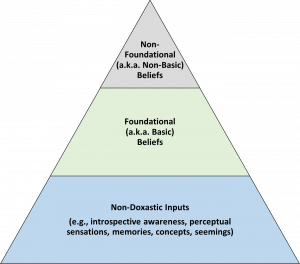
Foundationalism is perhaps the more intuitive of the two theories. It holds that our belief system is structured like a building: the bulk of our beliefs (the superstructure) are supported by, and derive their justification from, a secure foundation of "basic" beliefs.
A basic belief is one that is justified without being inferred from any other beliefs. This move stops the regress. But to avoid the charge of dogmatism or arbitrariness from Agrippa's Trilemma, the foundationalist must provide an account of what justifies these basic beliefs.
The standard foundationalist answer is that basic beliefs are justified by non-doxastic (non-belief) states. The most common candidates for these non-doxastic justifiers are experiences, such as perceptual sensations, memories, or introspective awareness. For example, my belief "there is a screen in front of me" isn't justified by another belief; it's justified directly by my visual experience of the screen.
This structure can be visualized as a pyramid, with non-doxastic inputs forming the base upon which foundational (basic) beliefs rest, which in turn support all other (non-basic) beliefs.
The Internet Encyclopedia of Philosophy (IEP) article on Foundationalism provides an excellent overview of how the theory is motivated by the regress argument and the key challenges it faces.
This article from the IEP explains foundationalism in detail.
First, read the section The Regress Argument to see how foundationalists use it to motivate their own position against its rivals. Then, carefully study the next section, Arguments Against Foundationalism, focusing on the "Problem of Arbitrariness" and the "Sellarsian Dilemma."
Evaluating Foundationalism: Strengths and Weaknesses
The main strength of foundationalism is that it provides a clear and intuitive answer to the regress problem, anchoring our knowledge in experience. However, as you just read, it faces powerful criticisms.
The Problem of Arbitrariness: If a foundational belief is justified by an experience, what justifies our trust in that experience? Critics argue that unless we have a reason to think our experiences are reliable, basing beliefs on them is arbitrary. This objection pushes the regress back one step: from beliefs to the experiences that are supposed to justify them.
The Sellarsian Dilemma: This is a more technical and, for many philosophers, more devastating objection. Wilfrid Sellars argued that non-doxastic justifiers (like raw perceptual experience) face a dilemma:
- Either the experience has conceptual, propositional content (e.g., the experience that there is a red square before me) or it is just a "raw," non-conceptual sensation (e.g., a mere feeling of redness).
- If the experience is just a raw, non-conceptual sensation, it's hard to see how it can justify a conceptual belief. A feeling of redness, by itself, doesn't logically support the proposition "this is red." There's a gap between the sensation and the judgment.
- If the experience does have conceptual content, then it seems to function just like a belief—it makes an assertion about the world. But if it makes an assertion, it can be true or false, and so it seems to stand in need of justification itself. If so, the regress has not been stopped.
The foundationalist is thus caught: their proposed foundation is either irrelevant to the beliefs it's meant to support, or it is not a genuine foundation because it requires its own justification.
2. Coherentism: Knowledge as a Web
Coherentism offers a radically different picture. It denies the very premise that justification is a linear, one-directional relationship that must be grounded in a foundation. Instead, coherentists propose a holistic model: a belief is justified by virtue of being part of a coherent network of beliefs. Justification is not about tracing a chain back to a starting point, but about how well a belief "fits" with and mutually supports all the other beliefs in the system. The philosopher Otto Neurath famously compared this to repairing a ship at sea: we can't stand on dry dock (a foundation) to fix it; we must stand on some planks to repair others, trusting the overall integrity of the vessel.
To understand how coherentism responds to the regress argument and its key challenges, the Stanford Encyclopedia of Philosophy (SEP) entry on the topic is an invaluable resource.
Coherentist Theories of Epistemic Justification
This SEP entry provides a rigorous analysis of coherentism.
First, read the second paragraph, starting "A central problem..." to see how coherentism arises from the failures of foundationalism. Then, read the section titled 2. The Regress Problem to understand the coherentist's holistic counter-proposal. Finally, study the paragraph on the two major objections to coherentism within the first section.
Evaluating Coherentism: Strengths and Weaknesses
The primary strength of coherentism is that it avoids the difficult problems associated with foundational beliefs. However, it introduces its own set of serious challenges, which you've just read about.
The Isolation Objection: Since coherence is a relationship among beliefs, it seems possible to have a perfectly coherent system of beliefs that has no connection to reality whatsoever. A detailed and internally consistent fantasy novel is coherent, but that doesn't make it true. How can coherence, an internal property of a belief system, be a guide to external truth? The system seems "isolated" from the world.
The Alternative Systems Objection: For any coherent system of beliefs, it seems possible to construct a different, incompatible system that is equally coherent. If coherence is the sole basis of justification, then we would be forced to say that the beliefs in both incompatible systems are justified. This is a highly counterintuitive result and undermines the idea that justification should lead us toward truth.
A Formal Interlude: Can Coherence Create Justification?
The debate between foundationalism and coherentism can be sharpened using the tools of probability theory, which should resonate with your background in physics and mathematics. The question becomes: can coherence among a set of beliefs (or witness reports) generate justification "from scratch," or can it only amplify a pre-existing degree of justification?
This question brings us to a famous debate between C. I. Lewis and Laurence BonJour.
- Lewis, a weak foundationalist, argued that for coherence to boost the probability of a set of claims, each claim must have some small, non-zero initial probability (credibility). Coherence can amplify credibility, but it can't create it from nothing.
- BonJour, a pure coherentist, argued that coherence can generate justification even when the individual beliefs have zero initial credibility, as long as they are independent.
The SEP article on coherentism formalizes and resolves this debate using probability theory. This analysis is a prime example of the formal rigor you are seeking in this course.
Coherentist Theories of Epistemic Justification
This section of the SEP article on Coherentism uses probability to analyze whether coherence alone can justify beliefs.
Please read the entire section The Role of Coherence: Lewis vs. BonJour. Pay close attention to the formal setup: the definitions of Conditional Independence, Nonfoundationalism, and Coherence Justification. The key result is the proof that these three conditions are inconsistent, showing that within this probabilistic framework, coherence cannot generate justification from nothing.
The probabilistic argument shows that if individual reports are truly independent and have no initial credibility on their own (the nonfoundationalist condition), then their agreement (coherence) adds no justification at all. $P(A \mid E_1, E_2) = P(A)$. This is a powerful, formal argument in favor of at least a "weak" foundationalism, which holds that beliefs must have some initial, non-inferential warrant (however small) for coherence to be able to amplify it into full-blown justification.
Conclusion
We have evaluated the two primary responses to the epistemic regress argument. Foundationalism and Coherentism offer starkly different visions of our epistemic lives—one a pyramid built on solid ground, the other a self-supporting web.
- Foundationalism stops the regress with basic beliefs justified by experience. Its strength is its intuitive connection to the world, but it struggles to explain the link between non-conceptual experience and conceptual belief without falling prey to the Sellarsian Dilemma.
- Coherentism avoids the problem of foundations by proposing a holistic model of mutual support. Its strength lies in its sophisticated picture of belief systems, but it faces the charge of being disconnected from reality (the Isolation Objection).
The probabilistic analysis we examined suggests that a purely coherentist account, where coherence creates justification from scratch, is untenable. This has led many philosophers to adopt hybrid views, often called weak foundationalism, where beliefs about experience have some minimal initial credibility, which is then substantially amplified by coherence with the rest of the belief system. This view attempts to get the best of both worlds: a connection to reality from foundationalism and the holistic power of mutual support from coherentism.
Key Takeaways:
- Foundationalism posits that knowledge rests on a foundation of "basic" beliefs justified non-inferentially, typically by experience.
- The primary challenges to foundationalism are the Problem of Arbitrariness and the Sellarsian Dilemma, which question how experience can provide justification for beliefs.
- Coherentism posits that justification is a holistic property of an entire belief system, arising from the mutual support among its parts (the "web of belief").
- The main challenges to coherentism are the Isolation Objection (a coherent system could be detached from reality) and the Alternative Systems Objection (multiple, incompatible systems could be equally coherent).
- Probabilistic models suggest that coherence alone cannot generate justification; it can only amplify pre-existing credibility, lending support to a "weak foundationalist" or hybrid view.
Preview of the Next Lesson:
Our discussion today has centered on the structure of justification. A related, and equally fundamental, question concerns the location of the facts that determine whether a belief is justified. Are these facts exclusively "internal" to the believer's mind (like their other beliefs and their awareness of their own experiences), or can they be "external" (like the actual reliability of their perceptual system), even if the believer is unaware of them? This leads to the crucial distinction between internalism and externalism in epistemology, which will be the topic of our next lesson.