Welcome to our final lesson in the module on Empiricism and the Kantian Synthesis. In our previous discussion, we delved into the heart of Kant's "Copernican Revolution," exploring how the mind's own structure—the a priori forms of sensibility (space and time) and the pure concepts of the understanding (the categories)—actively shapes our experience of reality. We saw how this revolutionary framework provides an answer to the critical question: How are synthetic a priori judgments possible?
Today, we will take a step back to appreciate the grand architecture of Kant's system. We will examine precisely how his doctrine of transcendental idealism serves as a masterful and deliberate synthesis, designed to resolve the long-standing philosophical war between rationalism and empiricism. By the end of this lesson, you will be able to explain how Kant attempts to carve a third path, preserving the core insights of both traditions while overcoming the limitations that led each to a dead end.
1. The Philosophical Impasse
To understand Kant's solution, we must first clearly recall the problem he inherited. The landscape of early modern philosophy was defined by the conflict between two powerful, opposing schools of thought on the origin and scope of human knowledge.
-
Rationalism, championed by figures like Descartes, Spinoza, and Leibniz, placed its trust in pure reason. It argued that the most fundamental truths about reality—including the existence of God, the nature of the soul, and the structure of the universe—could be known a priori, through reason alone, independent of sensory experience. For the rationalists, genuine knowledge was universal and necessary, a standard that the fleeting data of the senses could never meet. They posited innate ideas or principles as the foundation for this knowledge.
-
Empiricism, culminating in the work of David Hume, took the opposite stance. It maintained that all knowledge originates in experience. The mind begins as a tabula rasa (a blank slate), and all its ideas are derived from sensory impressions. Hume's radical conclusion was that this principle dismantles the pretensions of rationalist metaphysics. Concepts central to science and philosophy, like causation, could not be traced back to any specific impression of a "necessary connection." Instead, they were merely habits of mind formed by observing constant conjunctions. This led to a profound skepticism about the foundations of science and the possibility of any metaphysical knowledge.
The impasse was stark: rationalism led to dogmatic metaphysical systems that seemed to float free of reality, while empiricism led to a skepticism that threatened to undermine the very possibility of scientific laws.
2. Kant's Synthesis: A Middle Way
Kant, awakened from his "dogmatic slumber" by Hume, did not seek to prove one side right and the other wrong. Instead, he sought a "third way" that could accommodate the legitimate insights of both. His system, transcendental idealism, can be understood as a grand negotiation between the two camps.
The core of his strategy is to agree with the starting premise of each school but to radically limit its conclusion.
- From the empiricists, Kant takes the foundational principle that all human knowledge begins with experience. There are no "innate ideas" of objects or pre-formed knowledge of the world. Without sensory data—what he calls intuitions—our thought would be empty.
- From the rationalists, Kant takes the conviction that genuine knowledge, especially in mathematics and physics, involves necessity and universality—qualities that cannot be derived from experience. This is the reality of synthetic a priori knowledge.
How can both be true? How can knowledge begin with experience yet contain elements that are not from experience? This is the paradox that the Copernican Revolution resolves. The mind does not derive a priori concepts from experience; it brings them to experience as its own organizing principles.
This synthesis is perfectly captured in one of the most famous sentences of the Critique of Pure Reason. To understand it, let's first look at a short, clear resource.
This slide from a presentation titled "Kant for Physicists" contains a concise statement of Kant's "discursivity thesis," which lies at the heart of his synthesis.
Please read the slide titled Kant’s discursivity thesis. This famous passage encapsulates his entire project.
As you just read, Kant states: "Thoughts without content are empty; intuitions without concepts are blind."
- "Thoughts without content are empty" is Kant's concession to empiricism. Pure reason, spinning concepts on its own without the "content" provided by sensory intuition, cannot produce knowledge of objects. It's just playing a formal game. This is his critique of dogmatic rationalist metaphysics.
- "Intuitions without concepts are blind" is his rebuttal to radical empiricism. The raw data of the senses, without being organized and unified by the a priori concepts of the understanding (the categories), is just a "blooming, buzzing confusion." It is not yet an experience of an objective world.
Knowledge, therefore, is a joint production of sensibility and understanding. It requires both the raw material from the world (via sensibility) and the formal structure from the mind (via the categories of the understanding).
3. A Scorecard: Kant's Verdict on the Debate
Kant's synthetic position becomes even clearer when we see how he would answer the key questions that divided the rationalists and empiricists. Professor Daniel Bonevac provides an excellent summary of this.
Kant's Transcendental Idealism
In this segment of his lecture on "Kant's Transcendental Idealism," Professor Bonevac directly compares Kant's positions with those of Descartes (as a model rationalist) and Hume (as a model empiricist).
Please watch from this section. He poses three critical questions and shows where Kant sides with each tradition.
Let's summarize the results from the video, as they perfectly illustrate the synthesis:
-
Is there synthetic a priori knowledge?
- Rationalists (Descartes): Yes.
- Empiricists (Hume): No.
- Kant: Yes. He sides firmly with the rationalists that knowledge giving, non-experiential truths exist and form the basis of science and mathematics.
-
Does our knowledge (specifically a priori knowledge) extend beyond experience?
- Rationalists (Descartes): Yes, we can have metaphysical knowledge of God, the soul, and the world as it is in itself.
- Empiricists (Hume): No, knowledge is confined to experience.
- Kant: No. Here, he sides firmly with the empiricists. The categories and forms of intuition, which make synthetic a priori knowledge possible, are only valid within the domain of possible experience (the phenomenal realm). They are the rules for constituting experience, not for knowing a reality beyond it (the noumenal realm).
-
Can we know the world as it is in itself?
- Rationalists (Descartes): Yes, through pure reason.
- Empiricists (Hume): No, we only know our impressions.
- Kant: No. Again, he agrees with the empiricist conclusion. The "thing-in-itself" (noumenon) is a necessary concept—it is that which appears—but it is fundamentally unknowable to us.
Kant’s strategy is brilliant. He saves the rationalists' prize possession—certain, universal knowledge—but accepts the empiricists' restriction on its domain. He gives science and mathematics their firm foundation but, in the very same move, demonstrates that traditional metaphysics, which aimed to know the super-sensible, is impossible as a science.
4. The Terminology of the Synthesis
Kant's resolution gave rise to a new and complex philosophical vocabulary. His position is most famously called transcendental idealism, but he also insisted it was a form of empirical realism. Understanding these labels is key to grasping his synthesis.
Kant's Transcendental Idealism
This entry from the Stanford Encyclopedia of Philosophy provides an authoritative clarification of Kant's terminology by contrasting it with the views he opposes.
Please read the subsection 1.1 Transcendental Realism and Empirical Idealism. Focus on how Kant defines his view by setting it against two others: Transcendental Realism: The common-sense view he rejects. Empirical Idealism: The view of Berkeley or the skepticism of Descartes, which he claims to have defeated.
Let's unpack these crucial distinctions:
- Transcendental Realism: This is the default, pre-philosophical view that space and time are features of the world as it is in itself, and the objects in it exist entirely independently of our minds. Kant argues this view inevitably leads to skepticism (like Hume's) or illusion, because if the world is truly independent of the mind's structures, we have no way of guaranteeing that our concepts match it.
- Transcendental Idealism (Kant's view): The doctrine that space, time, and the categories are not features of things-in-themselves, but are the mind's own contribution to experience. They are transcendentally ideal.
By adopting transcendental idealism, Kant can avoid the problems of transcendental realism and secure a different, more powerful position:
- Empirical Idealism: This is the view Kant attributes to Berkeley (that bodies are just ideas) or the skepticism of Descartes (we can't be sure an external world exists). The empirical idealist doubts or denies the existence of a real, objective world in space.
- Empirical Realism (Kant's view): Because space and time are the unshakeable forms of our own sensibility, the objects within them are empirically real. We have direct, immediate access to them. The world of science—the phenomenal world—is not an illusion or a dubious inference; it is the objective reality for us.
Kant's masterful stroke is to show that one must be a transcendental idealist to be an empirical realist. By making the framework of the world (space, time, causality) a feature of the mind, he anchors our knowledge of the empirical world with absolute certainty, defeating the skeptic.
5. Knowledge, Kant-Style
We can now visualize Kant's entire structure of knowledge and see exactly where his synthesis operates.
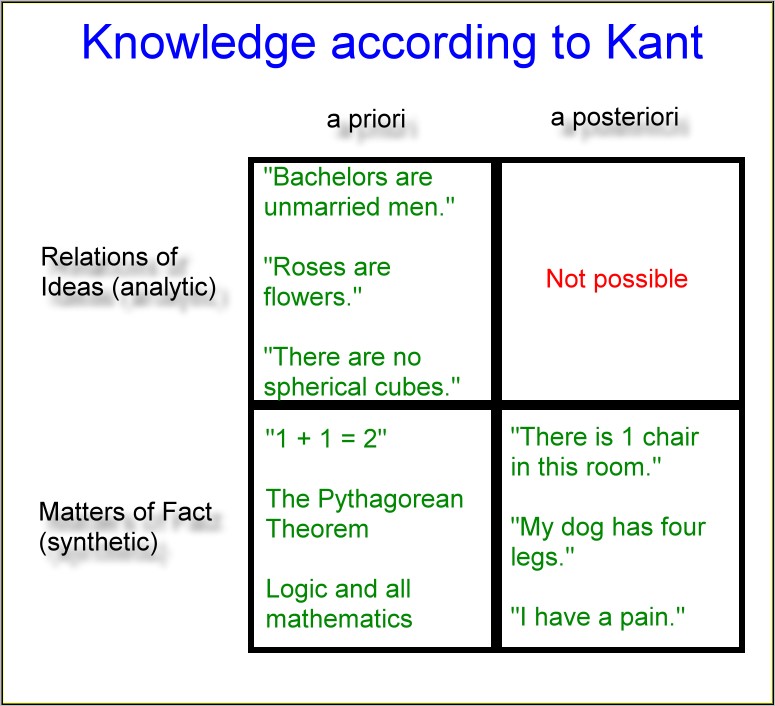
As the diagram shows:
- Analytic a priori: "Relations of Ideas." These are definitions ("Bachelors are unmarried men"). Both rationalists and empiricists accepted these.
- Synthetic a posteriori: "Matters of Fact." These are empirical observations ("My dog has four legs"). Both sides also accepted these, though they disagreed on their certainty.
- Analytic a posteriori: This quadrant is correctly labeled "Not possible." An analytic truth is known by its concepts alone, making experience irrelevant to its justification.
- Synthetic a priori: This is the battleground. For Hume, this quadrant was empty. For the rationalists, it contained all of metaphysics. For Kant, it is the home of the foundational principles of mathematics ("1 + 1 = 2," Pythagorean Theorem) and science ("Every event has a cause," which falls under his "logic and all mathematics" category as a principle of pure understanding). These are necessary truths that structure the empirical world.
Your own background in physics and mathematics puts you in a prime position to appreciate what Kant was trying to achieve. He saw Newtonian physics as a paradigm of synthetic a priori knowledge—a system of universal and necessary laws (like universal gravitation) that couldn't possibly be justified by finite observation alone. His entire philosophical system can be seen as an elaborate answer to the question, "How is a science like Newton's even possible?" His answer is that the fundamental laws of nature are the fundamental laws of our own understanding, projected onto the phenomenal world.
Conclusion
Kant's transcendental idealism is not a simple compromise but a radical reconceptualization of the relationship between mind and world. It resolves the rationalism-empiricism debate by demonstrating that both were half-right. The empiricists correctly saw that knowledge is rooted in sensory experience, while the rationalists correctly saw that it contains necessary, a priori elements. Kant's genius was to show that these are not opposing sources of knowledge, but two indispensable components that must work together, with the mind providing the universal structure and the world providing the particular content.
Key Takeaways:
- The Synthesis: Kant accepts the empiricist premise that knowledge begins with experience, but accepts the rationalist conclusion that true scientific knowledge contains necessary, a priori components.
- The Limit: The great price of this synthesis is the restriction of knowledge to the realm of phenomena. The categories of the understanding provide certain knowledge of the world of experience, but they are invalid when applied to the noumenal realm of things-in-themselves. This move saves science at the expense of traditional metaphysics.
- Transcendental Idealism / Empirical Realism: Kant is a transcendental idealist because the form of the world (space, time, causality) is mind-dependent. He is an empirical realist because within that formal structure, the world of objects is objectively real and immediately knowable, not an illusion or inference.
This lesson concludes our journey through the major figures and ideas of the early modern period. We have seen the pendulum swing from the bold rationalism of Descartes to the corrosive skepticism of Hume, and finally to Kant's monumental effort to synthesize them into a new and enduring philosophical framework.
Preview of the Next Module:
Having established this historical and conceptual foundation, we will now pivot to a systematic exploration of one of philosophy's core subfields: Epistemology. We will begin by examining the classic "justified true belief" (JTB) account of knowledge and see how it was challenged by a short, revolutionary paper by Edmund Gettier, setting the stage for contemporary debates about the very nature of what it means to know.