Welcome to the next stage of our journey into Aristotelian philosophy. In our last lesson, we contrasted Plato’s transcendent world of Forms with Aristotle’s immanent realism, where universals exist only within the particular things we observe. We established what Aristotle thought reality was made of—a hierarchy of substances and accidents. Now, we will explore his framework for explaining why things are the way they are.
This lesson addresses a central component of the Aristotelian worldview: the doctrine of the Four Causes. This is not merely a historical footnote but a sophisticated explanatory toolkit that Aristotle applied across physics, biology, and even human action. By the end of our session, you will be able to explain each of the four causes and demonstrate how they apply to both artificial and natural objects, paying special attention to the often-misunderstood concept of natural purpose, or teleology.
1. From "Cause" to "Explanation"
First, we must clarify our terminology. The modern English word "cause" typically refers to what Aristotle called the efficient cause—the event or agent that brings something about (e.g., the cue ball striking the eight ball causes it to move). Aristotle's concept, aition (αἴτιον), is much broader. It refers to any factor that helps answer the question "Why?". Therefore, it's more accurate to think of the four causes as four fundamental types of explanation or "explanatory factors."
This shift in perspective is crucial. Aristotle is not just asking "what produced this?" but rather, "what are all the factors we must cite to give a complete account of this thing's existence and nature?"
To begin our inquiry, we'll watch a short video that introduces this framework and notes the difference between the ancient and modern uses of the word "cause."
Introduction to Philosophy Lecture #4: Metaphysics & Philosophy of Science - Aristotle
This excerpt from a lecture by Jack Sanders introduces Aristotle's four causes as different modes of explanation for "why" questions. It sets the stage by highlighting that only one of these—the efficient cause—aligns with our common, modern understanding of causality.
Please watch the segment from the introduction to the four causes. The key idea to grasp here is that Aristotle is sorting out the different ways we might answer a "Why?" question, providing a systematic structure for explanation.
2. The Four Causes of an Artifact
The easiest way to understand the four causes is by applying them to an artifact, where the role of a maker and a purpose is clear. Let's use Aristotle's own favorite example: a bronze statue.
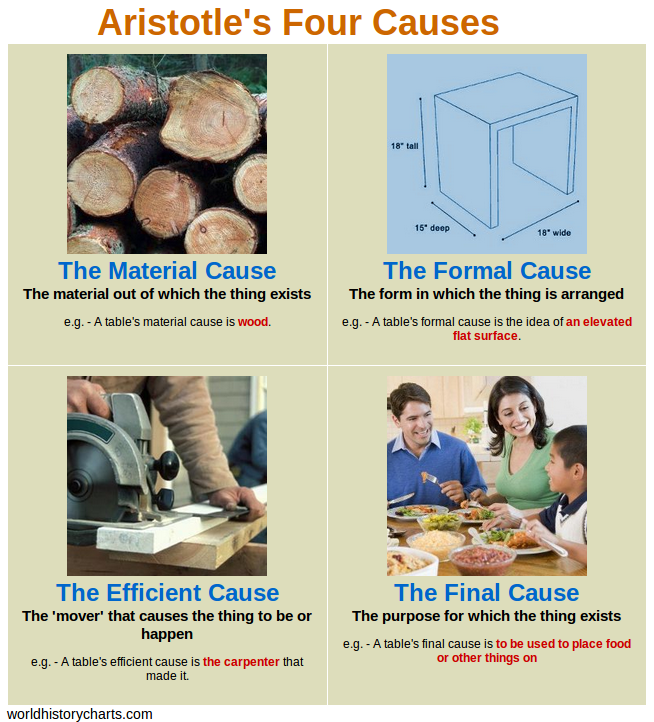
-
The Material Cause: The matter or substance from which something is made. It is the "that out of which" a thing comes to be.
- For the statue: The bronze.
- For the table: The wood.
-
The Formal Cause: The form, pattern, essence, or structure of a thing. It is "the account of what-it-is-to-be." This is the universal from our last lesson, embodied in the particular matter.
- For the statue: The sculptor's idea or blueprint; the shape that makes the bronze a statue and not just a lump of metal.
- For the table: The design or concept of a table (e.g., a flat top supported by legs).
-
The Efficient Cause: The primary source of the change or motion; the agent that brings something into being. This is the "cause" in our modern sense.
- For the statue: The sculptor. More precisely, for Aristotle, it is the art of sculpting resident within the sculptor that is the true efficient cause.
- For the table: The carpenter.
-
The Final Cause (
telos, τέλος): The end, purpose, or "that for the sake of which" a thing exists.- For the statue: To be an object of beauty, to commemorate a hero, to be worshipped.
- For the table: To provide a surface for eating or working.
To see these definitions applied in a detailed, structured way, please read the following section from the Stanford Encyclopedia of Philosophy.
Aristotle on Causality - Stanford Encyclopedia of Philosophy
This section provides a rigorous account of the four causes, using the bronze statue example. It clarifies the metaphysical and epistemological components of Aristotle's theory and highlights the non-psychological nature of his teleological explanations, which will be important later.
Please read the section titled "2. The Four Causes". Pay close attention to the precision with which each cause is defined, especially the identification of the art of bronze-casting as the most accurate efficient cause.
An illuminating way to structure these is to see them as answering two different kinds of questions. The material and formal causes provide a static analysis of a thing—what it is made of and what it is at a given moment. The efficient and final causes provide a dynamic analysis—how it came to be and why the change occurred. This division should feel familiar from your physics background, where you distinguish between describing a system's state and describing its evolution.
3. Causes in Nature: The Challenge of Teleology
Aristotle's real ambition was to apply this framework to the natural world. While matter, form, and efficient cause seem to apply straightforwardly (e.g., an oak tree is made of organic matter, has the form of an oak, and was efficiently caused by a parent oak), the final cause is deeply controversial. How can a tree or an animal have a purpose without a conscious designer?
Aristotle's response is one of the most powerful—and most misunderstood—ideas in his philosophy. He argues for an immanent teleology, where the telos is internal to the organism itself, not imposed by an external mind like a craftsman or a deity.
The final cause of a natural object is its mature state, the end-point of its development.
- The
telosof an acorn is to become a fully-grown oak tree. - The
telosof a lion cub is to become a mature lion.
This is not a mystical claim. For Aristotle, it is an empirical observation. Things in nature don't just change randomly; they change in highly regular and predictable ways, "always or for the most part." He argues that the best explanation for this regularity is that the process is directed toward a specific end.
Consider his famous example of teeth. Why do humans regularly grow sharp incisors in the front and flat molars in the back? An opponent might say it happens by necessity from material processes, and it's just a lucky coincidence that this arrangement is useful for eating. Aristotle finds this deeply unsatisfying. Coincidence cannot explain regularity. The consistent, functional outcome is the explanation. The teeth grow that way for the sake of tearing and grinding food. The function is the final cause.
This concise text from a University of Washington course page does an excellent job of clarifying how final causes work in nature. It directly confronts the common misunderstandings and explains the concept of an internal telos.
Please read the sections "Causes of natural objects" and "Final causes in nature". These sections are crucial for grasping the distinction between the external purpose of an artifact and the internal end-state of a natural being.
This notion of an internal telos can be compared to concepts in modern science. In dynamical systems, an "attractor" is a state toward which a system evolves over time. In physics, systems tend toward states of minimum energy. While the analogy is not perfect (Aristotle's telos is a normative good for the organism), the underlying idea of an inherent, goal-directed tendency based on a system's internal nature is a powerful one.
4. The Convergence of Causes
In the natural world, Aristotle observes that three of the four causes often converge into one. He encapsulates this with the slogan, "it takes a human being to generate a human being."
Let's analyze the generation of a tiger:
- Final Cause: The end of the process is to actualize the form of a mature tiger.
- Formal Cause: The essence or defining structure is that of a tiger.
- Efficient Cause: The process is initiated by a parent tiger, which already possesses the tiger form.
So, the form of 'tiger' is the end of the process (final), the definition of the being (formal), and the principle that drives its creation (efficient). The telos (the end) and the eidos (the form) are one and the same, and this form is transmitted by the moving cause.
This elegant convergence shows the tight integration of Aristotle's metaphysics. It's a holistic system where the explanation for being, becoming, and purpose are all deeply interconnected.
For a final, deeper look at this convergence and the explanatory priority of the final cause, we'll consult the Stanford Encyclopedia of Philosophy one last time.
Aristotle on Causality - Stanford Encyclopedia of Philosophy
These sections explore the application of the four causes to the study of nature, focusing on the convergence of the formal, final, and efficient causes and the explanatory primacy of the telos.
First, read section "3. The Four Causes and the Study of Nature" to see the "it takes a human to generate a human" slogan explained. Then, read section "5. The Explanatory Priority of Final Causes". This advances the argument by claiming that the final cause is the most fundamental explanation, as the process of generation itself can only be understood by reference to its end product.
Conclusion
Aristotle’s four causes provide a comprehensive framework for scientific and philosophical explanation. It is a system that moves beyond simple linear causality to offer a multi-faceted account of why the world is the way it is. By distinguishing four unique explanatory roles, Aristotle sought to bring a new level of rigor and completeness to the "inquiry into nature" he inherited from his predecessors.
Key Takeaways:
- Four Modes of Explanation: The four causes—Material, Formal, Efficient, and Final—are best understood as four distinct answers to the question "Why?".
- Artifacts vs. Nature: In artifacts, the final cause is an external purpose in the mind of a designer. In natural objects, the final cause (
telos) is an internal principle, the mature form or function toward which the organism develops. - Teleology as an Explanation for Regularity: Aristotle's argument for final causes in nature is not based on faith, but on the need to explain the observed, non-coincidental regularity and functionality of biological processes.
- The Convergence of Causes: In natural generation, the formal cause (the what), the final cause (the for-what), and the efficient cause (the by-what) often coincide in a single form.
This framework, particularly its emphasis on the telos of a thing, is not just a theory of physics or biology. It is the foundation for Aristotle’s entire philosophy. As we will see, understanding the telos of a human being is the key to understanding his ethics.
Preview of the Next Lesson:
We have now established that for Aristotle, every natural being has an end or function. The question that immediately follows is: what is the function of a human being? By answering this, Aristotle believes we can determine what it means to live a good human life. In our next lesson, we will transition from his metaphysics and physics to his virtue ethics, exploring his famous account of eudaimonia (flourishing) and the doctrine of the mean.