Welcome back. In our last lesson, we examined the Socratic elenchus, a powerful method for dismantling claims to knowledge by revealing internal inconsistencies. We saw that while it is ruthlessly effective at exposing ignorance, it consistently ends in a state of aporia, or impasse, leaving the central question—"How ought we to live?"—unanswered. Socrates shows us that we lack knowledge, but he doesn't give us a clear path to attaining it.
This epistemological void is the point of departure for his most brilliant student, Plato. Where Socrates was the critic, Plato is the architect. He sets out to build a philosophical system that can provide a firm foundation for the objective knowledge and universal values that the elenchus could only gesture towards. The cornerstone of this entire edifice is his celebrated Theory of Forms.
This lesson will explore that theory. We will investigate what Forms are, the philosophical problems they were designed to solve, and how they function as the linchpin of Plato's metaphysics (his theory of reality) and epistemology (his theory of knowledge). By the end of our session, you will be able to explain the core tenets of this theory, its role in grounding objective truth, and the powerful allegories Plato uses to illustrate it.
1. From Opinion to Knowledge: The Motivation for the Forms
Plato's starting point is a fundamental distinction between two cognitive states: opinion (doxa) and knowledge (episteme). You have already encountered this in your reading on the Justified True Belief (JTB) account, but Plato gives it a metaphysical basis.
- Opinion concerns the world we experience through our senses: a world of particular things that are constantly changing, coming into being, and passing away. A specific flower is beautiful, but it will wither. A particular act may seem just, but its circumstances are complex and debatable. This is the realm of Heraclitean flux.
- Knowledge, for Plato, must be of something different. It must be infallible and concern what is eternally and unchangingly true. You cannot have knowledge of something that is in one moment and different in the next. Knowledge requires a stable, permanent object.
This distinction sets up a critical problem: If the world of our senses is constantly changing, it cannot be the object of true knowledge. So, if knowledge is possible, its objects must exist elsewhere.
To understand this foundational argument, let's watch a segment from a lecture that lays out Plato's distinction.
A History of Philosophy | 05 Plato's Theory of Forms
In this clip from "A History of Philosophy," the lecturer clearly explains Plato's contrast between knowledge and opinion, highlighting why experience of the changing physical world is deemed an unreliable source for true knowledge.
Please watch from the beginning. Focus on the characteristics assigned to knowledge (certain, of unchanging truths, gained via intellect/dialectic) versus those assigned to opinion (relative, changing, based on experience of particulars).
Plato's solution is to posit a "two-world" ontology. He accepts Heraclitus's view of the sensible world as being in flux, but he also accepts Parmenides's insight that true reality must be eternal and unchanging. He resolves the tension by arguing that these two thinkers were describing two different realms of existence:
- The Sensible World: The physical world we perceive, the realm of particulars, change, and opinion.
- The Intelligible World: A non-physical realm of perfect and unchanging entities, accessible only to the intellect, which are the objects of true knowledge. These entities are the Forms.
2. The Nature of the Forms
So, what exactly is a Form (Greek: eidos or idea)? It's crucial not to confuse Plato's "idea" with our modern psychological notion of an idea as a mental concept. For Plato, a Form is a real, objective, mind-independent entity. Forms are the perfect archetypes or blueprints of which the particular things in the sensible world are merely imperfect copies.
For every general property or kind of thing, there is a corresponding Form. There is a Form of Justice, a Form of Beauty, a Form of Equality, and even, as we shall see, Forms for physical kinds like "Human" or "Tree." Any particular beautiful thing is beautiful only because it participates (methexis) in the Form of Beauty.
The following video provides a concise introduction to the Forms as archetypal ideals.
A History of Philosophy | 05 Plato's Theory of Forms
The same lecturer now introduces the concept of the Form (eidos) as an archetype or ideal pattern.
Watch the segment from this point, which clarifies that Forms are not mental ideas but real, immaterial entities that serve as models for classes of things.
To be more precise, Forms have a specific set of characteristics that distinguish them from sensible particulars. Let's turn to a more detailed, scholarly account to formalize these properties.
David Sedley: Plato’s Theory of Forms (Royal Institute of Philosophy)
In this lecture from the Royal Institute of Philosophy, Professor David Sedley offers a rigorous analysis of the Theory of Forms, tracing its development and characteristics.
First, watch the section that traces the theory's origins from Socrates' search for definitions and the doctrine of recollection (background). This provides context for why Plato needed a non-sensible object of knowledge. Next, watch the crucial segment that details the fundamental characteristics of Forms. As you watch, identify the key properties Professor Sedley outlines.
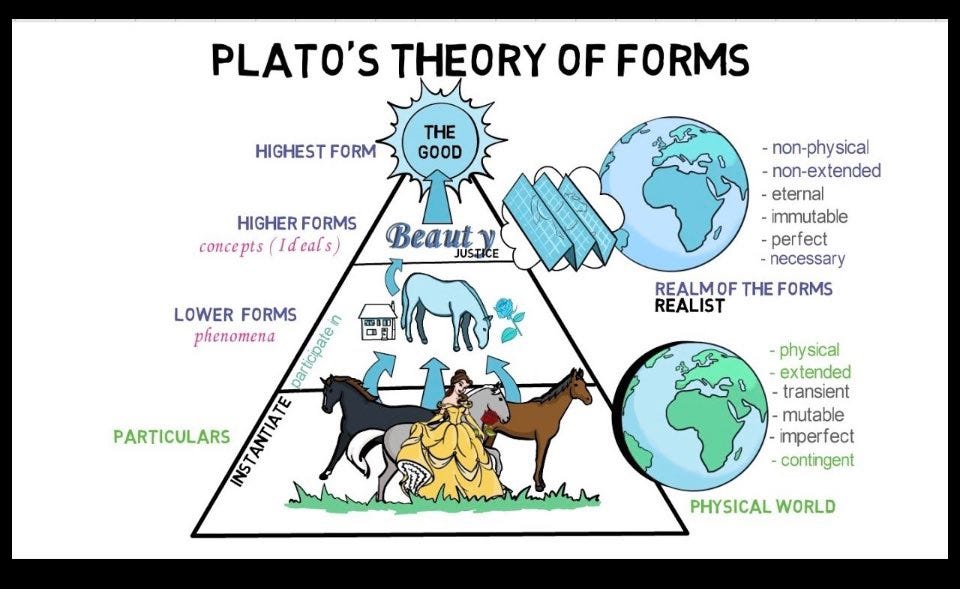
Based on this analysis and other Platonic texts, we can compile a list of the core attributes of the Forms:
- Objective: They exist independently of our minds or the physical world.
- Transcendent: They exist in a separate, non-physical, non-spatial, and atemporal realm.
- Eternal & Unchanging: They are not subject to coming into being, changing, or passing away. They are what they are, perfectly and forever.
- Perfect: Each Form is the perfect exemplar of the property it represents. The Form of Beauty is perfectly beautiful.
- Intelligible: They cannot be perceived by the senses but can only be apprehended by the intellect (nous).
- Unitary: Each Form is a single, unified thing. While there are many beautiful things, there is only one Form of Beauty.
This infographic provides a useful visual summary of the hierarchy and the two realms.
3. The Structure of Reality: The Allegories of the Line and the Cave
Plato doesn't just state that these two worlds exist; he provides detailed allegorical maps to illustrate the structure of reality and our cognitive journey from ignorance to knowledge.
The Divided Line
In the Republic, Plato asks us to imagine a vertical line divided into two unequal sections, representing the visible (sensible) and intelligible realms. Each of these sections is then subdivided in the same ratio. This creates four segments, each corresponding to a different level of reality and a different cognitive state.

- Segment 1 (Eikasia/Imagination): The lowest level, consisting of shadows, reflections, and other images. The cognitive state is mere conjecture.
- Segment 2 (Pistis/Belief): The level of ordinary physical objects—animals, plants, artifacts. The cognitive state is belief or conviction based on sense-perception.
- Segment 3 (Dianoia/Thought): This is the lower part of the intelligible realm. It involves reasoning that uses the objects of the visible world as images or starting points (hypotheses), as a geometer uses a drawing of a triangle to reason about Triangularity itself.
- Segment 4 (Noesis/Understanding): The highest level, where the intellect directly apprehends the Forms themselves, culminating in the apprehension of the Form of the Good, the ultimate principle of all reality and knowledge.
The relationship between these segments is proportional. As one ascends the line, the objects of cognition gain in "truth" and "clarity," and the cognition itself becomes more reliable.
An interesting feature, often overlooked, is that a proper geometric construction of the line as Plato describes it results in the two middle segments (pistis and dianoia) being equal in length. This mathematical necessity, which Plato was almost certainly aware of, suggests a deep analogy: the relationship between mathematical or scientific models (dianoia) and the physical world they describe (pistis) is one of parity. This has led some to see in the Divided Line a profound insight into what Eugene Wigner, in a completely different context, called "the unreasonable effectiveness of mathematics in the natural sciences." Your background in physics and mathematics makes this subtle point particularly relevant, as it shows Plato embedding a deep philosophical insight about the structure of knowledge into the very geometry of his analogy.
The Allegory of the Cave
The Cave allegory is a narrative dramatization of the Divided Line. It describes prisoners chained in a cave, facing a wall. Behind them, a fire illuminates puppets, casting shadows on the wall. The prisoners mistake these shadows for reality (eikasia).
If a prisoner is freed, he first sees the puppets and the fire, realizing the shadows were mere copies (pistis). If he is then dragged out of the cave into the sunlit world, he is initially blinded. He first looks at shadows and reflections of the real objects (dianoia), then at the objects themselves (trees, animals—representing the Forms), and finally, he can look at the Sun itself (the Form of the Good).
This allegory powerfully illustrates the philosopher's painful journey from the darkness of opinion to the light of knowledge. It also establishes the Form of the Good as the ultimate source of reality and intelligibility, just as the sun is the source of all light and life in the visible world.
Professor Sedley provides an excellent walk-through of the Cave and its implications.
David Sedley: Plato’s Theory of Forms (Royal Institute of Philosophy)
Let's return to Professor Sedley's lecture for a clear explanation of this famous allegory.
Watch the final section on the Cave allegory. Pay attention to how it maps onto the levels of reality and knowledge from the Divided Line and how it reveals the hierarchical structure of the intelligible world, culminating in the Form of the Good.
4. Metaphysical Mechanics and Plato's Self-Critique
Having established the "what" and "why" of the Forms, we must address the "how." How exactly do these transcendent Forms relate to the messy world of particulars? This question leads to some of the most difficult and fascinating problems in Plato's metaphysics.
The two key concepts are Participation (methexis) and Self-Predication.
- Participation: A particular thing has a property by "participating" in the corresponding Form. A man is a man because he participates in the Form of Man.
- Self-Predication: The Form of F is itself F. The Form of Largeness is large; the Form of Beauty is beautiful. This seems intuitive, as the Form is the perfect exemplar of that property.
However, Plato himself recognized that this model creates profound logical problems. In his later dialogue, the Parmenides, he presents a stunning self-critique, staging a dialogue where the elder philosopher Parmenides subjects a young Socrates' theory of Forms to a devastating cross-examination.
A History of Philosophy | 05 Plato's Theory of Forms
The lecturer from Wheaton College provides a fantastic overview of Plato's self-criticism in the Parmenides.
This is a longer but crucial segment. Please watch from this point on self-critique. As you watch, focus on two major problems: The Range of the Forms: Are there Forms for undignified things like "mud" and "dirt," or negative things like "evil" and "injustice"? The theory seems to require them, but it feels absurd. The Third Man Argument (TMA): This is a powerful regress argument. If a particular man and the Form of Man are both men, we need another Form—a "third man"—to explain what they have in common. But then we'd need a fourth Form to explain what the particular, the first Form, and the second Form have in common, and so on to infinity. This argument directly attacks the combination of self-predication and participation.
The fact that Plato articulates these criticisms himself demonstrates his extraordinary intellectual honesty. He doesn't just present a doctrine; he actively probes its weaknesses. While he never explicitly solves the Third Man Argument, his later work suggests a move towards a more complex understanding of the relationships between Forms, possibly viewing them not as isolated archetypes but as an interconnected, structured system.
For a deeper dive into the metaphysical mechanics of Plato's theory, the Stanford Encyclopedia of Philosophy provides an exceptionally clear analysis.
Plato's Middle Period Metaphysics and Epistemology
This article breaks down the core concepts with academic precision. It is dense but highly rewarding.
I suggest you read three key sections to solidify your understanding: Start with Section 2, "The Metaphysics of the Phaedo". This introduces the fundamental distinction between Being (how a Form is what it is) and Partaking (how a particular has a property). Next, read Section 5, "The Separation of Forms". This explains what it means for Forms to be "separate" and exist auto kath auto (in their own right). Finally, read Section 8, "Being and Partaking". This synthesizes the previous points and explains how the distinction between these two modes of being underpins the entire two-worlds doctrine and the "deficiency" of sensible particulars.
This analysis provides a formal framework that should resonate with your background. Plato is essentially positing two different kinds of predication: one for the relationship between a Form and its essence (Being, Is -ness) and another for the relationship between a particular and its property (Partaking, is ). This distinction is the metaphysical engine driving his entire system.
Conclusion
Plato's Theory of Forms is one of the most ambitious and influential philosophical systems ever conceived. It is a direct response to the epistemological crisis left by Socrates, attempting to provide a stable, metaphysical grounding for knowledge, ethics, and meaning.
Key Takeaways:
- Dual Role: The theory serves both a metaphysical function (defining what is truly real: the eternal, unchanging Forms) and an epistemological function (defining what can be known: the Forms, apprehended by the intellect).
- Two Worlds: Plato posits two realms: the sensible world of changing particulars (the object of opinion) and the intelligible world of perfect Forms (the object of knowledge).
- Participation and Imitation: Particulars in the sensible world are imperfect copies that "participate in" or "imitate" their corresponding Forms.
- Hierarchy of Knowledge: The allegories of the Divided Line and the Cave illustrate a hierarchy of reality and a corresponding ascent of cognition, culminating in the intellectual apprehension of the Form of the Good, the ultimate source of all being and intelligibility.
- Internal Problems: Plato himself recognized significant logical challenges to his theory, most notably the Third Man Argument and the problem of the range of Forms, demonstrating a commitment to rigorous self-critique.
The Theory of Forms offered a powerful, transcendent solution to the problem of knowledge. But its solution—positing an entirely separate world of abstract entities—was not without its critics. The most formidable of these critics was Plato's own student, who would propose a radically different approach to understanding reality.
Preview of the Next Lesson:
In our next session, we will turn to Aristotle. We will examine his profound critique of the Theory of Forms—arguing that it unnecessarily "separates" universals from the world we actually live in—and explore his alternative account, which seeks to locate form and essence within the particular substances of the sensible world. This will set the stage for one of the most fundamental debates in the history of Western thought: the clash between Platonic and Aristotelian metaphysics.