Welcome back. In our last lesson, we explored Aristotle's framework of the Four Causes, culminating in the crucial concept of the telos—the internal end or purpose for which a thing exists. We saw that for Aristotle, natural beings, from acorns to animals, have an inherent drive to realize their mature form. This teleological worldview is the very foundation of his ethics.
Today, we transition from metaphysics to moral philosophy by asking the question that naturally follows: What is the telos of a human being? For Aristotle, answering this question is the key to discovering how to live a good life. This lesson will introduce you to his virtue ethics, a system focused not on rules or consequences, but on character. Our goal is to explain his account of human flourishing, or eudaimonia, and the celebrated "doctrine of the mean," which defines virtue as a balance between extremes.
1. The Chief Good: Eudaimonia
Aristotle begins his Nicomachean Ethics with an empirical observation: all human actions aim at some good. We pursue medicine for the sake of health, shipbuilding for the sake of a vessel, and strategy for the sake of victory. These activities form a hierarchy of goals. You might take a course to get a degree, get the degree to find a job, work the job to earn money, and so on.
If this chain of "for the sake of what?" went on forever, our desires would be "empty and vain." Therefore, there must be some ultimate end or chief good, which we desire for its own sake and for the sake of which we desire everything else.
To see this argument laid out with logical precision, let's turn to a short video lecture.
Aristotle's Nicomachean Ethics - Book I
In this clip, Jeffrey Kaplan from his "Aristotle's Nicomachean Ethics - Book I" video reconstructs Aristotle's argument for the existence of a "chief good." This will lay the formal groundwork for our inquiry.
Please watch the segment from this logical reconstruction. Notice how Aristotle dismisses the possibility of an infinite regress of instrumental goals, a form of argument that should be familiar from your mathematical studies.
So, what is this chief good? Aristotle notes that there is widespread agreement on its name: eudaimonia (εὐδαιμονία). While this is often translated as "happiness," that word can be misleading in modern English, as it suggests a fleeting, subjective feeling. A better translation is "flourishing" or "living well and doing well."
For Aristotle, eudaimonia is not a mental state. It's an objective condition of a person's life as a whole. He systematically dismisses common candidates for the good life:
- Pleasure: A life of pleasure is "suitable for beasts," not for humans.
- Wealth: Wealth is merely an instrument, a means to other ends, not an end in itself.
- Honor: Honor is too dependent on those who bestow it, whereas the chief good should be something of our own.
The following video provides an excellent discussion of eudaimonia and clarifies why it's not simply a psychological state.
21. Happiness as Eudaimonia: Aristotle's Virtue Ethics
In this segment from "Happiness as Eudaimonia," Mark Thorsby explains why Aristotle rejects fame, wealth, and pleasure as the ultimate good. He emphasizes the objective, life-circumstance-based nature of eudaimonia.
Watch the portion of the video from the discussion of happiness. Pay close attention to the argument that eudaimonia is a condition of life and not just a feeling, exemplified by the prisoner who might feel good due to medication but is not objectively flourishing.
2. The Function Argument
If eudaimonia is the chief good, how do we determine what it consists in? Aristotle employs his "function argument" (ergon argument). The good of any thing, he argues, resides in performing its specific function excellently. The function of a knife is to cut, so a good knife is one that cuts well. The function of an eye is to see, so a good eye is one that sees well.
What, then, is the unique function of a human being?
- It is not life itself (nutrition and growth), as we share that with plants.
- It is not a life of perception, as we share that with other animals.
- The function unique to humanity is an activity of the soul that expresses or is guided by reason (logos).
From this, Aristotle derives his famous definition: The human good, eudaimonia, is an activity of the soul in accordance with virtue (aretê). And if there is more than one virtue, it is in accordance with the best and most complete one.
The video below gives a clear and concise presentation of this pivotal argument.
Aristotle's Nicomachean Ethics - Book I
This clip, also from Jeffrey Kaplan's lecture, walks through the function argument step-by-step, showing how Aristotle identifies rationality as the distinctive function of human beings.
Please watch from the function argument. This argument is a beautiful example of how Aristotle's teleological physics, which we studied last time, directly informs his ethical conclusions.
3. The Nature of Virtue (Aretê)
The word aretê (ἀρετή) translates to "virtue" or "excellence." It is the quality that enables a thing to perform its function well. Aristotle divides the virtues into two categories, corresponding to the parts of the human soul:
- Intellectual Virtues: These belong to the purely rational part of the soul and are acquired through teaching. They include theoretical wisdom (sophia) and practical wisdom (phronesis).
- Ethical (or Moral) Virtues: These belong to the non-rational part of the soul (appetites and emotions) in its capacity to obey reason. They are acquired not by instruction, but by habituation (ethos). Aristotle famously states, "we become just by doing just acts, brave by doing brave acts."
This is analogous to learning a craft or a musical instrument. You don't become a physicist by reading a book about physics; you become one by solving problems and conducting experiments. Similarly, you don't become courageous by reading about courage; you become so by repeatedly acting courageously in the face of fear.
This brings us to the heart of our lesson: Aristotle's specific definition of what an ethical virtue is.
4. The Doctrine of the Mean
Aristotle defines ethical virtue as a hexis—a state, disposition, or condition of character. This disposition is a mean (mesotes, μεσότης) that lies between two opposing vices, one of excess and one of deficiency.
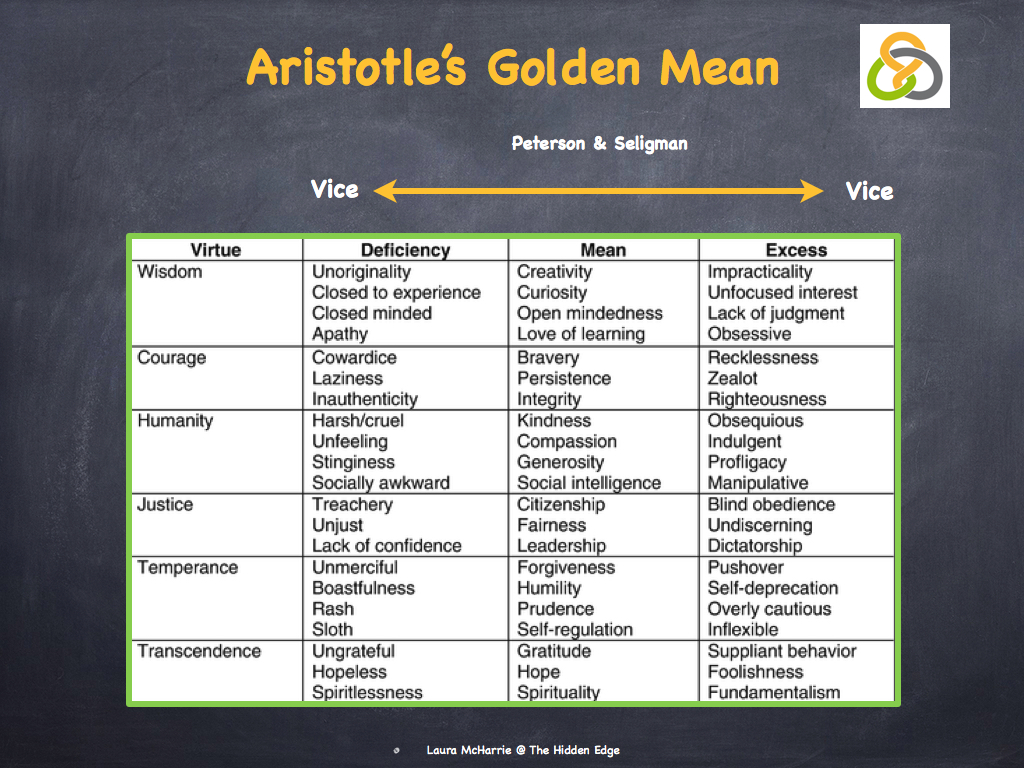
Let's unpack this with some canonical examples:
- In the face of fear and confidence:
- Virtue: Courage (the mean).
- Vice of Deficiency: Cowardice (too much fear, too little confidence).
- Vice of Excess: Rashness (too little fear, too much confidence).
- Regarding pleasures and pains:
- Virtue: Temperance (the mean).
- Vice of Deficiency: Insensibility (unconcerned with pleasures).
- Vice of Excess: Self-indulgence (pursues every pleasure).
- Regarding giving and taking money:
- Virtue: Generosity (the mean).
- Vice of Deficiency: Stinginess.
- Vice of Excess: Wastefulness.
The following video explains this core concept very effectively.
21. Happiness as Eudaimonia: Aristotle's Virtue Ethics
This portion of Mark Thorsby's lecture introduces the Doctrine of the Mean, using the "teeter-totter" analogy to illustrate virtue as the balance point between the vices of excess and deficiency.
Please watch from the doctrine of the mean. This segment will provide the basic intuition behind the theory.
Now, we must add two critical layers of sophistication to this picture.
First, the mean is not a mathematical average. Aristotle emphasizes that the mean is "relative to us." This does not mean it's subjective. It means the appropriate action is relative to the situation and the person. For example, the amount of food that is temperate for a large athlete in training (like the ancient wrestler Milo of Croton) would be self-indulgent for a small person with a sedentary lifestyle. Finding the mean requires a full assessment of the circumstances.
Second, the doctrine of the mean is not a decision procedure. It's a framework for understanding the structure of virtue. Aristotle is clear that there are no simple rules for finding the mean. Rather, it is determined by reason, specifically by the person of practical wisdom (phronesis). Furthermore, he notes that some actions (like murder, theft, adultery) and emotions (like spite and envy) are inherently base and do not admit of a mean; they are always wrong.
For a more rigorous analysis of these points, please read the following sections from the Stanford Encyclopedia of Philosophy.
Aristotle's Ethics - Stanford Encyclopedia of Philosophy
This text from the Stanford Encyclopedia of Philosophy delves into the details of the doctrine of the mean. It clarifies its structure, the meaning of "relative to us," and its role in Aristotle's ethical theory.
Please read the sections 5.1 Ethical Virtue as Disposition and 5.2 Ethical Theory Does Not Offer a Decision Procedure. Focus on how Aristotle's account avoids being a simplistic "everything in moderation" platitude.
5. A Deeper Analysis: Mesotes and Meson
For a student of formal philosophy, it is valuable to appreciate a subtle but important distinction in Aristotle's terminology. He uses two related Greek words:
- Mesotes (μεσότης): The state of the virtuous person, the disposition. This is the mean state.
- Meson (μέσον): The target of the virtuous person's action or feeling in a particular situation. This is the intermediate action/feeling.
The core argument, often missed in introductory accounts, is that a virtue is a mesotes (mean state) because it is a disposition that aims at and achieves the meson (the intermediate, or "just right," response). The goodness of the character trait is derived from the rightness of the actions and feelings it produces.
The following academic text provides a close reading of the key passage in Nicomachean Ethics II.6, where Aristotle makes this argument. This level of analysis is central to doing philosophy, not just learning about it.
Why Is Aristotle's Virtue of Character a Mean?
This paper by Lesley Brown, a leading scholar on ancient philosophy, offers a precise analysis of Aristotle's argument. It distinguishes between the "Usual thesis" (virtue is between two vices) and the more fundamental "Key thesis" (virtue is a mean state because it hits the intermediate target).
First, read the introduction to get the main thesis. Next, read Section I, "the proof that virtue is a mesotēs", which breaks down Aristotle's argument. Finally, read Section II, "two competing reasons," which clarifies why aiming at the meson is the more fundamental explanation.
This analysis shows that for Aristotle, the rightness of conduct is explanatorily prior to the goodness of character, a position that contrasts with some modern virtue ethicists. The virtuous state is defined by its function: hitting the target of appropriate action.
Conclusion
Aristotle’s virtue ethics presents a compelling picture of the moral life, one grounded in his broader metaphysical worldview. It is a life of activity, guided by reason, aimed at the ultimate human telos of flourishing.
Key Takeaways:
- The ultimate goal of human life is eudaimonia (flourishing), an objective state of living and acting well.
- Eudaimonia is achieved by fulfilling the unique human function: "an activity of the soul in accordance with virtue."
- Ethical virtue is a hexis (disposition) acquired through habituation.
- This disposition is a mesotes (mean state) between two vices of excess and deficiency.
- The virtuous person, guided by practical wisdom (phronesis), chooses the meson (the intermediate action/feeling) that is appropriate to the specific circumstances.
- The doctrine of the mean is a structural analysis of virtue, not a mechanical decision-making procedure.
Preview of the Next Lesson:
Having explored Aristotle's influential account, we will next turn to the major Hellenistic schools that followed him: Stoicism and Epicureanism. We will see how they developed distinct and competing conceptions of the good life, one centered on virtue and harmony with nature, and the other on the pursuit of a particular kind of pleasure.