Hello! Welcome to our lesson on the next major theater of US-China competition.
In our last session, we examined the rivalry in Southeast Asia, focusing on the flashpoint of the South China Sea and ASEAN's struggle to maintain its centrality. We saw how a region of medium-sized states tries to navigate the pressures of giants. Today, we shift our focus to a vast maritime expanse dotted with much smaller nations: the Pacific Islands.
This region, once considered a strategic backwater after the Cold War, has exploded into a new front in the contest for global influence. For you, this lesson offers a powerful case study in how the smallest states can have outsized geopolitical importance and how they employ unique strategies to survive and even thrive amidst great power rivalry—a dynamic highly relevant to understanding the options available to smaller states everywhere.
Our learning outcome for today is to: Analyze the growing strategic competition in the Pacific Islands, including security pacts and resource politics.
We will cover:
- The strategic value of the Pacific Islands: why geography, resources, and diplomacy make them so important.
- China's playbook for building influence in the region.
- The United States' response and efforts to re-engage.
- How the island nations themselves are navigating this competition.
1. From "Strategic Backwater" to "Strategic Hub"
For decades after World War II, the Pacific Islands were firmly within the US and its allies' sphere of influence. However, a period of relative neglect by Washington created a vacuum that Beijing has been systematically filling.
To understand this shift and the islands' newfound importance, let's start with a brief overview.
Indo-Pacific Islands: Caught in Between U.S.-China Competition
This video from the Carnegie Endowment for International Peace provides a concise introduction to why the Indo-Pacific islands have become central to the US-China competition.
Please watch the full video (it's under 3 minutes). As you watch, pay attention to the three core themes: The historical military significance of the islands. The shared interests of the island nations themselves (e.g., climate change, 'blue economy'). How the arrival of Chinese investment has changed the region's dynamics.
The video sets the stage perfectly. The competition isn't just about military bases; it's a multi-layered contest involving economics, diplomacy, and security. Let's break down the sources of the islands' strategic value.
2. The Three Pillars of Strategic Value
The importance of the Pacific Islands to great powers rests on three pillars: their geographic position, their control over vast resources, and their diplomatic weight.
a) Geographic Position: The "Tyranny of Distance" as an Asset
The Pacific Ocean's sheer size creates what historian Geoffrey Blainey called the "tyranny of distance." For a navy to project power across it, it needs places to rest, refuel, and re-arm. The Pacific Islands serve as these critical nodes.
-
The Island Chains: As we've discussed, military strategists often see the region in terms of "island chains." The Pacific Islands form the crucial Second Island Chain and the pathways beyond. Controlling access to these islands can either enable or deny a military's ability to move across the Pacific.
-
The COFA States: The US has unique agreements with three Pacific nations—the Marshall Islands, the Federated States of Micronesia, and Palau—known as the Compacts of Free Association (COFA). These agreements grant the US military exclusive access to their territory and, crucially, the right to deny access to other militaries.
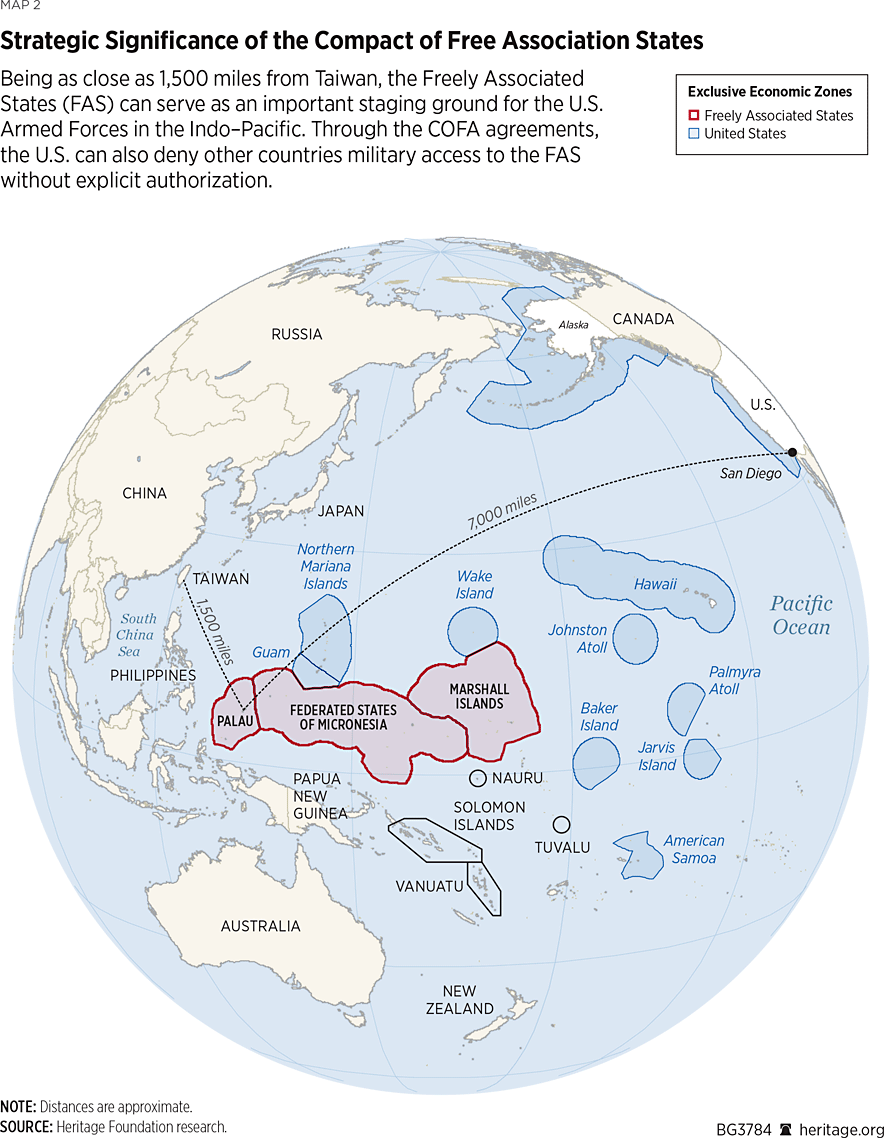
b) Resource Politics: A Blue Continent
While their landmass is tiny, these nations are large ocean states. Their Exclusive Economic Zones (EEZs)—the area of the sea over which a state has special rights regarding the exploration and use of marine resources—are enormous.
- Fisheries: The region is home to one of the world's richest tuna fisheries, a vital source of revenue for island governments and a key component of the global food supply.
- Deep-Sea Minerals: The seabed within these EEZs contains vast, untapped deposits of critical minerals like cobalt, nickel, and manganese, which are essential for green energy technologies and defense manufacturing.
The competition for access to these resources—both living and mineral—is a major driver of the geopolitical rivalry.
c) Diplomatic Weight: One Nation, One Vote
In international forums like the United Nations General Assembly, each country gets one vote, regardless of its size. The bloc of Pacific Island nations can be an influential swing vote on major global issues. This also makes them a key battleground in the diplomatic contest between Beijing and Taipei, with several island nations being among Taiwan's few remaining official diplomatic partners.
To bring these points together, let's look at a more detailed analysis.
[PDF] pacific island microstates and us security cooperation ... - DKI APCSS
This academic chapter, 'Pacific Island Microstates and U.S. Security Cooperation,' provides a thorough breakdown of the islands' strategic importance.
Please read the following sections from the PDF: 'Diplomatic Influence and UN Engagement of Pacific Microstates' and the following two subsections (pages 554–555). Focus on how these states exert influence disproportionate to their size. 'Geopolitical Positioning and Strategic Routes' and its subsections (pages 556–558). This details the island chains and the importance of the COFA agreements. 'Economic Significance and Resource Control in Pacific Microstates' and its subsections (pages 560–562). This covers the importance of EEZs, fisheries, and deep-sea minerals.
3. The Competition in Action
With the stakes now clear, let's analyze how the US and China are competing. Both are pursuing influence, but their methods and goals differ significantly.
China's Playbook: A Holistic Strategy
China has pursued a patient, multi-pronged strategy to build influence, undermine US partnerships, and create strategic options for its military.
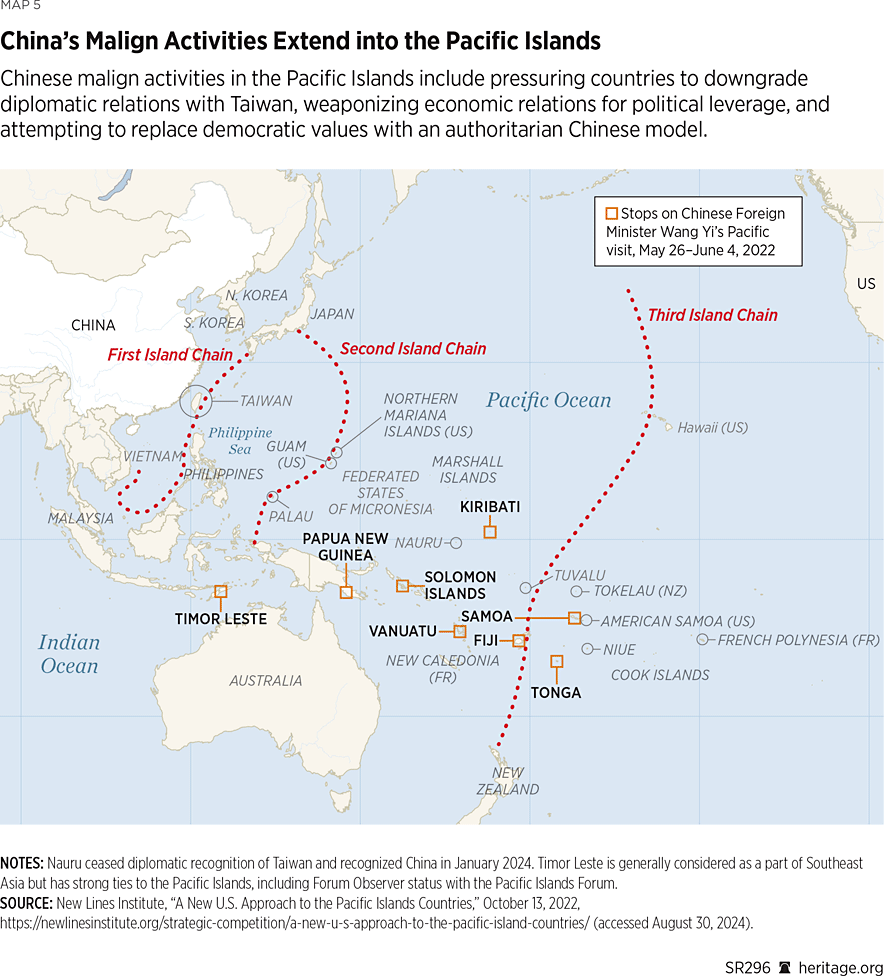
China's approach includes:
- Economic Enticement & Leverage: Becoming the region's largest trade partner and a key source of infrastructure loans and investment through the Belt and Road Initiative (BRI). This creates economic dependency that can be converted into political influence.
- Dual-Use Infrastructure: Funding and building ports, airports, and communication networks that are ostensibly for civilian use but are constructed to standards that could allow them to support People's Liberation Army (PLA) operations in the future.
- Security Pacts & Police Cooperation: This is a key innovation in China's strategy. Since most island nations lack a military, China has focused on signing security and policing agreements. This allows China to embed its police forces, provide training and equipment, and potentially gain a foothold it could use to protect its citizens and investments, or even suppress local dissent favorable to its interests. The 2022 security pact with the Solomon Islands was a major wake-up call for the US and its allies.
The following reading details this playbook with specific examples.
[PDF] Small Islands, Big Stakes: China's Playbook in the Pacific Islands
This U.S.-China Economic and Security Review Commission report, 'Small Islands, Big Stakes: China’s Playbook in the Pacific Islands,' provides an exhaustive look at Beijing's strategy. We will focus on the security dimension.
Please read the section titled 'Policing Agreements Expand China’s Presence and Influence' (pages 295–296). Focus on the details of the Solomon Islands agreement and how this model of police cooperation serves China's strategic goals.
The US Response: Re-engagement and Reassurance
Alarmed by China's inroads, the US has dramatically increased its engagement with the region after years of relative neglect.
How US-China rivalry is playing out among Pacific Island nations
This news report from ThePrint captures the moment of this US 're-engagement,' focusing on the first-ever US-Pacific Island Country Summit and the islanders' mixed reactions.
Please watch from 00:00 to 04:48. Note the contrast between the US rhetoric of a 'shared vision' and the Solomon Islands' assertion of its sovereign right to partner with China. Also, note the specific areas of US investment announced.
The US response is centered on:
- Diplomatic Offensive: High-level summits, opening new embassies, and appointing special envoys to show the region it is a priority.
- Strengthening Alliances and Partnerships: Renewing the crucial COFA agreements, signing a new Defense Cooperation Agreement with Papua New Guinea, and enhancing cooperation with regional allies like Australia and New Zealand.
- Providing an Alternative: Offering development aid and investment focused on the islanders' own priorities, such as climate resilience, maritime security (countering illegal fishing), and secure digital infrastructure as an alternative to Chinese state-backed firms like Huawei. This approach leverages civilian agencies like the Coast Guard to build partnerships, contrasting with China's more state-security-focused model.
4. Island Agency: Not Just Pawns on a Chessboard
It is a mistake to view the Pacific Island nations as passive objects in this contest. Their leaders are often playing a sophisticated game, leveraging the rivalry to extract maximum benefits for their countries.
They perform a delicate balancing act:
- Hedging: Many welcome Chinese infrastructure investment while simultaneously maintaining security ties with the US and Australia.
- Prioritizing their Agenda: They consistently use their platforms to force the great powers to address their primary existential threat: climate change.
- Asserting Sovereignty: As the Prime Minister of the Solomon Islands made clear, they resist being told who they can and cannot partner with, asserting their right to make their own foreign policy choices.
This dynamic, where small states are "friends to all, enemy to none," is an attempt to maintain strategic autonomy. However, as the competition intensifies, the pressure to choose sides is growing, creating deep divisions both within and between the island nations.
Conclusion
Today we've analyzed the Pacific Islands as a microcosm of the broader US-China competition. What was once a tranquil "American lake" is now a contested space where small island states hold significant strategic power.
Key Takeaways:
- Outsized Importance: The Pacific Islands are strategically vital due to their geographic location (island chains), control over vast oceanic resources (fisheries, minerals), and their collective diplomatic weight.
- Competing Playbooks: China uses a holistic strategy of economic leverage, dual-use infrastructure, and police/security agreements to build influence. The US is responding with a surge in diplomatic engagement, renewing alliances (like COFA), and offering alternative partnerships focused on islander priorities like climate change and maritime security.
- Security Pacts as a Key Front: The competition over security partnerships, particularly China's focus on police cooperation versus the US's traditional military and coast guard agreements, is a central feature of the rivalry.
- Islander Agency: The Pacific nations are not passive pawns. They actively leverage the competition to secure resources and advance their own agendas, though this balancing act is becoming increasingly difficult to maintain.
Preview of the Next Lesson:
We have now examined two key regions—Southeast Asia and the Pacific Islands—where the US-China rivalry is playing out. In our next lesson, we will synthesize these observations to evaluate how US-China rivalry destabilizes smaller states forced to choose sides, using examples from South and Southeast Asia. This will bring the course's core themes directly to your specified region of interest and explore the difficult choices that nations like Nepal, Sri Lanka, and others face.