Hello! Welcome to our next lesson in the "Great Power Competition and Regional Destabilization" module.
In our previous lesson, we examined the Pacific Islands as a crucial arena for US-China competition. We saw how even the smallest nations can have outsized strategic importance and how they employ sophisticated strategies like hedging to navigate the pressures from global giants. You learned about the competition over security pacts and the strategic value of geography and resources.
Today, we bring these themes closer to home for you, focusing directly on your areas of interest: Southeast and South Asia. This lesson directly addresses a core question of the course: how does this intense rivalry impact smaller states? It's a phenomenon often described with the proverb, "When elephants fight, it is the grass that suffers."
Our learning outcome is to: Evaluate how US-China rivalry destabilizes smaller states forced to choose sides, using examples from South and Southeast Asia.
We will explore:
- The core dilemma facing smaller states caught between the US and China.
- A structured framework for analyzing how this external rivalry interacts with a country's internal politics.
- Case studies on how these dynamics play out in ASEAN and, more specifically, in South Asian nations like your home country, Nepal.
- The primary mechanisms through which this rivalry can lead to instability.
1. The Core Dilemma: The Pressure to Choose
For smaller states in Asia, the US-China rivalry is not an abstract geopolitical game; it is a daily reality that shapes their economic, political, and security decisions. On one hand, China is often the largest trading partner and a massive source of investment. On the other, the United States is a long-standing security provider and a key diplomatic and economic partner. Being forced to choose between them presents an impossible dilemma, while trying to remain neutral becomes increasingly difficult.
To understand this dilemma from the perspective of a regional bloc, let's start with a lecture on the implications of the rivalry for ASEAN (Association of Southeast Asian Nations).
The US-China Rivalry: Implications for ASEAN
In this video, 'The US-China Rivalry: Implications for ASEAN,' from CIL NUS, Ambassador-at-Large Tommy Koh provides a masterful overview of the challenges ASEAN faces. His analysis clearly lays out the risks and opportunities for smaller states.
Please watch two key segments: Implications for ASEAN (19:16 - 27:06): Pay close attention to the list of positive and negative implications. Note the pressure to support rival initiatives (like the BRI vs. the Quad) and the danger of a divided ASEAN, where one member state can act as another power's proxy. Economic Coercion and Lack of Trust (48:35 - 53:05): Focus on the discussion of China's willingness to use economic coercion and what Professor Koh identifies as the single biggest impediment to US-China cooperation: the 'total absence of trust.'
Professor Koh's lecture highlights a critical point: if the great powers move from a paradigm of competition and cooperation to one of competition and confrontation, the value of neutral, independent blocs like ASEAN diminishes. They are no longer seen as valuable conveners but as potential recruits in a zero-sum game. This pressure creates deep fissures within such organizations and within the domestic politics of their member states.
2. A Framework for Analysis: How Rivalry Permeates Politics
To analyze this destabilizing effect in a structured way, it's helpful to have a framework. The US-China rivalry doesn't just affect foreign policy; it can become deeply entangled with a country's internal political competition.
A recent paper from the Carnegie Endowment for International Peace offers a powerful way to categorize how this happens. Let's study its core ideas.
Major Power Rivalry and Domestic Politics in South Asia
The paper 'Major Power Rivalry and Domestic Politics in South Asia' by Sameer P. Lalwani provides a novel framework for understanding how geopolitical rivalries intersect with the domestic politics of 'swing states.'
Please read the 'Introduction' and the section titled 'Major Power Competition and Domestic Politics: A New Framework' (from the start of the article down to the end of the 'Fragmentation' subsection). Focus on understanding the five trajectories that describe the overlap between major power competition and domestic politics: Insulation: The rivalry is not a major domestic issue. Consolidation: A single approach to the rivalry dominates politics. Contestation: The rivalry is an issue, but allegiances are fluid and not stable. Polarization: Clear, stable domestic blocs form that are aligned with external powers. Fragmentation: The political system breaks down into armed conflict along geopolitical lines.
This framework gives us a more nuanced vocabulary than simply "pro-US" or "pro-China." It helps us see how the same external rivalry can produce very different effects inside different countries, or even within the same country over time.
3. Case Study 1: Southeast Asia's Balancing Act
Most Southeast Asian nations try to avoid choosing sides, pursuing a strategy of hedging. They seek to maximize economic benefits from China while maintaining security ties with the US and its allies. However, this balancing act is precarious and often places them in a state of Contestation or fragile Consolidation around neutrality.

The specific strategies these states employ can be broken down further.
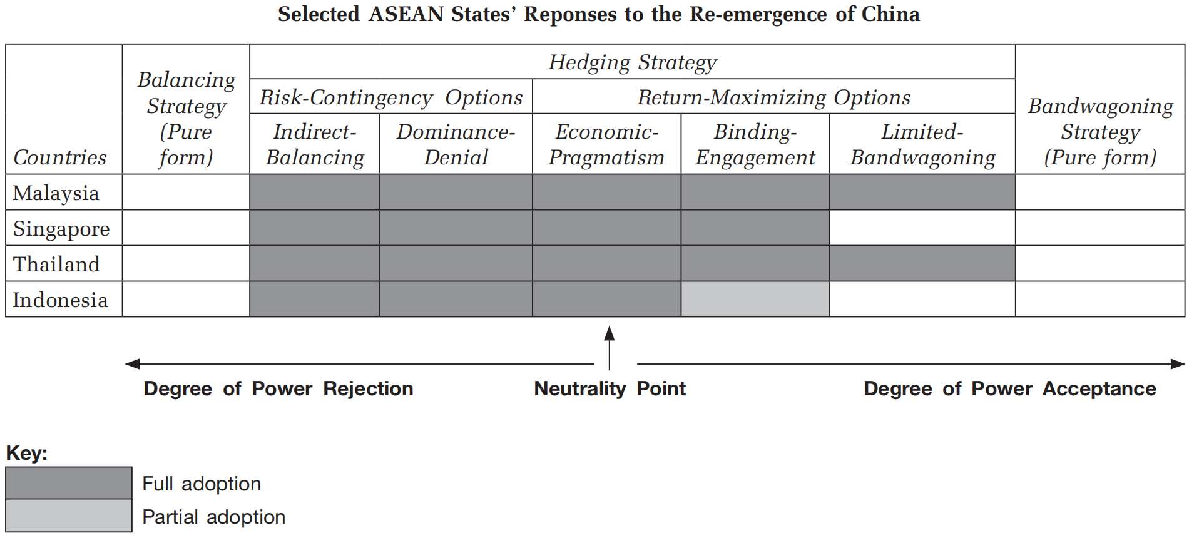
The destabilizing effect here is often the paralysis of regional institutions. As Professor Koh mentioned, China's influence over Cambodia has, at times, prevented ASEAN from reaching a consensus on statements regarding the South China Sea. This erodes the bloc's credibility and its ability to manage regional security, leaving individual states more vulnerable.
4. Case Study 2: South Asia – The Himalayan Squeeze
Nowhere is the pressure of being caught between giants more acute than in South Asia, where the US-China rivalry is layered on top of the pre-existing India-China rivalry. For a landlocked country like Nepal, navigating these dynamics is a matter of national survival.
A recent flashpoint in Nepal perfectly illustrates how external competition can inflame domestic politics.
South Asia Diary | America vs China in Nepal
This WION news report, 'South Asia Diary | America vs China in Nepal,' details the controversy around the US State Partnership Program (SPP) in Nepal. It's a concise case study of how a foreign initiative can become a battleground for domestic political factions and external powers.
Please watch the full report (it's less than 4 minutes). Observe how an ostensibly benign program for disaster readiness was framed as a 'military alliance,' sparking a fierce debate that drew in the US, China, and competing Nepali political parties.
The SPP controversy is a classic example of Contestation, the very category the Carnegie paper uses to describe Nepal's situation. Let's delve deeper into that analysis.
Major Power Rivalry and Domestic Politics in South Asia
Let's return to the Carnegie paper by Lalwani and read his specific analysis of South Asia. He applies the framework directly to Nepal, providing a clear diagnosis of its geopolitical predicament.
Please read the section titled 'South Asia Today'. Focus on the analysis of Nepal. Lalwani argues that while there are pro-India and pro-China inclinations, no stable cleavage has emerged. Instead, politicians use the rivalry in 'fluid and deeply uneven ways' to gain domestic support. This is the essence of 'Contestation'.
This dynamic is destabilizing because it makes long-term, coherent foreign and domestic policy incredibly difficult. As the paper notes, coalitions in Nepal shift constantly, and a policy championed by one government might be abandoned by the next.
This situation is exacerbated by a history that has made balancing a necessity. The USIP report China's Influence on Conflict Dynamics in South Asia notes how Nepal expanded ties with China following a 2015-16 border closure by India, which "underscored the risks of Nepali dependence on New Delhi." China's subsequent funding of projects like a fiber-optic link provided a direct alternative to Indian infrastructure, demonstrating how great power rivalry can be leveraged by a smaller state to increase its own strategic autonomy, even as it invites greater competition.
5. Mechanisms of Destabilization
Synthesizing these case studies, we can identify several key ways the US-China rivalry destabilizes smaller states:
-
Domestic Political Polarization: The rivalry becomes a tool in internal power struggles. Political parties brand their opponents as puppets of either Washington or Beijing, making national-interest-based compromise nearly impossible. This moves a country from fluid Contestation toward dangerous Polarization.
-
Erosion of Governance and Democratic Norms: As the USIP report (LINK) points out, some leaders use the rivalry to their advantage by threatening to deepen ties with Beijing—which offers development with "few if any requirements related to transparency, anticorruption, [or] human rights"—to deflect criticism from Western countries about democratic backsliding or corruption. This creates a "get out of jail free card" for illiberalism.
-
Paralysis of Regional Institutions: As seen in ASEAN, when member states become proxies or are heavily influenced by an external power, the entire bloc's ability to act cohesively is undermined. This weakens the collective security that these organizations are meant to provide.
-
Policy Whiplash: In states with a high degree of Contestation, like Nepal, foreign policy can become erratic. A major infrastructure deal or security agreement signed by one government may be stalled or cancelled by the next, creating an unstable environment for investment and long-term planning.
Conclusion
Today, we've moved from the general principle of great power competition to its tangible, often destabilizing effects on the ground in Southeast and South Asia. You've seen that for smaller nations, the rivalry is not a distant chess match but a powerful force that permeates their domestic politics and constrains their choices.
Key Takeaways:
- The Core Dilemma: Smaller states face immense pressure to choose sides in the US-China rivalry, with significant risks associated with alignment or neutrality.
- A Useful Framework: External rivalries can be linked to domestic politics through Insulation, Consolidation, Contestation, Polarization, or Fragmentation. Most states in South and Southeast Asia currently exist in a state of Contestation.
- ASEAN's Strain: The bloc's unity and effectiveness are threatened as members are pulled in different directions, undermining its role as a stabilizing force.
- Nepal's Predicament: As a classic case of Contestation, Nepal's political actors fluidly use the US-China-India rivalry for domestic gain, leading to policy instability and making the country a key arena for geopolitical competition.
- Mechanisms of Instability: The rivalry fuels instability by polarizing domestic politics, enabling democratic backsliding, paralyzing regional bodies, and causing erratic policymaking.
Preview of the Next Lesson:
We've focused today on how the global US-China rivalry impacts South Asia. Next, we will zoom in on the region's own powerful dynamic. Our next lesson will be to analyze the India-Pakistan rivalry as a persistent regional conflict and its intersection with great power politics. We will explore how this long-standing conflict is itself shaped by, and in turn shapes, the strategic calculations of both Beijing and Washington.