Hello! Welcome back to our course on geopolitics.
In our last lesson, we assessed the global consequences of the Russia-Ukraine war, noting how it acted as an accelerant for several geopolitical trends. One of the most significant of these was the deepening of the strategic alignment between China and Russia. You noted that this alignment of two great powers presents a formidable challenge to the US-led international order.
Today, we will dissect that very partnership. This lesson directly addresses the learning outcome: Evaluate the Sino-Russian strategic alignment and the limits of their 'no limits' partnership.
Our goal is to move beyond the headlines and develop a nuanced understanding of this critical relationship. Is it a durable alliance poised to reshape the 21st century, or a temporary, transactional marriage of convenience with inherent structural limits? Think of it as analyzing a complex, distributed system: we need to understand not only the protocols that allow the nodes to cooperate but also the potential for network partitioning, asymmetrical loads, and fundamental design conflicts that could lead to instability.
1. The Narrative and Reality of a "No Limits" Partnership
On the eve of the 2022 Ukraine invasion, Xi Jinping and Vladimir Putin famously declared a partnership with "no limits." This narrative of an unbreakable bond is one both countries actively promote.
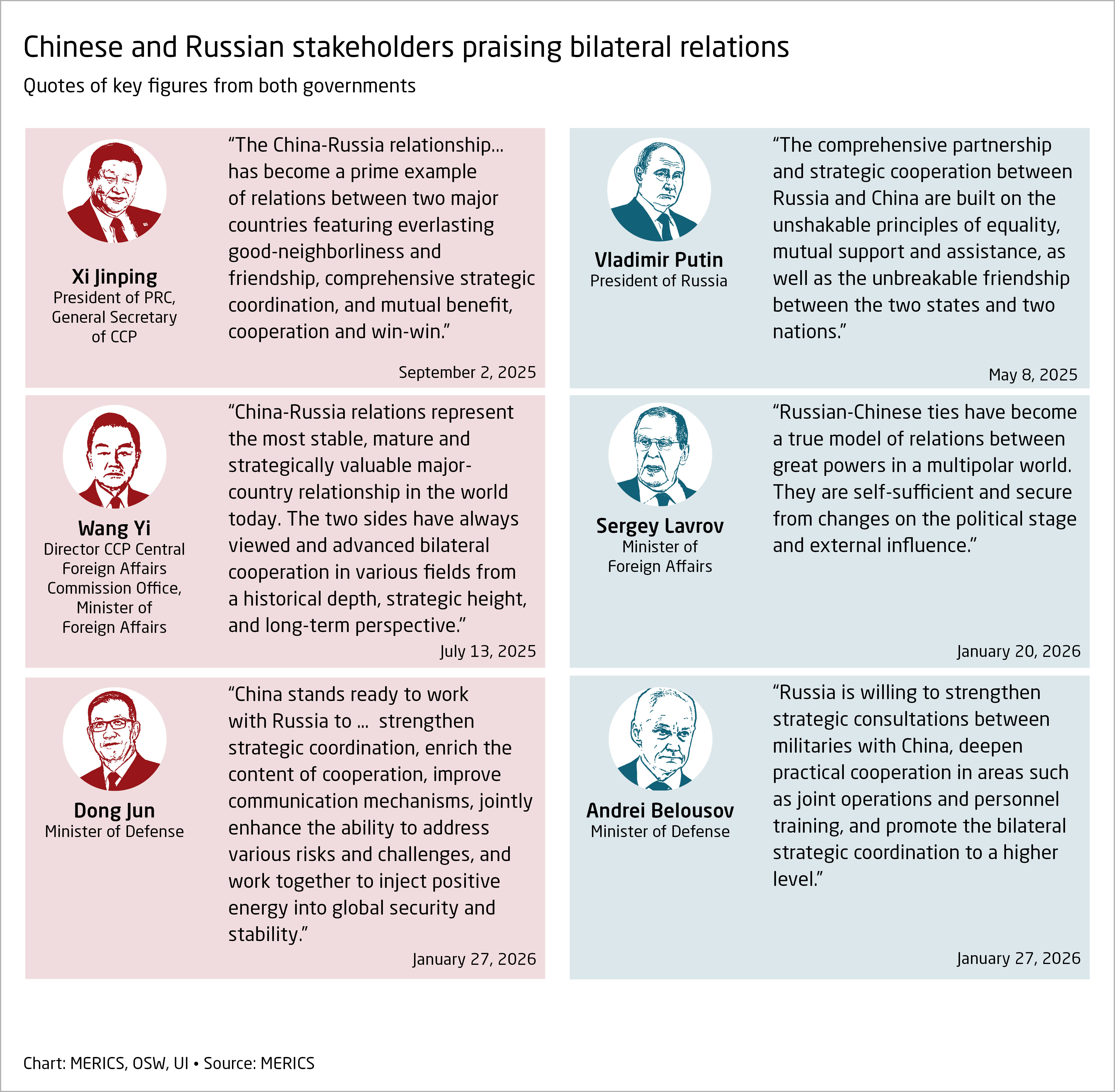
This isn't just talk. The tempo of their interaction is exceptionally high across all levels of government.

To grasp the substance behind this narrative, let's explore the concrete areas of their cooperation. The Council on Foreign Relations has produced a comprehensive report on this topic.
[PDF] No Limits? The China- Russia Relationship and U.S. Foreign Policy
This report, 'No Limits? The China-Russia Relationship and U.S. Foreign Policy,' details the extensive collaboration between the two nations. We will focus on the sections that provide evidence of their alignment.
Please read the sections titled 'DIPLOMATIC COLLABORATION,' 'MILITARY COLLABORATION,' and 'ECONOMIC COLLABORATION.' As you read, make a mental list of one or two key examples from each category: Diplomatic: How do they behave in the UN Security Council? What is their role in non-Western institutions like BRICS and the SCO? Military: What kind of joint exercises do they conduct? How does China support Russia's war effort? Economic: How has trade changed since 2022? How are they trying to reduce their reliance on the US dollar?
As the report makes clear, this is a comprehensive, multi-domain partnership. They coordinate vetoes at the UN, expand non-Western blocs like BRICS, conduct increasingly sophisticated joint military drills in sensitive areas like the Sea of Japan and the Arctic, and have reoriented their economies towards each other to bypass Western sanctions.
2. The Core Drivers: Why They Need Each Other
What fuels this intense cooperation? While the historical relationship has seen ups and downs, the current alignment is driven by a powerful convergence of modern strategic interests.
Let's begin with a short analysis that frames the relationship in the context of the Ukraine war.
War and Sino-Russian Partnership: An Indispensable but Uneasy ...
This report from the Center for European Policy Analysis (CEPA) succinctly explains why, despite some disappointments, the partnership remains indispensable for both sides.
Please read the 'Executive Summary' section. Focus on the distinct but complementary reasons why each country values the partnership.
The CEPA report captures the essence of their codependence. Building on this, we can identify four primary drivers:
- Shared Antagonism toward the U.S.-led Order: This is the primary glue. Both Beijing and Moscow view the current international system as a U.S.-dominated "hegemony" that constrains their power and threatens their political systems. They work together to weaken U.S. alliances and promote a "multipolar" world with greater freedom of action for themselves.
- Economic Complementarity and Sanction-Proofing: Russia is a treasure trove of natural resources (oil, gas) and advanced military technology (jet engines, submarines) that China needs. In return, China is a massive market for these resources and a provider of consumer goods and industrial technology that Russia can no longer source from the West due to sanctions. This trade, increasingly conducted in their own currencies, is a direct attempt to create an economic ecosystem insulated from U.S. financial power.
- Mutual Support for Authoritarian Rule: Both governments are deeply hostile to liberal democracy and fear "color revolutions." They pledge to support each other against what they see as foreign-backed subversion, sharing surveillance technologies and propaganda techniques to ensure regime stability.
- Strategic Security: For China, a friendly Russia secures its vast northern land border, creating a "stable strategic rear." This allows Beijing to focus its military and strategic attention eastward, on Taiwan and the Pacific. For Russia, China's backing provides a vital diplomatic and economic lifeline, preventing complete international isolation.
This short video provides useful historical context and explains how the Ukraine war has impacted both countries' perceptions of the partnership.
The Limit of Russia-China “No-Limit Friendship” & Why 'Reverse Nixon' Will Fail | Elizabeth Wishnick
Professor Elizabeth Wishnick, an expert on Sino-Russian relations, discusses the evolution of their partnership and how it has been tested by the war in Ukraine.
Please watch from 05:46 to 10:02 for historical context, and then from 13:15 to 17:08 and 21:36 to 24:46 for an analysis of the war's impact. Pay attention to: The historical undercurrents of their relationship. How China's support for Russia (e.g., dual-use items) has been substantial but carefully calibrated.
3. The Limits: An Axis of Convenience, Not an Alliance
Despite the powerful drivers of cooperation, the "no limits" declaration is more rhetorical than real. A true evaluation requires us to critically examine the partnership's inherent fractures and asymmetries.
Fundamental Divergence in Worldview
The most significant limit is their fundamentally different strategic posture.
War and Sino-Russian Partnership: An Indispensable but Uneasy ...
Let's return to the CEPA report, which draws a crucial distinction between China's and Russia's goals.
Please read the section 'The Sino-Russian Partnership and Global Order.' Focus on the distinction between China as a revisionist power and Russia as a revolutionary power.
This is a critical point:
- China is a revisionist power. It has benefited immensely from the existing globalized system and seeks to reform it from within to gain more influence, not to destroy it. Stability is crucial for its economic growth.
- Russia under Putin has become a revolutionary (or spoiler) power. Lacking the economic and technological might to compete within the system, it seeks to overturn it through disruption and chaos.
This difference explains China's careful balancing act: supporting Russia enough to keep it afloat as a strategic partner, but not so much that it risks a catastrophic break with the Western economies on which its own prosperity depends.
Asymmetries and Hedging
This fundamental divergence manifests in several concrete limits, as illustrated by China's actions.
China's Strategic Shift: Unraveling the 'No-Limits' Partnership with Russia
This video from analyst Jason Jay Smart provides a strong counter-narrative, using specific examples to argue that China consistently prioritizes its own interests over its partnership with Russia.
Please watch from 01:29 to 08:25. Note the concrete evidence presented for China's strategic hedging: Economic Asymmetry: Compare the value of China's trade with Russia to its trade with the US and EU. Energy Infrastructure: The stalled Power of Siberia 2 pipeline. Trade Routes: China's investment in Belt and Road Initiative (BRI) corridors that pointedly bypass Russia.
Let's summarize the key limits:
- Economic Asymmetry: As the video highlights, China's trade with the US and EU dwarfs its trade with Russia. Beijing cannot afford to have its access to Western markets and technology completely severed in the way Russia's has been. Its own economic stability comes first.
- Power Imbalance: China's economy is roughly ten times the size of Russia's. Russia is increasingly the "junior partner" in the relationship, a dependent supplier of raw materials. While Putin may accept this out of necessity, it creates an underlying tension and limits Russia's leverage.
- Divergent Strategic Logics: The video introduced Sarah Payne's theory of continental vs. maritime powers. Russia, a classic continental power, is obsessed with territory, borders, and buffer zones. China, increasingly a maritime power, is focused on trade, markets, and access to global sea lanes. Their ultimate goals are different.
- Historical Distrust: While publicly papered over, centuries of rivalry, border clashes, and what China considers "unequal treaties" from the era of the Russian Empire have not been entirely forgotten. This creates a deep-seated, albeit suppressed, layer of mistrust.
- Competition for Influence: In regions where their interests overlap, such as Central Asia and the Arctic, they are as much competitors as they are partners. China's growing economic and political influence in former Soviet republics is a source of quiet concern for Moscow.
Conclusion
The Sino-Russian strategic alignment is one of the most significant geopolitical developments of our time. It is a powerful, pragmatic partnership cemented by a shared desire to counter U.S. influence and driven by mutual necessity. However, it is not a monolithic bloc or a true alliance.
Key Takeaways:
- Strengths: The partnership is deep and comprehensive, with strong collaboration in the diplomatic, military, and economic spheres. Its primary driver is a shared opposition to the U.S.-led international order.
- Limits: The partnership is constrained by significant asymmetries. China's economic reliance on the West, its superior power status, and its fundamentally different strategic goal (revising, not wrecking, the system) mean that Beijing will always prioritize its own national interests.
- Evaluation: The "no limits" partnership is best understood as a highly developed quasi-alliance or an axis of convenience. It is transactional, not ideological. Both sides will cooperate extensively as long as it serves their interests, but they retain strategic autonomy and will not sacrifice their core objectives for the other.
Preview of the Next Lesson:
We have now analyzed the key players in the new era of great power competition: the US, China, and Russia. But how does this competition affect other nations? Our next module, "Great Power Competition and Regional Destabilization," will explore this question. In our first lesson, we will analyze how great power proxy conflicts destabilize regions, using Syria as a primary case study. We will see how the dynamics of rivalry and partnership we've discussed play out on the ground, with devastating consequences for smaller states caught in the middle.