Hello! Welcome to our next lesson.
In our previous session, we examined the contentious issue of NATO expansion, analyzing it as a significant driver of tension between Russia and the West. We contrasted the realist perspective, which frames expansion as a predictable provocation threatening Russia's strategic depth, with the counter-argument emphasizing the sovereign right of nations to choose their alliances for protection against perceived Russian imperialism.
Today, we will synthesize these ideas to construct a multi-layered analysis of one of the most significant geopolitical events of the 21st century. This lesson directly addresses the learning outcome: Analyze the long-term and immediate causes of the Russia-Ukraine war, referencing concepts of strategic depth and NATO expansion.
We will break down the causality of the 2022 invasion into three distinct but interconnected layers:
- Deep, long-term factors rooted in geography and history.
- The primary accelerant of post-Cold War NATO policy.
- The immediate triggers and miscalculations that led to the final decision to invade.
This structured approach will help us move beyond a single-cause explanation and appreciate the complex interplay of forces that led to the conflict.
1. The Foundation: Long-Term Causes
The decision to launch a full-scale invasion was not made in a vacuum. It was the culmination of centuries of historical experience and deep-seated security perceptions.
The Tyranny of Geography and the Need for Strategic Depth
As you know from your reading of Tim Marshall's Prisoners of Geography, Russia's geography is both a blessing and a curse. Its vast size provides strategic depth, but its lack of natural barriers on its western frontier creates a permanent sense of vulnerability.
Let's hear directly from Tim Marshall as he explains this crucial geographic reality.
Tim Marshall on Ukraine, Gaza and how Geography Explains Our World | Intelligence Squared
In this clip, Tim Marshall, author of Prisoners of Geography, outlines the core geographic dilemma that has shaped Russian history and strategy for centuries.
Please watch the segment from 02:17 to 05:06. Focus on these key points: His description of the North European Plain as a '300-mile gap' and a historical invasion route. The list of historical invasions from the West (Poles, Swedes, Napoleon, Germans) and how this shapes the Russian psyche. How this historical geography translates into a modern imperative to 'plug that gap' with buffer zones.
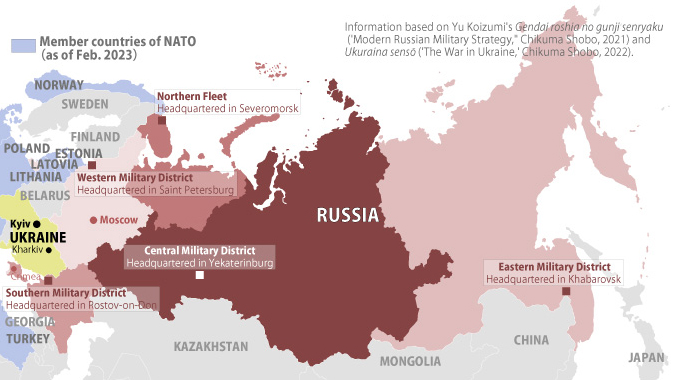
This perpetual vulnerability, born from geography and reinforced by history, is a fundamental long-term cause of Russian behavior. The desire to control the flatlands to its west—to create a buffer—is not a recent invention of Vladimir Putin's regime; it is a centuries-old strategic imperative.
Strategic Culture and National Identity
Beyond geography, a nation's "strategic culture"—its shared beliefs, attitudes, and historical narratives about security and its role in the world—shapes its actions. Russian strategic culture is defined by several key elements that contribute to its actions in Ukraine.
To understand this better, let's turn to an academic analysis of this concept.
The Russia-Ukraine War through the Lens of Strategic Culture
This article from the Columbia Journal of International Affairs delves into the components of Russian strategic culture that predispose it to certain actions.
Please read the section titled 'Strategic Culture of Russia' (it starts after the 'Europe: A Theatre of Battling Strategic Cultures' heading). Pay close attention to the four features it outlines: A perception of being a 'besieged fortress' due to a history of invasions. The use of a glorified past to justify current behavior. The belief in its status as a 'great power' (derzhavnost) that requires a buffer zone and sphere of influence. A long tradition of autocratic, centralized rule.
These cultural elements—the "besieged fortress" mentality and the "great power" identity—combine with the geographic reality to create a powerful long-term driver for Russian foreign policy. From this perspective, a westward-oriented, democratic Ukraine is not just a policy challenge; it is a threat to Russia's historical identity and its fundamental conception of security.
2. The Accelerant: NATO Expansion as a Perceived Existential Threat
If geography and strategic culture are the combustible materials, NATO expansion was the accelerant poured on top. As we discussed in the last lesson, the eastward growth of the alliance throughout the post-Cold War period was viewed in Moscow with increasing alarm.
The key is to understand that regardless of the West's stated defensive intentions, Russia perceived this expansion as an existential threat. Professor John Mearsheimer explains this realist viewpoint succinctly.
RUSSIA VS THE WEST: Mearsheimer’s Chilling Prediction for Ukraine and Europe
Here, Mearsheimer explains exactly why Russian leaders, regardless of who is in power, view Ukraine joining NATO as an unacceptable threat.
Please watch from 00:06 to 01:30 and then from 24:42 to 27:02. Focus on his core argument that 'it is what they think that matters,' and his assertion that Russia sees NATO in Ukraine as a 'mortal threat' and a 'declaration of war.' He explicitly identifies the 2008 Bucharest decision as the main driving force.

This perception is what an academic paper you'll read next calls a ‘Hobbesian Fear’. It's the fear of what a rival could do in the future, even if they have no current intention of doing so.
[PDF] GEOPOLITICAL IMPLICATIONS OF THE RUSSIA-UKRAINE WAR ...
This academic paper formally outlines the realist interpretation of the conflict, framing NATO expansion as the primary cause that upset the regional balance of power.
Please read the section 'THEORETICAL FRAMEWORK'. Focus on how it explains the realist perspective: the war as a 'natural reaction' to NATO growth. Note the specific mention of Crimea's strategic importance and the 'Hobbesian Fear' that a Western-aligned Ukraine could one day expel Russia's Black Sea Fleet, regardless of treaties.
By connecting the long-term need for strategic depth with the accelerating threat of NATO expansion, we can see how Russia's actions, while a flagrant violation of international law, followed a certain brutal geopolitical logic from its own point of view.
3. The Spark: Immediate Triggers and Miscalculations (2014-2022)
While the underlying causes were in place for years, specific events and calculations triggered the 2022 invasion.
-
The 2014 Pivot: The pro-Western Maidan Revolution in 2014 was the immediate catalyst. In Moscow's eyes, Ukraine had decisively "flipped" to the enemy camp. This triggered Russia's initial response: the annexation of Crimea to secure its critical warm-water naval base at Sevastopol and the fomenting of a separatist war in the Donbas to destabilize Ukraine and make it an unattractive candidate for NATO membership.
-
Hardening Positions (2014-2021): In the years that followed, positions on both sides solidified. Ukraine amended its constitution to make NATO membership an official goal. The US and other NATO members increased military training and arms supplies to Ukraine. From Moscow's perspective, the threat was not receding but growing more acute.
-
The Window of (Mis)Opportunity: By late 2021, Vladimir Putin appears to have made a critical miscalculation. He likely perceived a window of opportunity, believing the West was weak, divided, and distracted.
Let's return to Tim Marshall for an analysis of this final piece of the puzzle.
Tim Marshall on Ukraine, Gaza and how Geography Explains Our World | Intelligence Squared
Marshall discusses the immediate context leading up to the invasion, focusing on Putin's perception of Western weakness.
Please watch from 09:23 to 12:24. Note his argument that both Russia and China believed the West was in 'terminal decline.' He specifically cites French President Macron's 2018 statement that NATO was 'brain dead' and the chaotic US withdrawal from Afghanistan in 2021 as events that signaled weakness to Moscow and prompted Putin to 'test' the West.
Putin's calculation was that a "short, victorious war" would quickly topple the government in Kyiv, install a pro-Russian regime, and permanently halt Ukraine's westward drift before a disunited West could mount an effective response. This was a catastrophic misjudgment, both of Ukrainian resolve and of Western unity.
Conclusion
To analyze the causes of the Russia-Ukraine war is to peel back layers of history, geography, and strategy. No single factor is sufficient.
Key Takeaways:
- Long-Term Causes: The war's deepest roots lie in Russia's enduring geographic vulnerability on the North European Plain and its corresponding historical quest for strategic depth. This is reinforced by a strategic culture that sees Russia as a "besieged" great power entitled to a sphere of influence.
- Accelerating Cause: Post-Cold War NATO expansion was the primary accelerant. It activated Russia's deep-seated security fears, and the prospect of Ukraine joining the alliance was explicitly and repeatedly described by Moscow as an existential "red line."
- Immediate Triggers: The 2014 pro-Western turn in Ukraine was the pivotal event that began the active conflict. The final decision to launch the full-scale invasion in 2022 appears to have been driven by a miscalculation that a divided and weak West would not effectively resist, creating a perceived window of opportunity to solve the "Ukraine problem" once and for all.
Understanding this chain of causality—from the deep past to the immediate present—is essential for any serious geopolitical analysis of the conflict and its ongoing consequences.
Preview of the Next Lesson:
Having thoroughly analyzed the causes of the war, our next lesson will shift focus to its effects. We will assess the primary global consequences of the Russia-Ukraine war on energy markets, international alliances, and the global food supply, exploring how a regional conflict has sent shockwaves through the entire international system.