Hello! Welcome back.
In our last lesson, we established the three core geopolitical imperatives that drive Russian grand strategy: the quest for strategic depth, the need for warm-water ports, and the enforcement of the 'near abroad' doctrine. We saw how geography and history have instilled in Russia a deep-seated sense of vulnerability and a desire to control its periphery.
Today, we will analyze the primary catalyst that has activated these security concerns in the post-Cold War era. This lesson addresses the learning outcome: Analyze NATO expansion as a driver of tension between Russia and the West.
We will explore one of the most contentious debates in modern international relations. Is NATO's growth into Eastern Europe a defensive and stabilizing measure that protects the sovereignty of free nations? Or is it an aggressive and unnecessary encroachment on a great power's sphere of influence that predictably provoked a conflict? Your prior reading of Prisoners of Geography gives you a head start, as you're already attuned to how maps and borders can become sources of existential tension.
1. A Post-Cold War Promise? The Waves of Expansion
When the Soviet Union collapsed, a debate began about the future of NATO. Was its purpose fulfilled? For the newly independent nations of Central and Eastern Europe, joining the Western alliance was seen as a security guarantee against any potential resurgence of Russian power.
Let's start with a visual overview of how NATO has grown since its inception.
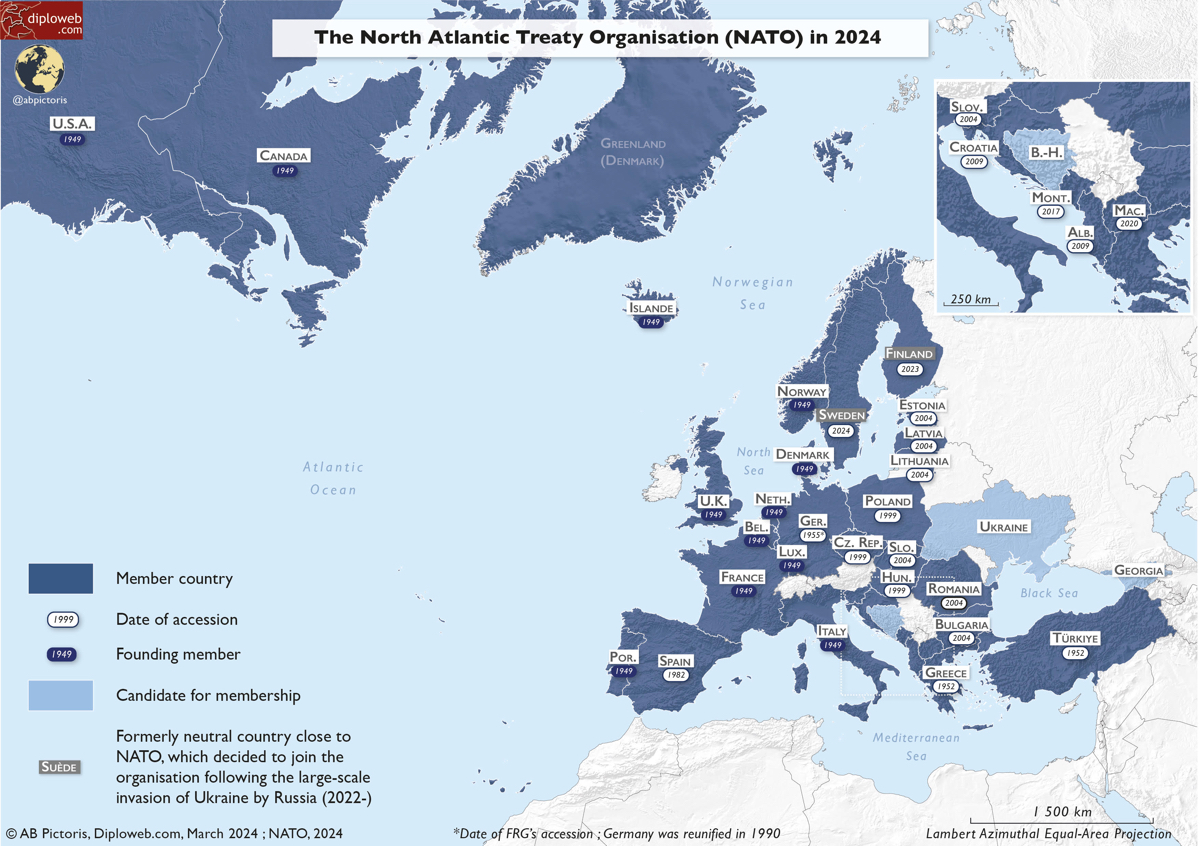
Russia's opposition to this process was not a recent development. It began in the 1990s as the first wave of enlargement was being planned. To understand the historical depth of this tension, it's useful to examine Russia's initial arguments.
[PDF] Russia and NATO Enlargement - Columbia International Affairs Online
This academic paper, 'Russia and NATO Enlargement,' written well before the 2014 or 2022 invasions, provides a crucial historical perspective on Russia's long-standing opposition.
Please read two key sections from this paper: Start on page 154 under the heading 'FIRST WAVE OF NATO ENLARGEMENT'. Read until the sub-heading 'Legal Form of NATO-Russia Relationship' on page 156. Focus on Russia's twofold arguments against expansion: the military-strategic (loss of the Central European buffer) and the political (perception of betrayal and isolation). Then, jump to page 161 and read the section 'Within a year of Vladimir Putin’s assuming the presidency...' to the end of the page. This part shows how, by 2000, Russia's official security documents were explicitly identifying NATO expansion as a primary national security threat.
As the paper details, from Moscow's perspective, NATO expansion erased the strategic depth gained by the Soviet Union and broke what it considered to be assurances from Western leaders that the alliance would not expand "one inch eastward" after German reunification. The Kosovo War in 1999, where NATO intervened without a UN Security Council mandate, further cemented the view in Moscow that NATO was an aggressive alliance no longer bound by its original defensive mandate.
2. The Realist View: NATO Expansion as Provocation
The most prominent and controversial argument that places primary responsibility on the West for the new tensions with Russia comes from the realist school of international relations. Professor John Mearsheimer of the University of Chicago is its leading voice. His argument is that great powers are acutely sensitive to threats in their near vicinity, and the West's decision to expand NATO into Russia's backyard was a strategic blunder that ignored the basic rules of power politics.
Why The Ukraine Crisis Is The West's Fault - John J. Mearsheimer
In this famous and widely debated lecture, John Mearsheimer lays out his case for why the West is principally responsible for the crisis in Ukraine. This is a quintessential realist analysis.
Please watch the following segments: 00:39 - 02:41: Mearsheimer introduces his central thesis that NATO enlargement, EU expansion, and democracy promotion were a 'triple package' of policies that provoked Russia. 09:59 - 11:13: He explains the core realist logic: Ukraine is a vital buffer state for Russia, and no great power would tolerate a rival military alliance on its border. He calls this 'Geopolitics 101'. 11:58 - 15:21: He argues that Western policymakers, operating under a liberal worldview, failed to understand Russia's legitimate security concerns and the enduring relevance of realpolitik.
Mearsheimer's argument connects directly to our previous lesson. The eastward expansion of NATO is, in his view, a direct assault on Russia's imperative for strategic depth. From a realist perspective, Russia's aggressive reaction was not only predictable but virtually inevitable.
This view gained further traction after a pivotal event in 2008.

At this summit, NATO leaders, despite reservations from France and Germany, declared that Ukraine and Georgia "will become members of NATO." While no formal membership plan was offered, this public declaration crossed what Moscow considered a "red line." Russia's war with Georgia followed just four months later.
The paper below puts this moment into the broader context of the academic debate.
[PDF] NATO Expansion: Enhanced Security or Race to Irrelevance?
This more recent paper, 'NATO Expansion: Enhanced Security or Race to Irrelevance?', analyzes the strategic trade-offs of enlargement and directly addresses the 'provocation' argument.
Please read the section titled 'Expansion as Provocation to Adversaries' (starting on page 14). Focus on how Russian elites interpreted enlargement as a betrayal and how the 2008 Bucharest declaration is seen as a pivotal turning point that triggered a Russian backlash.
This sequence of events—the Bucharest declaration followed by the Russo-Georgian War—is the cornerstone of the realist argument that NATO's actions, however well-intentioned, directly provoked Russian hostility.
3. The Counter-Argument: Russian Agency and Imperialism
The realist explanation, while powerful, is far from universally accepted. Critics argue it is overly deterministic, stripping Russia of its own agency and ignoring other powerful motivations for its actions. This counter-narrative emphasizes that NATO is a defensive alliance that countries choose to join voluntarily, often precisely because they fear Russian aggression.
This video directly challenges Mearsheimer's thesis.
No, the war in Ukraine is not the West's fault
This analysis provides a critical perspective on the realist argument, suggesting that factors beyond NATO expansion, such as Russian imperialism and decision-making, are at play.
Please watch from 07:42 to 12:38. This section systematically rebuts the realist claim by highlighting several key points: Russian Agency: It points to Russia's own aggressive actions (Georgia 2008, Crimea 2014) as drivers of the conflict, not just reactions. Flawed Predictions: It notes that Mearsheimer and other realists repeatedly predicted that Russia would not attempt a full-scale conquest of Ukraine, suggesting their model may be incomplete. The Deterrence Factor: It poses a critical question: What would Russia have done if NATO didn't exist as a deterrent? It contrasts the fate of non-NATO Ukraine with the NATO-protected Baltic states.
This perspective argues that blaming NATO is a misdiagnosis. Instead, it posits that Russian foreign policy is driven less by a rational fear of encirclement and more by a revanchist desire to restore a sphere of influence, a neo-imperial ambition, and the domestic political needs of an authoritarian regime. In this view, Eastern European countries were not pawns in a great power game; they were sovereign states seeking protection from a historically aggressive neighbor.
Conclusion: Analyzing the Security Dilemma
So, who is right? The debate over NATO expansion is a classic example of a security dilemma: one state's defensive actions (NATO offering membership to protect new democracies) are perceived by another state as offensive and threatening (Russia seeing it as encirclement), leading to a spiral of hostility.
Analyzing this tension requires moving beyond a simple "for" or "against" position. Both narratives contain elements of truth that are crucial for a complete picture.
Key Takeaways:
- Russian Opposition is Long-Standing: From the 1990s, Russia consistently voiced military-strategic and political objections to NATO's eastward expansion, viewing it as a breach of post-Cold War understandings and a threat to its security.
- The Realist Argument (Provocation): This perspective, championed by John Mearsheimer, holds that NATO expansion into Russia's sphere of influence was a strategic error that predictably provoked a hostile backlash by threatening Russia's core need for strategic depth.
- The Liberal/Counter-Argument (Deterrence): This view emphasizes that NATO is a voluntary, defensive alliance that countries joined to escape Russian influence. It highlights Russia's own imperial ambitions and aggressive actions as the primary drivers of conflict, with NATO serving as a necessary deterrent.
- The 2008 Bucharest Summit: The declaration that Ukraine and Georgia would become members is widely seen as a critical turning point that significantly escalated tensions, regardless of which primary narrative one subscribes to.
Ultimately, understanding the role of NATO expansion requires you to weigh the structural pressures of the international system against the agency and specific character of the states within it.
Preview of the Next Lesson:
In our next lesson, we will build directly on this analysis to examine the long-term and immediate causes of the 2022 Russia-Ukraine war. We will synthesize our understanding of Russia's deep-seated geopolitical imperatives and the intense tensions over NATO expansion to construct a comprehensive explanation for the largest conflict in Europe since World War II.