Hello! Welcome back to our module on Information Warfare.
In our last lesson, we established the core definitions of information warfare, propaganda, disinformation, and misinformation. We saw how these tools are used strategically to pollute the information environment, erode trust, and achieve political goals, using the Russia-Ukraine war as an initial example.
Today, we will conduct a deep-dive analysis of one of the most significant case studies in modern information warfare. Your background in computer engineering gives you a unique perspective on how digital platforms function; now, we'll dissect how those very platforms were repurposed as battlegrounds for political influence.
This brings us to today's learning outcome: Analyze how states conduct election interference and political destabilization through social media, using the 2016 US election as a case study. We will explore the specific strategies, tactics, and actors involved in this watershed moment for digital democracy.
1. A Framework for Digital Threats
Before we examine the 2016 election specifically, it's helpful to have a structured way to think about the different types of digital interference. These operations are not monolithic; they are composed of distinct but often overlapping techniques.
[PDF] DIGITAL THREATS TO DEMOCRATIC ELECTIONS
The report 'DIGITAL THREATS TO DEMOCRATIC ELECTIONS' from the University of British Columbia provides an excellent framework for categorizing these threats.
Please read the 'EXECUTIVE SUMMARY' (pages 1-3). As you read, identify the four principal techniques of interference listed. We will use these as our analytical categories throughout the lesson.
As you saw, the report identifies four key techniques:
- Cyber Attacks: Hacking into systems to steal and leak information (e.g., the DNC email leak).
- Mass Misinformation: Spreading false or deceptive content, often using bots and fake accounts.
- Micro-targeted Manipulation: Using big data to profile and send customized, manipulative messages to specific groups.
- Online "Trolling": Coordinated harassment and intimidation to silence voices and sow discord.
The 2016 U.S. election saw all four of these techniques deployed in a coordinated fashion by multiple actors. We will now focus on the two most prominent ones: Russia's Internet Research Agency (IRA) and the political consulting firm Cambridge Analytica.
2. The State Actor: Russia's Internet Research Agency (IRA)
The most direct and well-documented case of state-sponsored election interference in 2016 came from the Internet Research Agency (IRA), a Russian company with deep ties to the Kremlin. The IRA operated as a professional "troll farm," using social media to conduct a sophisticated information warfare campaign against the United States.
To understand the scale and strategy of their operation, we will turn to a comprehensive analysis of the data provided by social media companies to the U.S. Senate.
[PDF] The IRA, Social Media and Political Polarization in the United States ...
This report from Oxford University's Computational Propaganda Project, 'The IRA, Social Media and Political Polarization in the United States,' is a landmark study that deconstructs the IRA's playbook.
Please begin by reading just the 'Executive Summary' on page 3. This will give you a high-level overview of the IRA's objectives, timeline, and key tactics.
The summary reveals the IRA's core objective: to polarize the US public and interfere in the election. They didn't achieve this through one single method, but through a complex, multi-platform strategy. Let's break down their key tactics.
Tactic 1: Cross-Platform Campaigning
The IRA didn't just use one platform; they created an entire ecosystem of fake accounts and pages across Facebook, Instagram, Twitter, and YouTube. These accounts would often promote each other to create a sense of legitimacy. A campaign called "Black Matters US," for example, had a presence on nearly every major platform, including a PayPal account for donations, to mimic a real activist group. This is a classic example of social engineering, creating a web of interconnected assets to build a credible facade.
Tactic 2: Audience Segmentation and Micro-targeting
The IRA's use of Facebook's Ads Manager is a direct application of the same data-driven targeting principles used in commercial digital marketing. They masterfully segmented the American electorate into distinct groups to receive different messages.
The image below shows some of the actual content produced by the IRA's fake accounts. Notice the variety of themes, from anti-immigrant and pro-gun messages to pages seemingly dedicated to Black activism and Texas pride.

The Oxford report details how these segments were targeted. For instance, they found that the African American segment was targeted with the most ads. Other key segments included conservatives, veterans, LGBT users, and Latin Americans. This wasn't random; it was a calculated strategy.
Tactic 3: A Dual Strategy of Mobilization and Suppression
This is the most critical strategic insight. The IRA's goal was not simply to promote one candidate, but to manipulate the entire electorate by pushing two different groups in opposite directions.
- Mobilize and Energize: For conservative and right-wing voters, the IRA's content focused on patriotism, gun rights, and anti-immigrant sentiment. The goal was to inflame passions and drive them to vote for Donald Trump.
- Suppress and Demobilize: For other groups, particularly African Americans, the goal was to decrease voter turnout for Hillary Clinton. IRA pages like "Blacktivist" pushed messages that the political system was corrupt, that both candidates were equally bad for the community, and that boycotting the election was a valid form of protest. The report quotes one post saying, “NOT VOTING is a way to exercise our rights.”
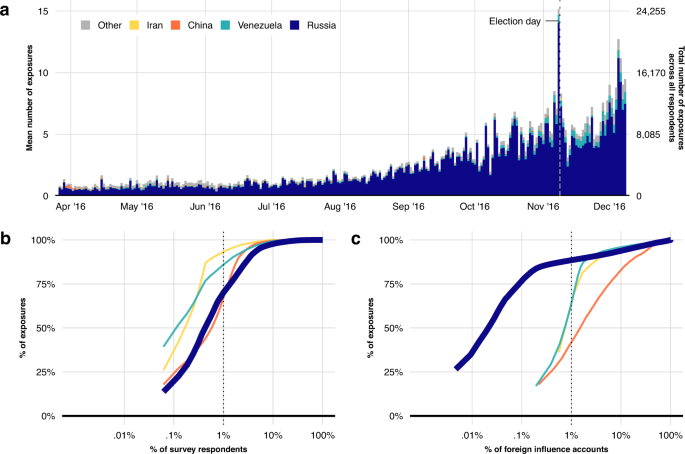
This dual strategy is a masterful piece of information warfare. It seeks to maximize a favored candidate's vote share while simultaneously shrinking the vote share of the opponent, effectively widening the final margin. The graph below shows the huge spike in exposure to this foreign influence content, dominated by Russia, in the months leading up to the election.
3. The Private Actor: The Cambridge Analytica Controversy
While the IRA was a state-run operation, the 2016 election also brought to light the role of private data analytics firms. The most notorious of these was Cambridge Analytica (CA), which worked for the Trump campaign.
The story of Cambridge Analytica is often told as a tale of powerful, data-driven psychological warfare. Let's watch a clip that explains this common narrative.
The Weaponization of Data: Cambridge Analytica, Information Warfare & the 2016 Election of Trump
In this clip from the documentary 'The Weaponization of Data,' Cambridge Analytica whistleblower Brittany Kaiser explains the firm's use of psychographic profiling.
Please watch from 03:50 to 07:57. Pay close attention to the explanation of the OCEAN five-factor model (Openness, Conscientiousness, Extraversion, Agreeableness, Neuroticism) and how CA claimed to use this personality data to craft fear-based, manipulative messaging.
Kaiser's testimony paints a picture of a firm that could "hack" voters' minds by exploiting personality traits identified through improperly harvested Facebook data. The idea that people high in neuroticism could be targeted with "fear-based messaging" is a chilling example of micro-targeted manipulation.
However, the true effectiveness of Cambridge Analytica's methods is a subject of intense debate. Another documentary explores the counter-narrative, suggesting CA's capabilities were vastly exaggerated.
How Did Cambridge Analytica Steal the 2016 Election for Trump? | ENDEVR Documentary
Now, let's look at a different perspective from the documentary 'How Did Cambridge Analytica Steal the 2016 Election for Trump?'. This challenges the idea of CA as an all-powerful puppet master.
Watch the segment from 39:12 to 44:38 and the concluding segment from 50:24 to 54:08. Notice the arguments made by Dr. Kogan (the scientist who collected the data) and others that CA's models were not magically accurate and that the firm became a convenient 'cinematic villain' to explain the election outcome.
This second perspective is crucial. For an engineer like yourself, the distinction between a system's marketing claims and its actual performance is fundamental. It's possible that Cambridge Analytica's greatest success was not in manipulating voters, but in marketing the idea of their own power.
Regardless of their true efficacy, the Cambridge Analytica scandal exposed the massive vulnerabilities in how social media platforms handle user data and how that data can be acquired and used for political purposes, both legally and illegally.
Conclusion
The 2016 US election serves as a stark case study of how social media platforms have become a central front in information warfare. We saw how state and private actors used a combination of techniques to interfere in a democratic process.
Key Takeaways:
- State-sponsored actors like Russia's Internet Research Agency (IRA) conducted a sophisticated information warfare campaign with the clear goal of polarizing the electorate.
- The IRA's strategy involved a dual approach: energizing one segment of voters (pro-Trump conservatives) while seeking to suppress the turnout of others (particularly African Americans and liberals).
- This was achieved using a toolkit of modern digital marketing and propaganda: cross-platform personas, audience segmentation, micro-targeting, and the creation of emotionally charged, divisive content.
- Private firms like Cambridge Analytica introduced the concept of psychographic targeting, though the actual effectiveness of their methods is highly debated. They highlight the danger of unregulated data collection.
- The ultimate goal of these operations was not just to influence an election outcome, but to destabilize the political system by eroding public trust in institutions, the media, and fellow citizens.
Preview of the Next Lesson:
In this lesson, we focused on largely covert social media operations. In our next lesson, we will shift our focus to the more overt instruments of state influence. We will assess the role of state-controlled media (e.g., RT, CGTN) and narrative warfare in shaping international perception.