Hello! Welcome back to our module on Information Warfare.
In our last lesson, we analyzed the covert side of information warfare, focusing on how actors like Russia's Internet Research Agency used social media to interfere in the 2016 US election. We saw how they leveraged platform mechanics for micro-targeting, polarization, and voter suppression.
Today, we shift our focus from the shadows to the spotlight. We will examine the overt instruments of state power: state-controlled media outlets. These are not hidden troll farms but global media corporations that act as official arms of a state's foreign policy.
This brings us to our learning outcome: Assess the role of state-controlled media (e.g., RT, CGTN) and narrative warfare in shaping international perception. We will dissect how countries like Russia and China use these platforms to fight a global battle over narratives, trust, and influence.
1. From Covert Ops to Overt Broadcasting: Defining the Battlefield
While the goal is similar—shaping belief and behavior—the method is different. Instead of impersonating domestic activists, state-controlled media operate openly, seeking to build an audience and compete directly with established international news outlets like the BBC, CNN, or Al Jazeera.
First, let's clarify what we mean by "state-controlled media." It's not always a simple government channel.
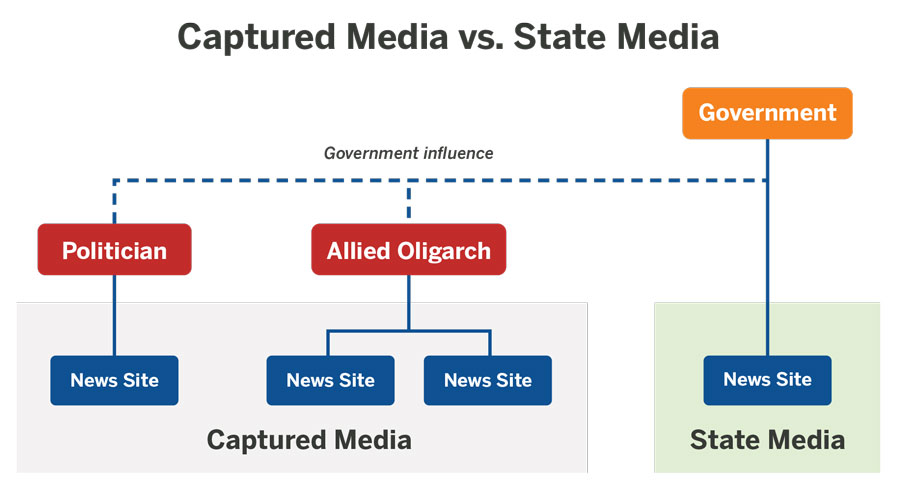
This battle for influence is often called narrative warfare: a contest not over facts themselves, but over their interpretation and the broader story they tell. The goal is to frame events in a way that serves the state's strategic interests.
To get a formal understanding of this concept, let's turn to a report from the Center for European Policy Analysis (CEPA).
China-Russia Convergence in Foreign Information Manipulation
This report, 'China-Russia Convergence in Foreign Information Manipulation,' provides a robust framework for understanding these activities, which they term Foreign Information Manipulation and Interference (FIMI).
Please read the 'Introduction' section of the report. Focus on how it defines FIMI and frames it as a challenge to democratic information ecosystems.
The report establishes that FIMI is considered a national security threat. It's not just about "soft power"; it's a deliberate effort to undermine trust in institutions, weaken alliances, and promote a state's own geopolitical vision. Now, let's see how this works in practice with two of the most prominent players: Russia and China.
2. Russia's Playbook: The Art of Disruption and Agenda-Setting
Russia's state media, particularly RT (formerly Russia Today) and Sputnik, have refined a strategy that often focuses on disruption. Instead of just promoting a pro-Russia view, their goal is often to erode trust in Western narratives and institutions, creating an environment where "nothing is true and everything is possible."
They do this by skillfully blending legitimate news, critical commentary, and outright disinformation, targeting the fault lines that already exist in Western societies.
Case Study: The Power of a Statement
A single statement from a Russian official, amplified by state media, is rarely an accident. It's a calculated move. The following video analyzes a specific instance to deconstruct the strategic intent.
Russia Signals Openness to Trump — “Come to Moscow” Remark Sparks Debate
This analysis from The News Angle, 'Russia Signals Openness to Trump,' breaks down how a seemingly provocative remark broadcast on Russian state TV functions as a multi-layered strategic communication.
Please watch from 01:28 to 07:39. Pay close attention to two key points: The explanation of the Russian media apparatus as a 'centralized instrument' (01:28 - 02:36). The breakdown of the three simultaneous goals: psychological warfare, institutional testing, and direct signaling (02:36 - 07:39).
As the video explains, a single state media broadcast can be simultaneously:
- A psychological operation to deepen divisions in a target country.
- A probe to test the resilience and response of Western institutions.
- A direct signal to a specific political actor, validating their personal narrative.
This is narrative warfare in its purest form. The value isn't whether the "asylum offer" is real; its value is in the debate and doubt it generates.
Intermedia Agenda-Setting: The Hidden Influence
State media's influence isn't limited to its direct audience. A more subtle and powerful effect is its ability to influence what other media outlets talk about. This is known as intermedia agenda-setting.
Your background in computer engineering and algorithms will be useful here. Researchers are now using computational methods to quantify this influence.
Exposing the obscured influence of state-controlled media via ...
A fascinating paper in the journal Nature, 'Exposing the obscured influence of state-controlled media,' demonstrates a novel method for this.
Please read the 'Abstract' and the 'Introduction'. You don't need to dive into the full methodology, but focus on the core idea: using 'quote following'—when one outlet uses a quote that appeared earlier in another—as a proxy for influence and applying causal inference to measure it.
The key insight here is that even an "independent" news outlet might have its agenda shaped by a state-controlled source. By setting the initial topic and providing the key quotes, outlets like RT and Sputnik can force other journalists to react to their framing, effectively pulling the entire information ecosystem in their direction.
3. China's Playbook: "Telling China's Story"
China's approach, primarily through CGTN (China Global Television Network), is generally different. While it also engages in anti-Western narratives, its core mission is more focused on proactive, long-term influence: promoting a positive image of China, defending its policies, and presenting its model of governance as a viable alternative. This aligns with its "Three Warfares" doctrine (public opinion, psychological, and legal warfare).
Case Study: The "Media Challengers" and Co-opting Foreign Voices
A key tactic for CGTN is to blur the lines between independent content creators and state propagandists. They actively recruit foreign journalists, vloggers, and influencers to "tell China's good story."
The next resource is from a critical perspective, but it provides a detailed inside look at the mechanics of this strategy.
The Chinese Communist Party's Biggest Soft Power Propaganda Fail!
The YouTube channel China Fact Chasers produced a deep dive into CGTN's methods, titled 'The Chinese Communist Party's Biggest Soft Power Propaganda Fail!'. We will use it to understand the tactics involved.
Please watch the following segments: What is CGTN? (00:11 - 04:15): This explains that CGTN is a direct propaganda arm of the CCP, not an independent company like CNN. The 'Media Challengers' Campaign (04:15 - 06:34): See how they openly recruit foreign influencers. Using Foreigners to Deny Atrocities (19:04 - 35:02): This lengthy segment shows how foreign vloggers are used to create content that promotes specific government narratives, such as denying human rights abuses in Xinjiang. Focus on the strategy being described: using foreign faces to lend credibility and counter Western criticism.
The strategy detailed in the video is a sophisticated form of influence:
- Borrowing Credibility: A message delivered by a Western-looking vlogger is often perceived as more credible or authentic than when delivered by a state official.
- Obscuring the Source: By hosting this content on "personal" YouTube channels, the link to the state is laundered, making it seem like organic, independent opinion.
- Strategic Denial: These influencers are deployed to create counter-narratives on sensitive issues like Xinjiang, Tibet, or Hong Kong, directly challenging reports from international human rights organizations and mainstream media.
This approach highlights a key difference: where Russian media often seeks to create chaos and distrust, Chinese media is heavily invested in building a specific, positive, and powerful global narrative for itself.
4. Convergence and Narrative Alignment
While their styles differ, Russia and China increasingly find themselves aligned in the information space. The CEPA report (LINK) you read from earlier notes that they often amplify each other's anti-Western narratives without explicit coordination.
For example, after the 2022 invasion of Ukraine, Chinese state media heavily amplified Russian talking points about NATO expansion being the cause of the conflict, framing the war as a "crisis" rather than an invasion.
This battle of narratives plays out in every geopolitical flashpoint. Consider the India-Pakistan rivalry, a topic of interest to you.

Imagine how CGTN or RT might cover a flare-up between India and Pakistan. Their framing would likely be guided by their respective strategic partnerships and goals in South Asia, rather than by a principle of neutral reporting.
Conclusion
Today we've moved from the covert social media campaigns of our last lesson to the overt narrative warfare conducted by state-controlled media giants.
Key Takeaways:
- State-controlled media like RT and CGTN are overt instruments of foreign policy, designed to engage in narrative warfare.
- Russia's strategy is often disruptive, aiming to exploit societal divisions, erode trust in Western institutions, and create an atmosphere of ambiguity.
- China's strategy is focused on long-term influence, building a positive narrative, and co-opting foreign voices to "tell China's story" and counter criticism.
- The influence of these outlets is not just direct; they engage in intermedia agenda-setting, shaping the topics and frames of reference for the entire media ecosystem.
- The ultimate goal is to shape international perception to create a global environment more favorable to their strategic interests.
Preview of the Next Lesson:
We've now looked at both covert and overt information operations. Both are informed by intelligence about a target audience's beliefs and vulnerabilities. In our next lesson, we will go one step deeper to explain the role of the intelligence community in geopolitical decision-making, building on concepts from intelligence analysis. This will connect directly to your previous reading of Richards Heuer's work.