Hello! Welcome to the final lesson of our module on Information Warfare and Strategic Influence.
In our last lesson, we examined how great powers used covert action during the Cold War to destabilize and overthrow governments. We saw how propaganda, economic sabotage, and the manipulation of local actors were key components of the "regime change playbook."
Today, we shift our focus to the 21st-century equivalent of this struggle for control. Instead of just controlling territory or political systems, the new battleground is the digital realm itself. This brings us to our learning outcome: to assess the concept of 'digital sovereignty' and how different states approach internet governance and data control.
We will define what digital sovereignty means and explore the fracturing of the once-global internet—a phenomenon sometimes called the "Splinternet." We will then analyze the three dominant models of internet governance championed by China, the United States, and the European Union, before applying these concepts to the specific context of South Asia, which is particularly relevant to your interests.
1. What is Digital Sovereignty and the "Splinternet"?
At its core, digital sovereignty is a nation's ability to control its own digital destiny—to govern its data, infrastructure, and the information that flows within its borders, independent of foreign influence.
The original vision of the internet was a borderless, unified global network. Technically, this is enabled by organizations like ICANN (Internet Corporation for Assigned Names and Numbers), which coordinates the global system of unique identifiers like IP addresses. However, this vision is now under threat as nations increasingly seek to assert control, leading to a fragmented "Splinternet."
To understand this fundamental shift, let's watch the beginning of the following video. It clearly explains the technical basis of the unified internet and how national interests are causing it to break apart.
The Splinternet | This Is How The Internet Dies
The video 'The Splinternet | This Is How The Internet Dies' from The Hated One provides an excellent primer on the concept. It explains the role of ICANN and introduces the ideas of digital sovereignty and the 'Splinternet.'
Watch the first three minutes of the video (00:00 - 02:56). Focus on: The technical function of ICANN and IP addresses in creating a unified global internet. The definition of the 'Splinternet' as a result of cyber-balkanization. The two main ways this happens: countries creating their own IP systems and governments setting up nationwide firewalls.
As the video explains, digital sovereignty isn't just a theoretical idea; it's being actively pursued through technical and legal means. This has led to the emergence of distinct models of internet governance around the world.
2. A Framework for Analysis: State, Business, and the Individual
To analyze these different approaches, it's helpful to use a framework. A comprehensive academic paper on this topic, "Three actors, eight models," proposes thinking about digital sovereignty as a power relationship between three key actors:
- The State (Government): Seeks control for national security, political stability, and economic advantage.
- The Business (Corporations): Seeks control over data and platforms for profit and market dominance.
- The Individual (Citizen/User): Seeks control over their personal data for privacy, autonomy, and freedom of expression.
Different models of internet governance emerge depending on which of these actors holds the most power. We'll now examine the three most influential models today, each representing a different configuration of this power dynamic.
3. Three Competing Models of Internet Governance
The global debate on internet governance is largely shaped by the competing philosophies of China, the United States, and the European Union.
a) The Authoritarian Model: State Sovereignty First
This model prioritizes the state's absolute control over the digital sphere. Individual rights and corporate freedom are secondary to national security and political stability as defined by the regime. This approach is sometimes called "Digital Authoritarianism."
[PDF] Three actors, eight models: A relational lens on digital sovereignty
To understand the theoretical basis of this model, let's read the section on 'Digital Authoritarianism' from the paper 'Three actors, eight models'.
Read the section titled 'Digital Authoritarianism'. It clearly outlines how authoritarian regimes perceive a free internet as a threat and use technology for surveillance, repression, and censorship, subordinating both corporate and individual sovereignty.
China is the most advanced practitioner of this model. It has built a sophisticated system of control often called the "Great Firewall." This involves not only technical censorship but also leveraging technology for mass surveillance and social control. Russia is following a similar path with its "Runet" initiative.
The following video segments provide concrete examples of how this model is implemented.
The Splinternet | This Is How The Internet Dies
These clips showcase the practical application of the authoritarian model in Russia and China, including the use of AI for state control.
First, watch the segment on Russia's 'Runet' from 'The Splinternet' video (02:56 - 05:02). Then, watch the segment on China's 'Great Firewall' and 'New IP' proposal in the same video (07:37 - 10:06).
AI supremacy: The artificial intelligence battle between China, USA and Europe | DW Documentary
This next clip, from 'AI supremacy,' focuses on how China integrates AI into its state-controlled digital ecosystem for surveillance and to expand its global power.
Watch the segment from 37:49 to 43:05. Notice how the government leverages tech companies and vast data collection to create what the video calls a 'perfect police state.' This is a direct manifestation of digital authoritarianism.
b) The Market-Led Model: Corporate Sovereignty Dominates
This model, most closely associated with the United States, prioritizes innovation and free-market competition with minimal state intervention. In this environment, sovereignty has effectively been captured by a handful of massive tech corporations (like Google, Amazon, Meta, Apple, Microsoft). This approach is described in the academic literature as "Digital Corporatocracy" or "Digital Libertarianism."
[PDF] Three actors, eight models: A relational lens on digital sovereignty
Let's turn back to the 'Three actors, eight models' paper to define this market-led approach.
Read the sections 'Digital Corporatocracy' and 'Digital Libertarianism'. Note how they describe a system where corporate power can become stronger than the state, and where individual sovereignty is framed in terms of consumer choice in a marketplace of digital services.
In this model, the state's role is not to direct the digital economy, but to protect it and allow it to flourish. This has led to unparalleled innovation but also to the rise of surveillance capitalism, where user data is the primary commodity, and to challenges in regulating misinformation and anticompetitive behavior.
c) The Regulatory Model: A Balance of Rights
The European Union has charted a third path that attempts to balance state, corporate, and individual interests. It asserts state sovereignty through comprehensive regulation designed to protect individual rights (like privacy) while reining in the power of large corporations. This is sometimes called a "Digital Pluralism" or "Digital Communitarianism" model.
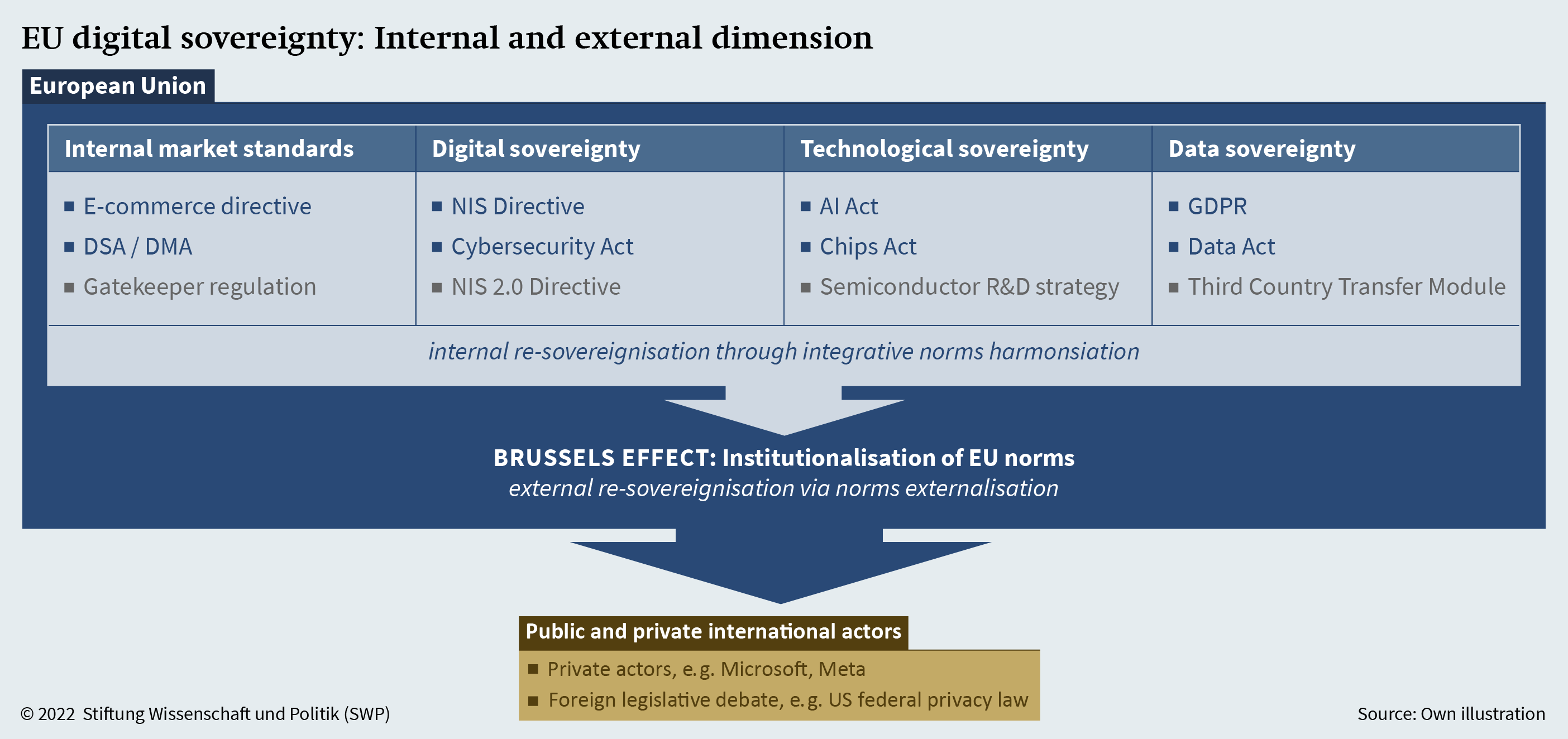
The EU's goal is to use its market power to export its values and standards globally—a phenomenon known as the "Brussels Effect." Key examples include the General Data Protection Regulation (GDPR) and the new AI Act.
AI supremacy: The artificial intelligence battle between China, USA and Europe | DW Documentary
The documentary 'AI supremacy' provides a detailed look at the EU's regulatory philosophy as applied to artificial intelligence.
Watch the segment from 01:09:17 to 01:18:03. Focus on the debate around the EU AI Act. Note the explicit goal to protect citizens' rights ('no mass surveillance, no social scoring') while trying not to stifle innovation. This highlights the delicate balancing act of the regulatory model.
4. The View from South Asia: Navigating the Digital Empires
For countries outside these three major blocs, especially in the Global South, the situation is more complex. They often lack the economic scale of the US, the state capacity of China, or the regulatory clout of the EU. They become a battleground where these competing models vie for influence.
This situation can be described as "Digital Anomie," where no single local actor—state, business, or individual—holds significant power, leaving the region vulnerable to external forces, a concept critics call "digital colonialism."
[PDF] Three actors, eight models: A relational lens on digital sovereignty
The paper 'Three actors, eight models' defines this state of powerlessness and connects it to postcolonial critiques.
Read the section titled 'Digital Anomie'. Focus on how it describes the digital dominance of the Global North over the Global South, where developing countries become 'disputed territory of tech empires.'
In response, many states in South Asia are developing their own approaches, often driven by "techno-nationalism"—an ideology linking technological prowess directly to national strength and geopolitical standing. This often involves borrowing elements from all three major models.

To explore this in the context of your region, please read the following sections from a white paper focused specifically on South Asia. It discusses the influence of global frameworks and the specific paths being taken by countries like Nepal, India, and Pakistan.
[PDF] Digital Governance and Rights in South Asia, and the Path ...
This white paper, 'Digital Governance and Rights in South Asia, and the Path Forward,' examines how the region is navigating the global digital order. It is highly relevant to your interests in South Asian dynamics and the challenges smaller states face.
Please read the following parts of the paper: Start with the section 'Lack of investment from major tech companies' and read to the end of the India section. This will introduce you to the 'Brussels Effect' and the fascinating concept of the 'Delhi Effect,' and give you overviews for Bangladesh and India. Next, read the sections on Nepal, Pakistan, and Sri Lanka to see how these issues manifest differently across the region. Finally, read the short thematic sections on 'Techno-Nationalism,' 'Vague and Oppressive Laws,' and 'Executive Overreach.' Focus on how these countries are trying to assert digital sovereignty while often using vague laws around 'national security' to consolidate state control, a pattern you've seen in other contexts.
As the paper highlights, South Asian nations are creating a hybrid model. They adopt rights-based language from the EU (like in Sri Lanka's data protection law), are influenced by India's push for Digital Public Infrastructure (the "Delhi Effect"), and simultaneously use authoritarian tactics (like internet shutdowns and vague security laws) to control online speech. For a country like Nepal, navigating these pressures from its large neighbors and global tech platforms is a central geopolitical challenge of our time.
Conclusion
Today, we've explored the critical concept of digital sovereignty and seen how it has become a central arena for geopolitical competition. The dream of a single, global internet is giving way to a "Splinternet" divided by competing ideologies and national interests.
Key Takeaways:
- Digital Sovereignty is a state's capacity to control its digital infrastructure, data, and information space.
- Three Models of Governance:
- Authoritarian (China): State control is absolute, prioritizing political stability over individual or corporate freedom.
- Market-Led (US): Corporate power dominates with minimal state regulation, prioritizing innovation and profit.
- Regulatory (EU): A "third way" that uses state power to protect individual rights and regulate corporations, exporting its standards via the "Brussels Effect."
- South Asia's Hybrid Approach: Countries in the region, including Nepal, are navigating this complex landscape by adopting elements from all models, driven by techno-nationalism but often resulting in increased state control and executive overreach.
The struggle to define the rules of the digital world is a direct continuation of the power politics we've been studying throughout this course. It is a fundamental battle over information, economic advantage, and political influence.
Preview of the Next Lesson:
This lesson concludes Module 11. We are now ready to begin our final Capstone module: Applied Geopolitical Analysis. In our next lesson, we will introduce the DIME framework (Diplomatic, Information, Military, Economic). This is a powerful analytical tool that will help you synthesize all the concepts from this course—from geography and international relations theory to the digital power dynamics we discussed today—into your own structured geopolitical assessments.