Hello! Welcome to the sixth lesson in our module on Information Warfare and Strategic Influence.
In our last lesson, we explored the intelligence community's role, differentiating between gathering information and actively shaping events through "covert action." Today, we will conduct a deep dive into that very concept. We will move from the theoretical definition to a concrete analysis of how great powers have historically used covert operations to destabilize and overthrow foreign governments. This directly addresses your interest in great power competition and its impact on smaller states.
Our learning outcome for this lesson is to analyze a case of covert regime change or political destabilization by a great power (e.g., CIA operations during the Cold War). We will dissect the "playbook" used in these operations, examining the motivations, methods, and long-term consequences of such interventions.
1. The Cold War Playbook: Operation Ajax in Iran (1953)
During the Cold War, the United States, through the Central Intelligence Agency (CIA), developed a systematic approach to undermining and replacing governments deemed hostile to its interests. This process often followed a predictable pattern, almost like an algorithm for regime change. To understand this playbook, we'll start with the textbook example: the 1953 coup in Iran.
To get a detailed, academic overview of this pivotal event, please watch the following segment from a lecture by Professor Kenneth Osgood.
The CIA and Regime Change in the Cold War
Professor Osgood's lecture, 'The CIA and Regime Change in the Cold War,' provides a thorough analysis of the 1953 Iranian coup. He details the context, motivations, and execution of Operation Ajax.
Watch the section on the Iran coup, which runs from 00:13:15 to 00:29:35. As you watch, focus on identifying the key steps and actors: The Trigger: The nationalization of the Anglo-Iranian Oil Company by Prime Minister Mohammad Mosaddegh. The Justification: How the British and Americans framed Mosaddegh, a nationalist, as a communist threat. The Method: The combination of propaganda, economic sabotage, and fomenting street-level chaos. The Outcome: The installation of the Shah and the long-term consequences for US-Iran relations.
The events in Iran established a blueprint for future operations. At its core, the playbook involved several distinct phases:
- Identify a Threat: A (usually democratically elected) nationalist leader moves to assert control over their nation's resources, threatening the economic interests of a great power.
- Create a Pretext: The leader's nationalist policies are framed as a precursor to a communist takeover, providing an ideological justification for intervention within the Cold War context.
- Destabilize: A multi-pronged campaign of psychological and economic warfare is launched. This includes:
- Propaganda: Planting stories in local and international media to discredit the leader.
- Economic Sabotage: Creating artificial shortages and financial panic to turn the population against the government.
- Political Agitation: Using paid agents, or "goons and thugs" as the video mentions, to stage violent protests and create an atmosphere of chaos.
- Foment a Coup: With the country in turmoil, a sympathetic faction within the local military is encouraged and supported to seize power, ostensibly to "restore order."
The images below capture the on-the-ground reality of this manufactured unrest.
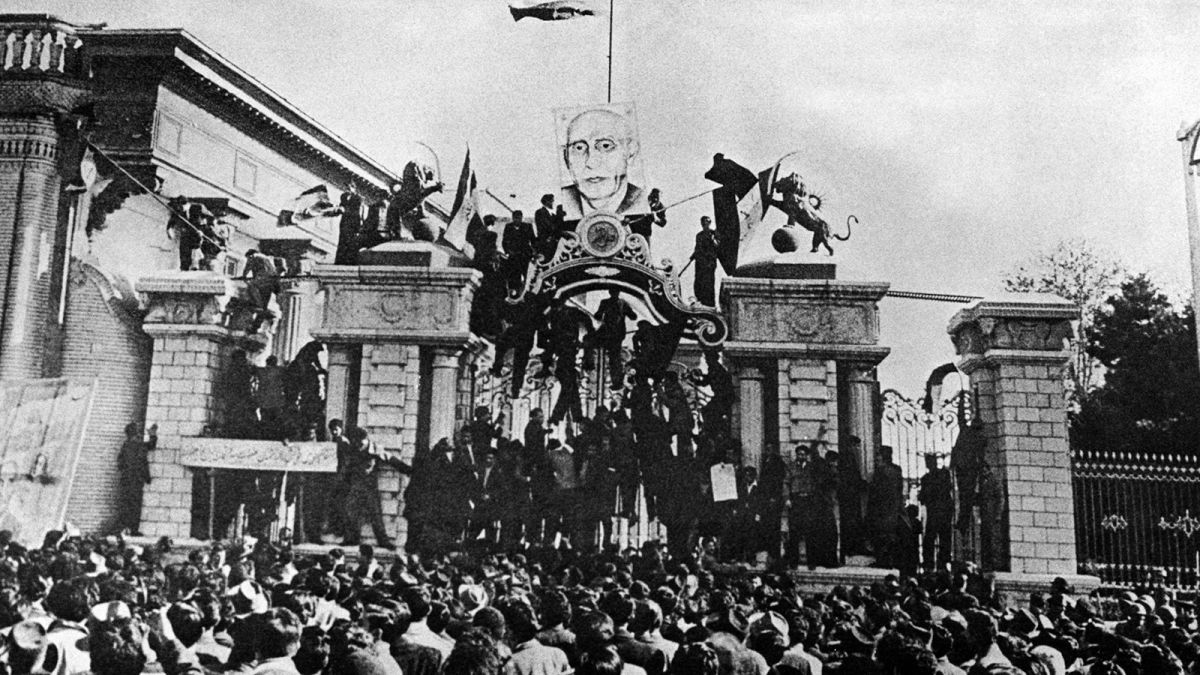

This "playbook" was not a one-off. The perceived success of Operation Ajax led US officials to replicate it elsewhere.
2. Replicating the Playbook: Guatemala (1954) and Chile (1973)
The year after the Iran coup, the CIA applied the same model in Guatemala. The target was another democratically elected leader, Jacobo Árbenz, whose proposed land reforms threatened the interests of the powerful American-owned United Fruit Company.
To see how the Iran playbook was adapted for Guatemala and later, in a more complex fashion, for Chile, please watch these next segments from Professor Osgood's lecture.
The CIA and Regime Change in the Cold War
The lecture continues by examining the 1954 coup in Guatemala and the prolonged efforts to destabilize Salvador Allende's government in Chile.
Watch the following two sections: Guatemala (00:29:35 - 00:36:55): Note the direct parallels to Iran: a nationalist leader, threatened US corporate interests (United Fruit Company), and the use of propaganda and a proxy military force. Chile (00:36:55 - 00:45:02): Pay attention to how the playbook was intensified, with President Nixon's direct order to 'make the economy scream' and the CIA's efforts to foment a military coup even before Allende took office.
The case of Chile is particularly well-documented due to a 1975 US Senate investigation. This investigation revealed the extent of the planning, which was divided into two parallel efforts, famously known as "Track I" and "Track II."
To get a sense of the raw, declassified detail of this planning, please read the following excerpt from the official Senate report.
COVERT ACTION IN CHILE 1963-1973
This document, 'Covert Action in Chile 1963-1973,' is a primary source from the U.S. Senate Select Committee to Study Governmental Operations (the 'Church Committee'). It provides an unfiltered look into the mechanics of the operation.
Please read the section titled '7. Direct Efforts To Promote A Military Coup' (page 24 in the PDF). Focus on understanding the distinction between 'Track I' (political and economic pressure) and 'Track II' (the direct promotion of a military coup ordered by President Nixon).
The existence of "Track II" shows how covert action can escalate from influencing politics to actively engineering the violent overthrow of a constitutional government.
3. An Analytical Framework: Why Do Covert Coups Succeed or Fail?
Analyzing these cases requires moving beyond mere description. We must ask why these operations worked. What were the critical variables for success? A useful way to explore this is to compare successful coups with failed ones. The CIA's attempt to overthrow Fidel Castro in Cuba at the Bay of Pigs in 1961 is the most famous failure.
The following academic paper analyzes the key differences between the successes in Iran and Guatemala and the failure in Cuba.
Operational Discrepancy: An Analysis of the CIA's Success in Iran ...
The paper 'Operational Discrepancy' by Cindy Lewis offers a comparative analysis of CIA operations, identifying the factors that determined their success or failure.
Read the final three paragraphs of the paper, starting from 'One of the primary reasons for the botched Bay of Pigs invasion...'. The author summarizes three key factors that were present in Iran and Guatemala but absent in Cuba. Identify and understand these three factors.
As the paper concludes, the key variables for a successful covert coup in that era were:
- Effective Public Opinion Manipulation: The ability to run a propaganda campaign that successfully turned the populace against their own leader.
- Cooperative Local Elites: The ability to identify and work with influential local figures (like the Shah in Iran or military leaders in Guatemala) who could legitimize and lead the coup.
- Appropriate Force: Correctly judging the strength of the target government and applying sufficient force (whether through proxy armies or street mobs) to ensure its collapse.
4. Motivations and Consequences
Finally, why did the US pursue these actions, and what were the long-term results? The official justification was stopping the spread of communism, but as we've seen, the primary driver was often protecting economic interests.
The final part of Professor Osgood's lecture provides a superb summary of the underlying motivations and the devastating, long-term consequences of these interventions.
The CIA and Regime Change in the Cold War
Let's return to the lecture to analyze the 'why' behind these operations and their lasting impact.
Watch the concluding segments from 00:45:02 to the end (00:55:47). Focus on the three main points the professor makes: These were not 'rogue' operations; they were authorized by presidents. The clash between third-world nationalism and foreign corporate interests over resources. The American tendency to confuse nationalism with communism, driven by a 'total war mindset.'
The professor highlights the tragic "blowback" from these short-term successes. In Iran, the coup led to 26 years of brutal dictatorship under the Shah, culminating in the 1979 Islamic Revolution and decades of hostility toward the US. In Guatemala and Chile, it ushered in periods of intense repression and civil war, leaving scars that persist today. The very act of intervention often created the radical anti-Americanism that policymakers claimed they were trying to prevent.
For a faster-paced summary that covers these cases and others (like Afghanistan and Iraq), the Johnny Harris video "American-Backed Coups, Mapped" (LINK) provides a compelling visual overview of the recurring patterns and negative consequences.
Conclusion
In this lesson, we have moved beyond the abstract concept of covert action to analyze its real-world application. By dissecting classic Cold War case studies, we have uncovered a systematic "playbook" for political destabilization and regime change.
Key Takeaways:
- The Playbook: A repeatable process involving propaganda, economic warfare, and the use of local proxies to overthrow a targeted government.
- Motivations: While publicly justified by anti-communist ideology, these operations were often driven by the desire to protect the economic interests of great-power corporations from nationalist leaders.
- Key Ingredients for Success: A successful covert coup required effective propaganda, cooperation from local elites, and the application of sufficient force.
- Long-Term Consequences: These interventions frequently resulted in the installation of brutal dictatorships, decades of political instability, and deep-seated anti-American sentiment—a phenomenon known as "blowback."
The dynamics we've studied—a great power intervening in a smaller nation to secure its strategic interests—are timeless. While the methods may evolve, the fundamental logic continues to shape geopolitics, including the pressures faced by countries like your native Nepal as they navigate the interests of larger neighbors.
Preview of the Next Lesson:
This concludes Module 11. We are now ready to begin our final Capstone module. In the next lesson, we will start by learning the DIME framework (Diplomatic, Information, Military, Economic). This is a comprehensive tool used by strategists to analyze a country's total national power. It will provide the structure for you to synthesize everything you've learned in this course into your own geopolitical analyses.