Hello! Welcome to the final module of our course, Capstone: Applied Geopolitical Analysis.
Over the past eleven modules, we have built a comprehensive understanding of geopolitics. We started with foundational concepts like geography and power, moved through the major theories of International Relations, analyzed the architecture of the global system, and explored the grand strategies of major powers like the US and China. Most recently, we delved into the modern arenas of conflict, including information warfare and digital sovereignty.
Now, it's time to bring all these threads together. This capstone module is designed to equip you with practical, structured methods for conducting your own geopolitical analysis.
In our last lesson, we examined the concept of 'digital sovereignty' and the competition to define the rules of the internet. That discussion of digital control, surveillance, and techno-nationalism is a perfect entry point for today's topic. We'll be learning a framework that helps us categorize and analyze these and all other forms of state power.
Our learning outcome for this lesson is to apply the DIME (Diplomatic, Information, Military, Economic) framework to analyze a country's geopolitical posture.
We will define the DIME framework, break down each of its four components, and then, acknowledging your background in computer engineering, explore a modern evolution of this model: DIMET, which adds Technology as a fifth instrument of power. Finally, we will apply this framework to two case studies directly relevant to your interests: Singapore's balancing act between the US and China, and the complex relationship between India and Nepal.
1. The "Ends, Ways, and Means" of National Strategy
Before we define the DIME framework, it's essential to understand where it fits into national strategy. A national strategy is a country's plan to use its available resources (means) in specific ways (ways) to achieve its national interests (ends).
The DIME framework is a tool for categorizing the primary means or "instruments of power" a state has at its disposal. To get a clear introduction to this concept, please watch the following segment from a lecture by Dr. Stephen Mariano at the Africa Center for Strategic Studies.
What is a National Security Strategy and Why Have One? - Stephen Mariano
In this video, 'What is a National Security Strategy and Why Have One?', Dr. Mariano introduces the 'ends, ways, and means' structure of strategy and then provides a comprehensive overview of the DIME framework.
Please watch two segments from the video: First, watch from 00:55 to 01:55 to understand the definition of a national security strategy as a whole-of-government approach using the 'ends, ways, and means' model. Then, watch from 07:26 to 11:37. This is the core of the presentation, where Dr. Mariano details each component of the DIME framework (Diplomatic, Information, Military, Economic) with excellent examples.
2. Deconstructing the DIME Framework
As Dr. Mariano explained, the DIME framework helps us systematically analyze the four traditional instruments of national power. Let's formalize those definitions and visualize how they work.
Curtis McGiffin, DIMET: Shaping the Age of “Techno-Strategic ... - Nipp
The article 'DIMET: Shaping the Age of “Techno-Strategic Power”' by Curtis McGiffin provides concise, powerful definitions for each instrument of power.
Read the section 'Explaining the Instruments of Power'. It provides clear, bullet-pointed definitions for each of the four DIME components.
In short, the DIME framework covers:
- Diplomatic: The use of engagement, negotiation, treaties, and alliances. It's the art of managing relationships between states.
- Informational: The use of communication to influence foreign audiences and shape narratives. This includes public diplomacy, propaganda, intelligence gathering, and cyber operations. Our last lesson on digital sovereignty falls squarely in this domain.
- Military: The threat or use of coercive force. This ranges from deterrence and combat operations to security assistance and military exercises.
- Economic: The use of economic resources to induce or compel. This includes trade policies, sanctions, foreign aid, and control over financial systems.
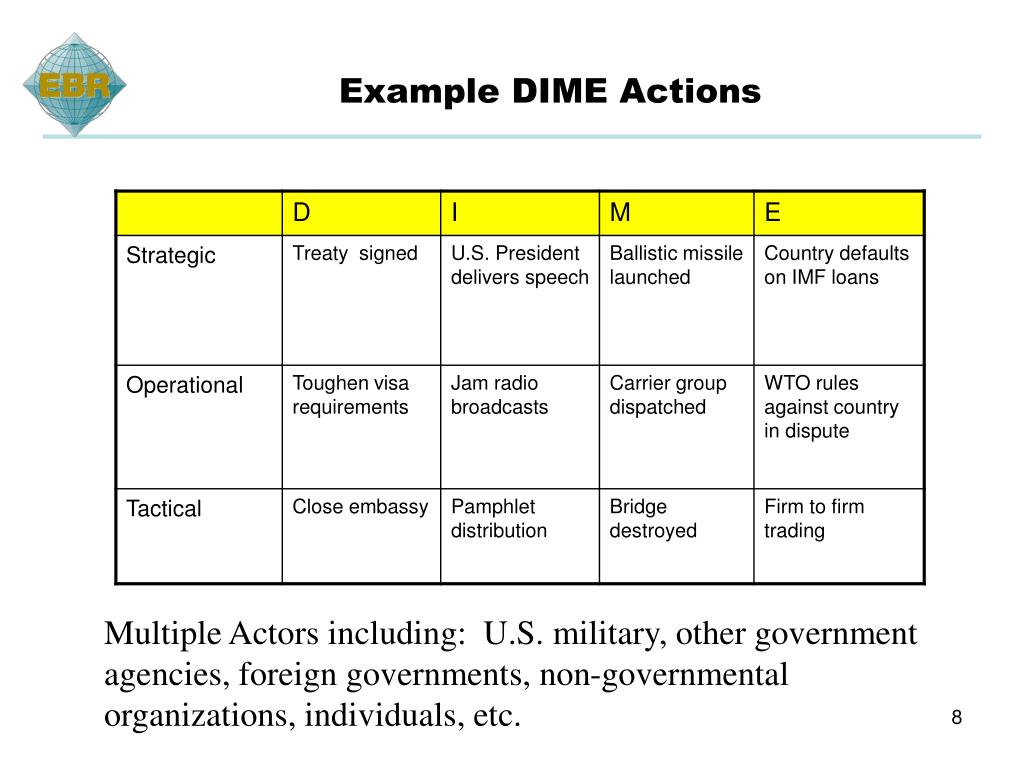
These instruments are not used in isolation. Effective statecraft involves orchestrating them in a coordinated way to achieve strategic objectives. The following image provides a useful matrix of DIME actions, categorizing them by their level of application: strategic, operational, or tactical.
3. An Evolution for the 21st Century: From DIME to DIMET
Given your background in computer engineering and your interest in how technology shapes geopolitics, you'll appreciate that the classic DIME model is evolving. Many analysts now argue that technology is no longer just an enabler of the other four instruments but has become a distinct instrument of power in its own right. This leads to the DIMET framework.
Curtis McGiffin, DIMET: Shaping the Age of “Techno-Strategic ... - Nipp
Let's return to the McGiffin article to explore the argument for adding 'Technology' to the framework.
Read the section 'Technology as an Instrument of National Power.' Pay close attention to: The argument for why technology is more than just an element of power. How it both projects real power (e.g., dependency on your systems) and shapes perceptions of power. The proposed definition for 'T – Technology' in the DIMET framework.
The rise of AI, semiconductors, quantum computing, and LEO satellite constellations as central arenas of great power competition strongly supports this evolution to a DIMET model. A nation's technological base is now a direct measure of its national power and future potential.
4. Applying the Framework: Case Studies
The real value of a framework is in its application. Let's use DIME to analyze two distinct geopolitical situations.
Case Study 1: Singapore's Strategic Hedging
Singapore is a classic example of a small state that masterfully uses all instruments of power to navigate the rivalry between the US and China, maximizing its autonomy and security.
The Military Alliance Singapore Doesn't Admit To
The video 'The Military Alliance Singapore Doesn't Admit To' from Difference Frames the World offers a fascinating look into Singapore's delicate balancing act, particularly its military relationship with Taiwan.
Watch the entire video (around 13 minutes). As you watch, try to identify actions Singapore takes that fall under each of the DIME categories. Think about: D: How does it manage its official vs. unofficial relationships with China, Taiwan, and the US? I: What narrative does it project to the world? M: What specific military actions and partnerships does it maintain? E: How does its economic position contribute to its strategy?
After watching, you can see a clear DIME strategy emerge:
- Diplomatic: Singapore officially adheres to the "One-China" policy to appease Beijing but maintains robust, albeit unofficial, relations with Taiwan and deep security ties with the US. It hosts regional security dialogues like the Shangri-La Dialogue.
- Informational: It carefully cultivates an image as a neutral, reliable, and indispensable hub for the entire region—a trusted partner for all sides.
- Military: It conducts sensitive military training in Taiwan ("Project Starlight"), maintains deep interoperability with the US military, and also engages in defence dialogues with China. This is a textbook example of hedging.
- Economic: Its status as a global hub for finance, trade, and logistics makes it too important to the global economy for any single power to alienate, giving it significant leverage.
Case Study 2: India's Influence on Nepal
This case is directly relevant to your personal background and interest in South Asian dynamics. We will use a unique resource: a master's thesis from the US Army Command and General Staff College, written by a Nepali Army Major, that explicitly uses the DIME framework to analyze India's influence on Nepal.
[PDF] Rising India: The Political and Economic Effects on the Future of Nepal
This paper, 'Rising India: The Political and Economic Effects on the Future of Nepal,' provides an in-depth application of the DIME framework to the complex India-Nepal relationship.
This is a long document, so we will be very selective. Please focus on these specific parts: Framework Setup (5 mins): Go to Chapter 3, 'RESEARCH METHODOLOGY.' Read the section starting with 'The methodology of the thesis will be based on framework of a “DIME” approach...' (page 33) to the end of the 'Step 2: Rise of India' section (page 35). This shows you how the author structures his analysis around DIME. Application (10 mins): Go to Chapter 4. Read the sections titled 'Political and Diplomatic Influence over South Asia' (page 46, section idx=3), 'The Economic Rise' (page 55, section idx=4), and 'Military Power' (page 59, section idx=5). Skim these sections to see how India's instruments of power are described. Impact on Nepal (10 mins): Still in Chapter 4, read the sections 'Effects on Nepal’s Political System' (page 68, section idx=6) and 'Effects on Nepal’s Economic Activities' (page 77, section idx=7) more closely. These sections directly analyze the impact of India's D and E instruments on Nepal. As you read, try to summarize India's posture towards Nepal using the DIME categories.
From this analysis, you can construct a DIME profile of India's posture toward Nepal:
- Diplomatic: India exerts significant influence on Nepal’s domestic politics, promoting democracy but also ensuring its own strategic interests are met, such as limiting Chinese influence.
- Informational: India's cultural and media soft power is immense in Nepal. At the same time, intelligence sharing and monitoring for cross-border threats are key concerns.
- Military: While direct intervention is rare, India's military is the dominant regional force, and security cooperation, training, and arms sales create deep institutional links with the Nepal Army. The open border also presents a shared security challenge.
- Economic: This is perhaps the most powerful instrument. India is Nepal's largest trading partner and a critical source of investment, foreign aid, and, crucially, transit routes for a landlocked country.

Conclusion
Today, we've introduced the DIME framework as a fundamental tool for geopolitical analysis. It provides a structured way to dissect a country's national power and strategic actions.
Key Takeaways:
- The DIME (Diplomatic, Informational, Military, Economic) framework categorizes the primary instruments a state uses to achieve its goals.
- Effective strategy involves the coordinated use of all four instruments in a "whole-of-government" approach.
- The rise of technology as a central arena of competition has led to the evolution of the DIMET framework, which adds Technology as a fifth, distinct instrument of power.
- Applying the framework to cases like Singapore and the India-Nepal relationship reveals the complex strategies states employ, whether they are small states trying to survive or regional powers seeking to maintain influence.
Preview of the Next Lesson:
The DIME framework is a foundational building block for more complex analysis. In our next lesson, we will move on to the next step: describing the components of a structured geopolitical risk assessment. You will learn how to identify actors, analyze their interests, and evaluate potential risks. The DIME framework will be essential, as it helps us understand the capabilities and tools each actor brings to a given geopolitical scenario.